Picture who reads that bottle. By Wednesday the knuckle on your index finger has split again, and the plaque on your palm stings every time you rinse. You bought the hypoallergenic soap because it was supposed to help.
So here is the honest answer. A hypoallergenic hand soap can't treat hand psoriasis, but a gentle formula can remove one trigger you control: the dryness and cracking that harsh cleansers and constant washing leave behind. Skip the label. Read the ingredients. And keep your dermatologist in the loop while you do.
NOWATA's founders, a dentist and a biomedical engineer, learned this with their own kids. They bought one "hypoallergenic" soap after another and still watched their daughter's hands turn red after every wash. Their experience, along with guidance from the National Psoriasis Foundation and the American Academy of Dermatology, shapes this guide.
TL;DR Quick Answers
Hypoallergenic Hand Soap
Definition: Hypoallergenic hand soap is hand soap that brands market as less likely to cause allergic reactions or skin irritation.
The catch: No U.S. federal rule defines "hypoallergenic." Any brand can print it without testing, so the label alone proves nothing.
What to look for on the ingredient list instead:
No sodium lauryl sulfate (SLS) or other harsh sulfates
Fragrance-free, not just "unscented"
No drying alcohols
No synthetic dyes or parabens
For psoriasis-prone hands: Psoriasis isn't an allergy, so a hypoallergenic claim can't treat it. A gentle formula helps by cutting the irritation and cracking that frequent washing causes, which is one flare trigger you can control.
Bottom line: Skip the label. Read the ingredients. Patch-test any new soap and keep your dermatologist in the loop.
Top Takeaways
Psoriasis is an immune condition, so a "hypoallergenic" claim doesn't reach its cause.
Hand washing can still spark flares, because cracked, irritated skin can grow new plaques through the Koebner phenomenon.
No federal rule defines "hypoallergenic," and any brand can use it without testing.
Pick a hypoallergenic hand soap by its ingredient list, with no fragrance, SLS, drying alcohol or dyes.
Warm water and a fragrance-free moisturizer after every wash protects the skin you're trying to calm.
Gentle soap supports psoriasis care and never stands in for a dermatologist.
Is Psoriasis an Allergy? Why the Label Only Tells Half the Story
No. An overactive immune system drives psoriasis, pushing new skin cells to the surface so fast that they pile up into thick, scaly plaques. Allergies work differently. Your body reacts to one specific trigger, like nickel or a fragrance compound, and that difference changes how you should read a soap label.
When psoriasis lands on the palms and soles, doctors call it palmoplantar psoriasis. The National Psoriasis Foundation says it affects 12 to 16 percent of people with psoriasis and counts the hands as a high-impact site. Cracks there can make buttoning a coat hurt.
Brands use the term hypoallergenic to suggest a product causes fewer allergic reactions. The FDA tried to define the word in 1975. Two cosmetic companies challenged that rule in court, and the judges struck it down in 1977.
That leaves a fair question. If the label aims at allergies and psoriasis isn't one, why should your soap matter? The answer is irritation, and it starts at the sink.
How Hand Washing Can Trigger Psoriasis Flare-Ups
Hurt the skin and psoriasis can follow. Dermatologists call this the Koebner phenomenon, after Heinrich Koebner, the German doctor who described it in the 1870s. A scrape can set it off. So can a knuckle that splits after a long day of washing.
A normal day at the sink wears the skin barrier down in four ways:
Sodium lauryl sulfate (SLS) and similar surfactants strip the oils that keep skin sealed.
Added fragrance and drying alcohol sting skin that's already inflamed.
Hot water pulls moisture out faster than warm water does.
Wetting and drying your hands over and over leaves them tight and ready to crack.
The UK's Psoriasis Association names over-washing and detergents, soap included, as things that can make hand psoriasis worse. Try telling that to a nurse, a line cook, a cleaner or a parent chasing a toddler. For them, "just wash less" isn't an option.
When the sink itself is the problem, some people keep a rinse-free cleanser in a bag or desk drawer for the in-between moments. Our guide to waterless soap explains how it works.
What to Look for in a Hypoallergenic Hand Soap for Psoriasis-Prone Hands
Turn the bottle around. The ingredient panel on the back tells you more than anything a marketer printed on the front.
Brands with nothing to hide make this easy. Take this hypoallergenic hand soap, which a dentist and a biomedical engineer developed for their own children. It spells out exactly what it leaves out, and that's the standard to hold every bottle to.
Ingredients to Avoid
Sodium lauryl sulfate and other harsh surfactants. If you're comparing options, start with an sls free soap.
Added fragrance or "parfum," one label word that can stand in for many undisclosed ingredients.
Drying alcohol is near the top of the list.
Synthetic dyes, which add color and nothing your skin needs.
Any preservative your skin has reacted to before.
Watch the word "unscented," too. A brand can add a masking fragrance to an unscented product to cover the smell of other ingredients. Look for "fragrance-free" on the front, then confirm it on the panel.
Hypoallergenic Label vs. What Actually Matters
If the front says "hypoallergenic," check that fragrance and parfum don't appear on the ingredient list.
If it says "gentle," make sure you find no SLS or other harsh sulfate.
"Dermatologist tested" only counts when you can look up who tested it and how.
"Natural" means little without full ingredient disclosure.
"For sensitive skin" matters less than how it patch-tests on yours.
Patch-test before you switch. Dab a little on the inside of your wrist once a day for several days. No redness or itch is a good sign.
Gentler Hand-Washing Habits That Protect Psoriasis-Prone Skin
A good soap does more when the routine around it is gentle too.
Keep the water warm, never hot.
Wash with your palms and fingertips, and leave the loofah and scrub brush out of it.
Pat dry instead of rubbing.
Smooth on a fragrance-free cream right after every wash, while your skin is still a little damp.
Pull on cotton-lined gloves for dishes and household cleaning.
Jot down which products or chores come before a flare so you can spot the pattern.
Stay on your prescribed treatment. The right soap supports it and can't replace it.
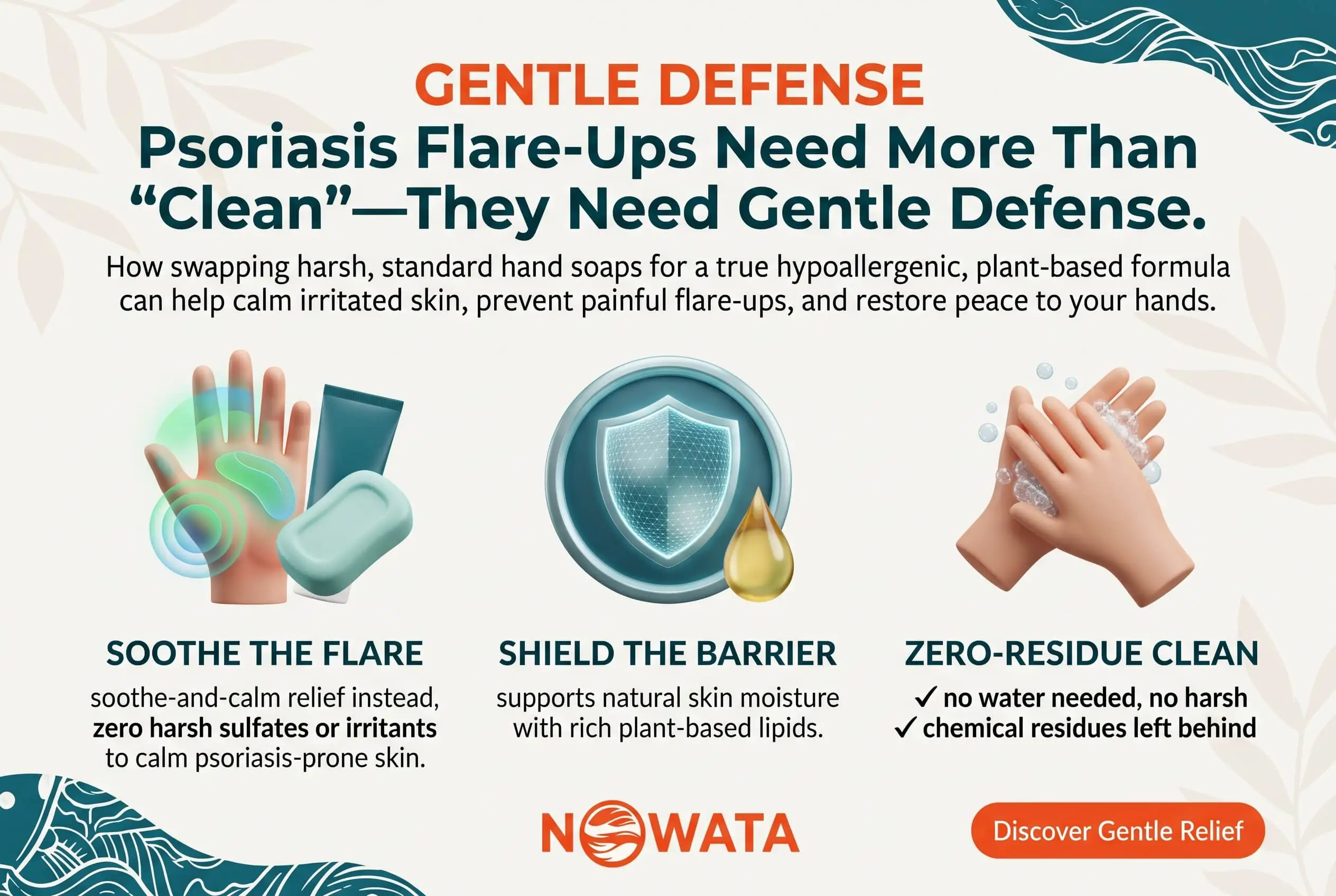
"We bought every 'hypoallergenic' soap we could find for our kids, and our daughter's hands still turned red after every wash. That's when we quit reading the front of the bottle. In my dental practice I watched patients develop chronic hand eczema from their jobs. Yalda kept finding the same irritants on ingredient list after ingredient list: sulfates, alcohol, parabens and synthetic fragrance. Reactive skin needs fewer irritants and fewer trips through the wet-dry cycle, and a softer marketing claim gives it neither. If you have psoriasis, bring your soap's ingredient list to your dermatologist. That conversation will tell you more than any label."
7 Essential Resources
These are the pages we'd send a friend who just spotted psoriasis on their hands. Every one comes from a patient group, a hospital, a regulator or a peer-reviewed journal.
National Psoriasis Foundation: Palmoplantar Psoriasis. Start here to learn what psoriasis on the palms and soles looks like and how doctors treat it.
National Psoriasis Foundation: Hands, Feet & Nails. Explains why hands count as a high-impact site and how gloves protect them during daily chores.
Cleveland Clinic: Psoriasis on the Hands and Feet. A plain-language overview that also shows how hand psoriasis differs from eczema.
U.S. FDA: "Hypoallergenic" Cosmetics. The regulator's own account of why the word has no federal definition.
Psoriasis Association: Hand Psoriasis Information Sheet (PDF). Practical coping tips from the UK charity, from soap substitutes to lined gloves.
American Academy of Dermatology: How to Relieve Itchy Psoriasis. A board-certified dermatologist's advice for calming the itch without hurting your skin.
The Koebner Phenomenon: Review of the Literature (PubMed). The research on why injured skin, cracked knuckles included, can grow new psoriasis plaques.
3 Statistics
About 3 percent of U.S. adults, roughly 7.55 million people, live with psoriasis, according to a 2021 JAMA Dermatology study built on national health survey data. That's a huge group of people, and most soap aisles still act as if they don't exist.
Between 12 and 16 percent of people with psoriasis have it on their hands or feet, reports the National Psoriasis Foundation. Those are the hands you wash all day long, so the bottle by your sink matters more than it seems.
Researchers writing in JAMA Dermatology in 2017 found that 83 percent of best-selling moisturizers that brands market as "hypoallergenic" contained at least one potentially allergenic ingredient. Hand soap labels play by the same rules, which is why the ingredient list is the only proof you get.
Final Thoughts and Opinion
We think a genuinely gentle hypoallergenic hand soap is worth the switch if psoriasis shows up on your hands, though the payoff has little to do with what the label promises.
Psoriasis isn't an allergy, so the benefit comes from cutting irritation. A sulfate-heavy, heavily scented soap hits an already struggling skin barrier every time you wash, and those small hits add up over a day. Take them away and you remove a trigger you can control. With psoriasis, that's rare.
We'd rather be plain about the limits, too. If your plaques crack, bleed, blister or keep spreading, see a dermatologist, who can offer prescription creams, light therapy, pills and injectable biologics aimed at the cause.
What frustrates us most is how much the word "hypoallergenic" gets away with. Families pay extra for it and still watch their hands turn red. Until regulators close that gap, the ingredient list is the only part of the label worth your time.
Frequently Asked Questions
Is hypoallergenic hand soap good for psoriasis?
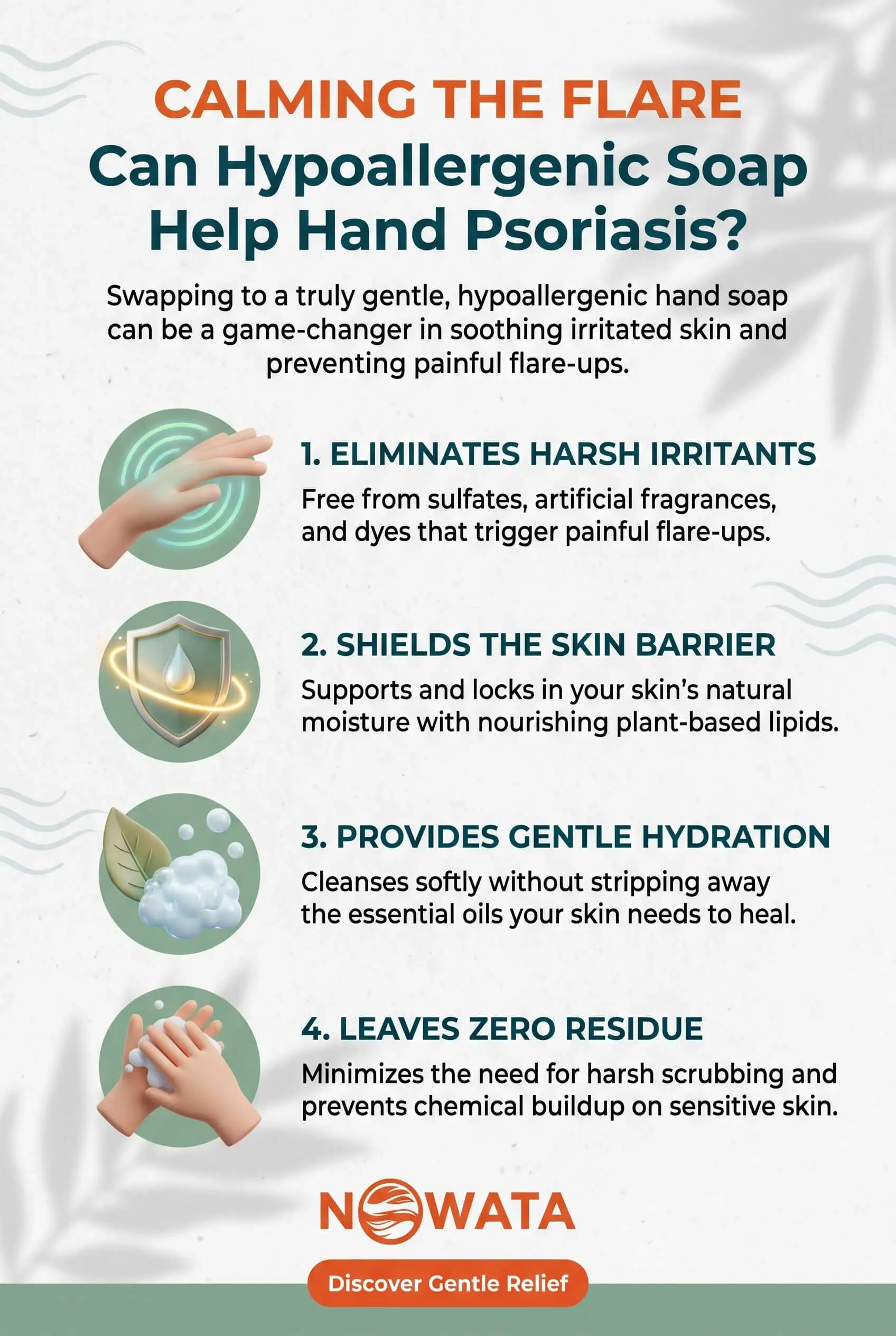
It can help when the ingredients back up the claim. A hypoallergenic hand soap without fragrance, SLS, alcohol or dyes is less likely to irritate psoriasis-prone skin. It won't treat the condition, and the label alone guarantees nothing.
What ingredients should I avoid in hand soap if I have psoriasis?
Start with sodium lauryl sulfate and other harsh surfactants, then added fragrance or parfum, drying alcohols and synthetic dyes. Each one strips or irritates the skin barrier. Skip anything you've reacted to before, too. The same caution applies after using pest control products, when residues on your hands may cause additional irritation.
Can washing my hands too often make psoriasis worse?
Yes. Frequent washing and hot water dry and crack the skin, and injured skin can grow new plaques. Switch to warm water and a gentle formula, then moisturize after every wash.
Is fragrance-free the same as unscented?
No. A brand can add a masking fragrance to an unscented product to hide other smells. Fragrance-free means nobody added any, and the ingredient list will confirm it.
Is psoriasis an allergy?
No. Psoriasis is an immune-mediated skin condition, which is why a hypoallergenic claim can't reach its cause. A gentle soap can still cut down on irritation.
When should I see a dermatologist about psoriasis on my hands?
Go if you've never had a diagnosis, or if your skin cracks, bleeds, blisters or keeps spreading despite gentle care. Hand psoriasis often needs prescription treatment, and a dermatologist can fit it to you.
Find a Gentler Hand Soap for Sensitive, Flare-Prone Hands
Pick up the soap by your sink and read the back. If you spot fragrance, SLS, alcohol or dyes on that list, your hands are taking hits they don't need. NOWATA's founders made their plant-based soap for their own kids' sensitive skin and left out SLS, alcohol, parabens, synthetic fragrance and dyes. Compare it with the checklist above and patch-test it first. Your hands could use one less thing to fight.


