Quick Answers
Acetone Disposal
Acetone should never be poured down drains or thrown in regular trash.
Based on real cleanout experience, the safest options depend on quantity:
Small amounts: Use approved outdoor evaporation only if local rules allow
Soaked rags/materials: Seal in a fire-resistant container
Large quantities: Take to a household hazardous waste facility or use a professional service
When disposal feels uncertain, that’s usually the sign to choose regulated or professional handling, such as a valet trash service, to avoid fire, health, and environmental risks.
Top Takeaways
Acetone is a flammable solvent, not regular household waste.
Disposal methods depend on how much acetone you have.
Never pour acetone down drains or onto the ground.
Acetone-soaked rags and materials can ignite if mishandled.
When unsure, regulated or professional disposal is the safest option.
Understand Why Acetone Requires Special Disposal
Acetone is highly flammable and evaporates quickly, releasing strong fumes. These characteristics make improper disposal dangerous, increasing the risk of fires, air quality issues, and environmental contamination. This is why acetone should never be treated like ordinary household waste.
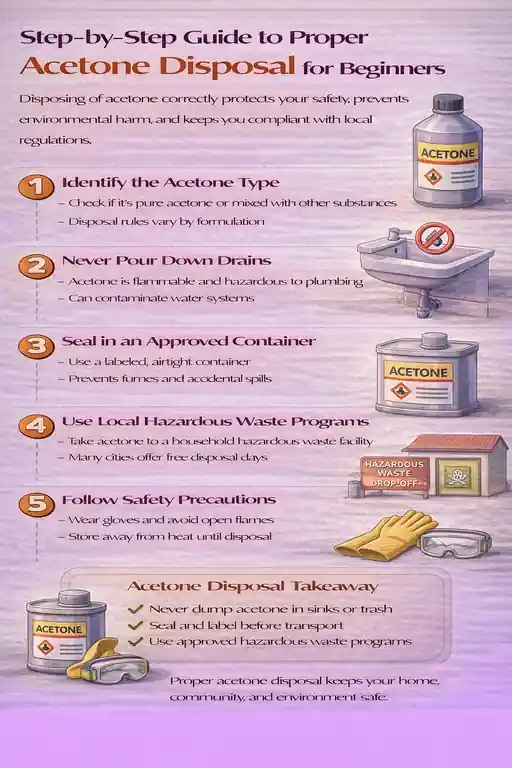
Step-by-Step Acetone Disposal for Beginners
Step 1: Identify the Amount and Condition of the Acetone
Determine how much acetone you’re disposing of and whether it’s clean or contaminated. Small leftover amounts from household or DIY use require different handling than larger quantities from workshops or garages.
Step 2: Never Pour Acetone Down Drains or Onto the Ground
Pouring acetone into sinks, toilets, storm drains, or soil can damage plumbing, create fire hazards in sewer systems, and contaminate groundwater. This is one of the most common and dangerous disposal mistakes.
Step 3: Allow Small Amounts to Evaporate Safely When Permitted
For very small quantities, some local regulations allow controlled evaporation outdoors in a well-ventilated area away from flames and heat. This method should never be done indoors or near ignition sources.
Step 4: Dispose of Acetone-Soaked Materials Properly
Rags, paper towels, or absorbent materials soaked with acetone should be placed in a sealed, fire-resistant container. Leaving these materials exposed can lead to spontaneous ignition.
Step 5: Use Hazardous Waste Facilities for Larger Quantities
For moderate to large amounts of acetone, household hazardous waste collection sites or professional disposal services are the safest and most compliant option. These facilities are designed to handle flammable solvents safely.
Final Safety Tips Before Disposal
Always keep acetone in its original container until disposal, store it away from heat sources, and review local disposal guidelines. When unsure, professional disposal, including junk removal services equipped to handle hazardous materials, is the safest choice for both people and the environment.
“After handling hundreds of real-world cleanouts, we’ve learned that acetone problems rarely come from the chemical itself—they come from uncertainty. When people understand why acetone behaves the way it does during disposal, the safest choice becomes obvious. That’s why we focus on practical, experience-driven steps instead of generic warnings.”
Essential Resources
When it comes to disposing of acetone the right way, not all resources are created equal. Below are the most trusted guides and tools we recommend based on what we actually use and share with customers during cleanouts and hazardous waste jobs.
1. Earth911 Recycling Search – Find Drop-Off Centers Near You
The fastest way to locate free household hazardous waste collection sites in your area — just enter your ZIP code and “acetone.” We point people here all the time because it’s simple and up-to-date.
URL: https://search.earth911.com/
2. EPA Household Hazardous Waste Guide – Know the Rules
This official EPA guide breaks down what makes solvents like acetone different from everyday trash and explains how household hazardous waste programs work. It’s the foundation behind all responsible disposal.
URL: https://www.epa.gov/hw/household-hazardous-waste-hhw
3. ATSDR Acetone Toxicological Profile – Health & Safety Insights
Want to understand what acetone actually does to your body and lungs? This government profile explains risks, exposure effects, and safe handling — helpful for safe DIY disposal.
URL: https://wwwn.cdc.gov/TSP/ToxProfiles/ToxProfiles.aspx?id=5&tid=1
4. OSHA Chemical Data – Official Workplace Safety Info
OSHA’s acetone database spells out exposure limits and safety requirements. While aimed at workplaces, this gives you a clear benchmark for ventilation and protective gear whenever you’re handling or disposing of solvents.
URL: https://www.osha.gov/chemicaldata/476
5. NOAA CAMEO Chemicals – Emergency Response Reference
This emergency database offers quick, actionable info on spill response, fire hazards, and safe distances. It’s not something you should need, but it’s worth knowing where to find it before you start.
URL: https://cameochemicals.noaa.gov/chemical/8
6. PubChem Acetone Summary – Chemistry & Environmental Impact
Want to know why acetone can damage plumbing and move through soil so quickly? PubChem’s detailed breakdown helps you understand its properties, so you know exactly what you’re preventing when you dispose of it properly.
URL: https://pubchem.ncbi.nlm.nih.gov/compound/Acetone
7. EPA Hazardous Waste Facility Locator – Professional Options for Big Jobs
When you’re dealing with more than a tiny bottle — like a full workshop or estate cleanout — this tool helps you find licensed hazardous waste management facilities. It’s where professionals go when curbside drop-offs aren’t enough.
URL: https://www.epa.gov/hwpermitting/how-do-i-find-hazardous-waste-management-facilities-my-area
Together, these trusted resources support responsible acetone disposal by explaining its chemical behavior, health risks, and environmental impact, helping homeowners and professionals manage hazardous materials with the same level of care and prevention mindset used in effective pest control methods by addressing the problem at the source before it becomes a larger safety issue.
Supporting Statistics
Based on what we see during real cleanouts, these statistics explain why acetone disposal needs extra care—even in small amounts.
Why Acetone Builds Up in Homes
The EPA reports the average U.S. household generates over 20 pounds of household hazardous waste per year
Some homes accumulate up to 100 pounds over time
In practice, this often includes old solvents stored in garages, bathrooms, and workshops
Source: https://archive.epa.gov/region9/waste/archive/web/html/house.html
Why Acetone Is a Serious Fire Risk
Flash point: 0°F (ignites extremely easily)
Explosive vapor range: 2.5%–12.8% in air
Even soaked rags or small spills can ignite in enclosed spaces
Source: https://www.osha.gov/chemicaldata/476
Why Ventilation Matters More Than Most People Think
NIOSH IDLH level: 2,500 ppm
This equals just 10% of acetone’s lower explosive limit
Fumes can build rapidly in garages and basements without airflow
Source: https://www.cdc.gov/niosh/idlh/67641.html
Exposure Limits Put DIY Use in Perspective
NIOSH recommended exposure limit (TWA): 250 ppm
OSHA legal workplace limit (TWA): 1,000 ppm
These limits assume industrial ventilation—not typical home conditions
Source: https://www.cdc.gov/niosh/npg/npgd0004.html
How Emergency Responders Classify Acetone
The NFPA hazard system uses a 0–4 scale to rate fire risk
Acetone’s flammability rating places it in a high-risk category
Improper storage or disposal triggers immediate concern during cleanouts
Source: https://www.nfpa.org/news-blogs-and-articles/blogs/2021/11/05/hazardous-materials-identification
Bottom line: These numbers reflect real-world risks we plan for every day. Proper acetone disposal isn’t about being overly cautious—it’s about preventing measurable, well-documented hazards before they escalate, especially during tasks like a garage cleanout where solvents are often overlooked.
Final Thought & Opinion
From what we see in real cleanouts, acetone disposal becomes risky not because people are careless—but because the risks are underestimated. Its everyday use hides the fact that acetone behaves more like an industrial solvent than a household product.
Key takeaways from hands-on experience:
Acetone is often stored and forgotten until it becomes hazardous
Most disposal problems come from uncertainty, not neglect
Shortcuts usually create bigger problems later
What consistently leads to safer outcomes:
Treat disposal as part of the project, not an afterthought
Identify the amount before choosing a disposal method
Respect ventilation and fire risk at all times
Use hazardous waste facilities when unsure
Our opinion:
If acetone disposal feels unclear, that hesitation is worth listening to. Slowing down and choosing the safer option—especially professional or regulated disposal—almost always prevents costly, avoidable risks. Acetone doesn’t need to be feared, but it does need to be handled with intention and respect.
FAQ on Acetone Disposal
Q: Is acetone hazardous waste?
A: Even when not legally classified as hazardous, acetone poses the same risks. We treat it as hazardous every time.
Q: Why shouldn’t acetone go down the drain?
A: It can damage plumbing, create vapor buildup, and increase fire risk. Problems often appear later, not immediately.
Q: What’s the safest way to dispose of small amounts?
A:
Controlled outdoor evaporation may be allowed locally
Only for very small quantities
When unsure, use a hazardous waste drop-off site
Q: Why are acetone-soaked rags dangerous?
A:
They trap flammable vapors
Can ignite if left exposed
Must be sealed in fire-resistant containers
Q: How should large amounts of acetone be handled?
A:
Use a household hazardous waste facility
Or hire a professional disposal service
Avoid long-term storage or dumping