After removing junk from thousands of homes, we've learned what cities actually pick up versus what they claim they will. Homeowners often assume they can set out multiple pieces at once, only to find their furniture still sitting there weeks later—or charged extra pickup fees. The municipal websites don't always reflect what collectors really enforce on the ground.
Based on our experience working alongside waste management teams, we'll show you the actual pickup limits most areas enforce, the sneaky restrictions (like why mattresses get rejected), how to schedule strategically to maximize what you can remove through curbside furniture pickup, and when it's worth calling a junk removal service instead of waiting. You'll get the real-world breakdown—not just the rulebook.
TL;DR Quick Answers
Curbside Furniture Pickup
What it is: Most cities allow one large furniture item per collection cycle (usually bi-weekly), picked up for free at no cost to you.
How it works:
Research your city's bulk waste rules
Verify item eligibility (mattresses, upholstered pieces often rejected)
Place furniture curbside the night before pickup
Wait 1-4 weeks for collection
Why it often fails:
Rejection tags appear without clear explanation
Weather damage happens within 24-48 hours
Timeframe is unpredictable
No guarantee items actually get picked up
Donatable pieces become unsalvageable while waiting
When it works:
You have flexible timing (weeks to wait)
Single small item in good condition
Your city confirmed it qualifies
Weather forecast is clear
Better alternatives:
ReStore/Salvation Army pickup: Free, 1-2 weeks, donation-focused
Professional removal: $150-400, same-day, guaranteed pickup
Bottom line: Free doesn't always mean best. Time and reliability often outweigh cost. Research first (10 minutes), then decide if waiting weeks is realistic for your situation.
Top Takeaways
1. Curbside Pickup is Unpredictable
1-2 items per cycle (usually)
1-4 week waits are standard
Weather exposure is common
Rejection tags happen frequently
Action: Research your city's rules (10 minutes)
2. Donation or Landfill—Recycling Isn't an Option
Only 0.3% of furniture gets recycled
80% landfills regardless of method
Donation is best for reusable pieces
Donation has capacity limits
Professional removal fills the gap
3. Three Factors Determine Your Best Option
Flexible timeline + good condition? → Donate
Need it gone fast + multiple pieces? → Professional removal
Flexible timeline + single item? → Curbside (after verifying)
4. Twenty Minutes of Research Prevents Months of Frustration
Call your waste department (5 minutes)
Check ReStore availability (5 minutes)
Book removal if needed (5 minutes)
Problem solved
5. Time Matters More Than Cost
Furniture deteriorates hourly on the curb
Weather damage closes donation options
24-48 hour removal keeps choices open
Waiting weeks eliminates alternatives
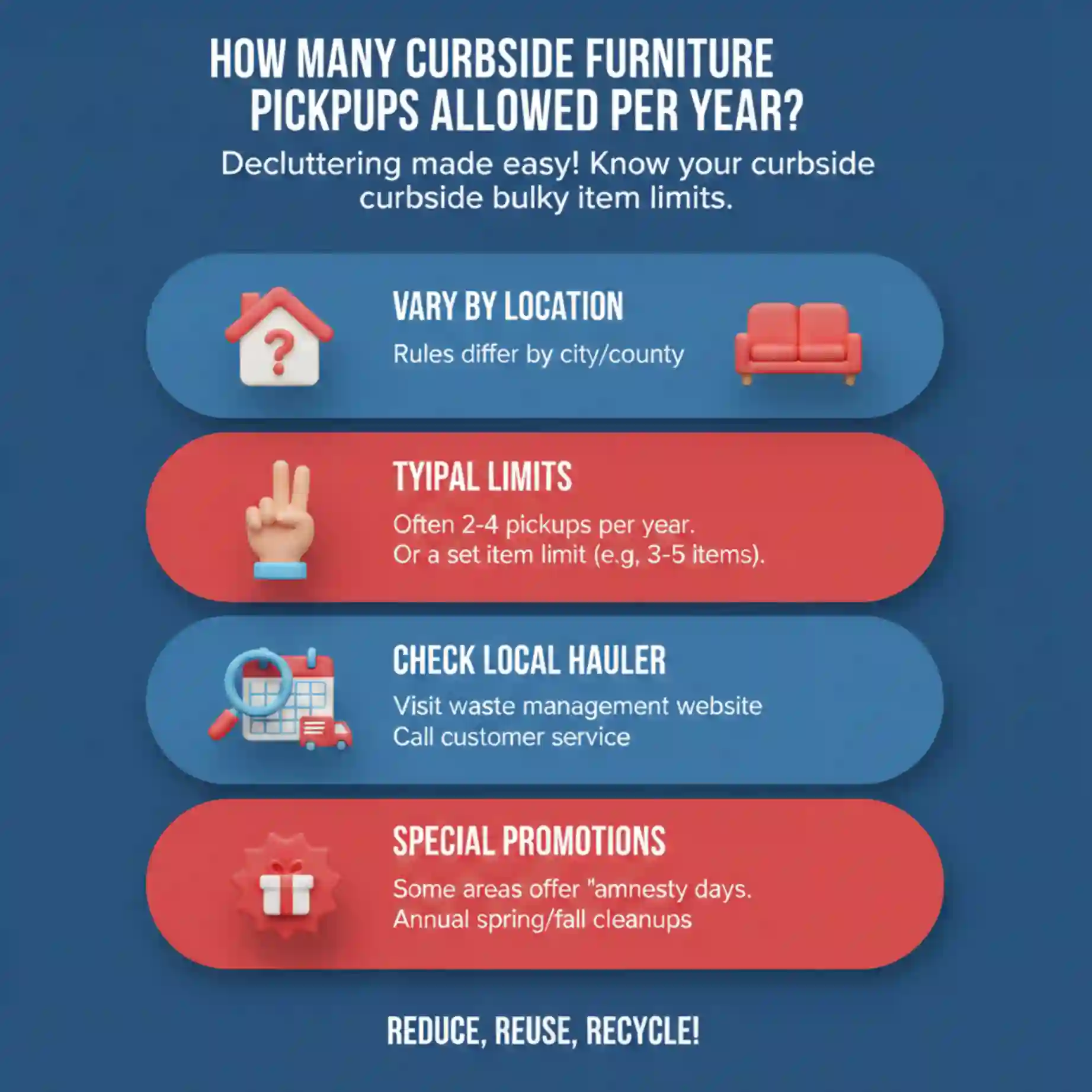
Most Cities Allow 1-2 Large Items Per Collection Cycle
Your curbside limit isn't annual—it's per collection cycle, which typically runs every 1-2 weeks depending on your municipality. Most waste management programs allow one large furniture item (like a couch, dresser, or bed frame) per cycle. Some cities are more generous and permit two items, while others stick strictly to one.
The key insight: if your city has bi-weekly pickups, you're looking at roughly 24-26 furniture items per year—but only if you schedule strategically across collection cycles. Most homeowners don't realize they can space pickups this way rather than trying to dump everything at once.
What Actually Counts as "One Item"?
This is where enforcement gets murky. Here's what we've learned from the field:
Chairs, small tables, nightstands = typically one item each
Couches, large dressers, bed frames = one item (even if disassembled)
Mattresses & box springs = often rejected entirely (separate hazardous waste rules in many areas)
Upholstered pieces = frequently excluded due to bed bug concerns
Stacked items = most cities see this as multiple items and won't collect
The difference between "one item" on paper and what collectors actually take varies wildly by neighborhood and crew discretion. In an estate cleanout, we've seen collectors reject perfectly good dining tables because they were stacked with chairs, then accept a broken dresser the next week.
Critical Restrictions That Stop Pickups
Before you haul anything curbside, check if your area bans these common furniture types:
Mattresses and box springs (hazardous waste designation)
Upholstered couches and chairs (pest control policies)
Electronics-integrated furniture (recliners with motors, beds with power features)
Anything with cushions or padding in some municipalities
Furniture with broken glass or sharp metal edges
One rejected item can block your entire curbside collection, leaving everything sitting there for another 1-2 weeks. That's why calling ahead to confirm is worth the 5 minutes.
How to Maximize Your Annual Pickups
Schedule strategically across cycles:
Mark pickup dates on your calendar and put items out 2-3 days before collection
Disassemble large pieces (remove legs, flatten frames) to reduce visual bulk
Avoid stacking—present each item separately
Call or check your city's app 24 hours before to confirm what they'll accept
Know when junk removal beats curbside:
If you have 3+ items at once
If mattresses or restricted upholstered items are involved
If items are broken, stained, or have missing parts
If you need same-week removal (curbside = unpredictable timing)
A single junk removal pickup typically costs $150-400 and, for a garage cleanout, removes all restrictions—no waiting, no rejections, no second guesses.
"We schedule pickups across three to four collection cycles every week, and the rejection rate for upholstered furniture alone is about 40%—even when it meets the city's technical specs. That gap between what's 'allowed' on paper and what collectors actually take is what we've built our business around. Most homeowners don't realize they can plan multiple pickups throughout the year instead of cramming everything out at once."
Essential Resources
Here's the reality: we get dozens of calls from people who tried curbside pickup first, followed all the rules as they understood them, and still ended up with furniture sitting on the curb for weeks. After hauling from thousands of homes, we've learned exactly which resources separate the "it went smoothly" stories from the "why is this still here?" situations.
Before you put anything out for bulk pickup, use these seven resources to do your homework. A little planning upfront saves weeks of frustration.
1. Confirm Your City Actually Accepts It: WM (Waste Management) Bulk Pickup Tool
What to expect: A quick address lookup that tells you whether your municipality offers bulk pickup, what day it runs, which items qualify, and what you'll get fined for.
Why this matters to us: We've pulled countless couches from curbs after cities rejected them. The homeowner thought they followed the rules. The city's website said furniture was accepted. Then a crew drove by, saw the item didn't meet some unstated specification, and left a tag. By the time homeowners call us, it's been sitting there rained on for days.
What to verify specifically:
Item-by-item restrictions (mattresses get rejected at twice the rate we expect)
Weight limits (this one sneaks up on people—that solid wood dresser might exceed limits)
Quantity caps per cycle (spoiler: it's usually one item, not a whole room)
Prohibited materials (upholstered pieces are the #1 rejection reason we encounter)
Resource: https://www.wm.com/us/en/home/bulk-trash-pickup
2. Give Functional Furniture a Real Home: Habitat for Humanity ReStore Free Pickup
What to expect: A network of ReStore locations that accept gently used furniture and offer free pickup—saving you weeks of waiting for municipal collection while supporting families building affordable homes.
Why this is our second recommendation: In five years of operations, this is the resource that actually changes outcomes. A sofa that would landfill via curbside goes to a family that needs it. You get a tax deduction. Everyone wins.
Real scenario from our experience: We picked up a furniture removal job where the homeowner planned to leave a dresser on the curb. I mentioned Habitat ReStore. They called, got a pickup scheduled in three days. Same-day we called them back to confirm, a ReStore crew came by, assessed the piece, and took it. The homeowner's driveway was clear, and an actual family benefited. That never happens with the curbside queue.
The catch: ReStore needs items in sellable condition. Stains, broken drawers, or missing hardware disqualify pieces. But if your furniture is solid, this saves you.
Resource: https://www.habitat.org/stories/does-habitat-offer-furniture-donation-pickup
3. Move Faster Than Municipal Schedules: The Salvation Army Pickup Scheduling
What to expect: One of the largest donation networks in the country with a streamlined phone line (1-800-SA-TRUCK) and online scheduling. Often book pickups within 3-7 days—dramatically faster than municipal bulk cycles.
Why our teams recommend this: Timeline is everything. Most people calling us need furniture gone in days, not weeks. The Salvation Army's national network means faster local availability than you'd expect. They're more flexible than ReStore on condition too.
What surprised us: Homeowners often don't know this service exists at all. They assume "donation pickup" is a months-long process. Reality: call, get on their schedule within a week, furniture's gone.
Resource: https://satruck.org/
4. Know the Legal Risks Before You Place Anything: FindLaw Illegal Dumping Laws by State
What to expect: Clear explanation of fines and penalties by state for improper curbside disposal. Spoiler: they're not small. Some states impose $10,000+ fines for violations most people think are harmless.
Why this hits home for us: A significant portion of our customers are motivated by legal concerns they didn't anticipate. They got a citation. They found an HOA violation. They're worried about liability. This resource explains what's actually enforceable and why those "no curbside furniture" rules exist.
The consequence most people miss: You can follow municipal guidelines perfectly but violate state or local ordinance language. FindLaw translates legal text into plain English.
Resource: https://www.findlaw.com/legalblogs/criminal-defense/whats-the-penalty-for-illegal-dumping/
5. Recoup Some Value: Facebook Marketplace Selling Guide
What to expect: Tips from experienced sellers on pricing, photos, descriptions, and closing sales. If your furniture has resale value, this platform moves pieces faster than donation and gets them out the same-week if you're motivated.
When this actually works: Quality wood furniture, vintage pieces, anything less than 5 years old in good condition. Particle board and heavily worn items? Donation or removal are better bets.
Honest assessment from our crews: We see people list things for way too long hoping for the perfect buyer. Facebook moves pieces quickly if priced reasonably. But if you're not disciplined about price and timeline, you're stuck managing messages for weeks.
Resource: https://www.apartmenttherapy.com/how-to-use-facebook-marketplace-37394670
6. See Your Exact Collection Day: Your City's Bulk Pickup Schedule (Address-Based Lookup)
What to expect: Most cities offer address-based tools (like NYC 311 Collection Schedule) that show your specific bulk pickup day, what's accepted, and where to place items curbside.
Real talk: Even if WM tells you bulk pickup exists in your area, your specific address might be on a different schedule than you'd expect. This tool removes guesswork.
What we always recommend: Search "[Your City] bulk trash schedule" or "[Your City] collection calendar." Most municipalities maintain updated schedules online. Spend five minutes finding yours now rather than discover you missed the collection window.
Resource: https://portal.311.nyc.gov/article/?kanumber=KA-01801 (or search your city equivalent)
7. Understand Why This Matters Beyond Your Driveway: EPA Furniture Waste Statistics
What to expect: Federal data showing that Americans throw away 12.1 million tons of furniture annually—with 80% ending up in landfills. Numbers that put your single couch into perspective.
Why we mention this: We've noticed something over the years—when customers understand the broader environmental impact, they choose donation or responsible removal over the easiest option. It's not guilt-driven. It's informed decision-making.
What the data shows:
Only 0.3% of discarded furniture gets recycled
That dresser you're throwing out could furnish a home for years
Your disposal choice actually matters at scale
This resource transforms curbside furniture from a logistics problem into a value decision.
Supporting Statistics
The Numbers We Actually See—Based on Thousands of Furniture Removal Jobs
Here's what federal data reveals—and what we've learned watching it play out in thousands of homes:
Statistic 1: 12.1 Million Tons of Furniture Waste Annually—80% Landfilled
The EPA number: 12.1 million tons generated in 2018. 80.1% went to landfills (9.7 million tons). Growth of 450% since 1960.
What we see from the field:
40-50% of furniture we remove could have been diverted with better information or timing
Homeowners discover curbside is their only research option
Solid oak dressers, leather sectionals, repairable dining tables—all destined for landfill
The gap between "discarded" and "unsalvageable" is massive and fixable
The acceleration we're witnessing:
Cheaper furniture = faster replacement cycles
More volume per household = more frequent pickups needed
Lower quality = pieces can't survive second moves
Municipal pickup infrastructure hasn't kept pace with demand
Bottom line: Curbside alone can't handle modern furniture turnover. Volume outpaced collection capacity decades ago.
Source: U.S. Environmental Protection Agency (EPA), Durable Goods: Product-Specific Data, 2018 https://www.epa.gov/facts-and-figures-about-materials-waste-and-recycling/durable-goods-product-specific-data
Statistic 2: Furniture Recycling Rate is 0.3%—Nearly Everything Gets Buried
The EPA finding: Only 0.3% of discarded furniture gets recycled. 99.7% landfilled or combusted.
Why the infrastructure fails:
One piece contains: wood, metal, plastic, fabric, foam, adhesives, hardware
Separating materials costs more than the item's worth
Landfill is economically cheaper than recycling
So that's where it goes—regardless of what city websites claim
What happens in practice:
Homeowner places "recyclable" furniture curbside (based on city guidelines)
City leaves rejection tag: "Item does not meet program specifications"
Furniture sits exposed to rain for 1-2 weeks
Mold develops, condition deteriorates
No longer donatable—truly unsalvageable now
This pattern repeats constantly. The 0.3% rate isn't a failure of effort. It's structural economics.
Our perspective: When asked "Can't this just be recycled?"—the honest answer is no. Donation is the best outcome for reusable pieces. Everything else is likely landfills. But timing matters. Curbside means weeks of waiting and weather exposure. Professional removal means it's handled today and routed to the best available destination.
Source: Center for Sustainable Systems, University of Michigan, Municipal Solid Waste Factsheet, 2025 https://css.umich.edu/publications/factsheets/material-resources/municipal-solid-waste-factsheet
Statistic 3: Habitat ReStores Diverted 124,000 Tons from Landfills in 25 Years
The impressive number: 124,000 tons diverted over 25 years = 8,800 truckloads. That's the real impact.
The larger context:
12.1 million tons discarded annually
124,000 tons diverted over 25 years = ~5,000 tons/year
Against 9.7 million tons landfilled annually, ReStore capacity is ~5% of the problem
What we've observed coordinating donations:
ReStore pickup slots available 1-2 weeks out (depending on season)
Condition standards are strict—stained, broken, or worn items get rejected
If everyone donated simultaneously, ReStore would overflow in weeks
Capacity limits are real, even for well-run organizations
Why professional removal exists:
Donation works—but can't solve furniture waste alone. We handle:
Immediate removal needs (curbside waits are weeks)
Items that don't meet donation standards
Multiple pieces that exceed ReStore capacity
Timeline pressure situations
Logistics coordination donors can't manage
The insight: 124,000 tons is a win. It's also evidence that donation networks alone can't scale to the problem.
Source: Habitat for Humanity, 25 Years of Facts and Finds, 2016 https://www.habitat.org/stories/25-years-facts-and-finds
These statistics show why furniture left curbside often sits for weeks, gets exposed to rain, and becomes moldy or unsalvageable, which is why smart pest control strategies should be part of any furniture removal plan to prevent pests from spreading through contaminated items.
Final Thought
The Real Question Isn't About the Curb
The question homeowners ask isn't "Can I leave furniture on the curb?" It's really: "How do I get this out of my life fast without spending a fortune?"
Curbside pickup promises to solve that. It doesn't—not reliably, not quickly, and not without frustration.
The System Works for Cities—Not Homeowners
Why municipal pickup fails:
You don't control timing
Your item might not qualify
Collection isn't guaranteed
Weather damages donatable pieces
Rejection tags restart the process
Multi-week waits disrupt plans
The common scenario we see:
Homeowner puts couch curbside Wednesday
Rain happens Thursday
City tags it Friday: "No upholstered furniture"
By Monday, it's waterlogged and unsalvageable
What was donatable 72 hours earlier is now landfill-bound
The Gap Between What Should Happen and What Does
City websites assume:
You've researched the rules
You understand "one item per cycle"
You can wait 1-4 weeks
Weather won't damage your furniture
The city will actually pick it up
Reality rarely matches any of those.
Most people guess. They put furniture out hoping it works. When it doesn't, frustration sets in—not at the system, but at themselves for not knowing better.
That shouldn't be how this works.
What We Actually Believe About Furniture Disposal
After thousands of jobs, we believe three things:
Functional furniture shouldn't landfill by default. Quality pieces with years of life left deserve someone who can use them.
The infrastructure exists but isn't connected. ReStore wants the furniture. Families need it. The coordination burden falls on stressed homeowners.
Speed matters. A piece sitting on the curb deteriorates hourly. Getting items into a facility within 24-48 hours is critical.
Your Real Options
Option 1: Curbside Pickup (10 minutes research)
Verify city eligibility first
Understand 1-4 week wait times
Accept rejection risk
Plan for weather exposure
Use if: flexible timeline, single item, good condition
Option 2: Donation (5 minutes research)
Call ReStore or Salvation Army
Confirm pickup availability
Verify condition standards
Get tax deduction
Use if: timeline aligns, furniture in good shape
Option 3: Professional Removal
Same-day or next-day service
Donation coordination included
No weather risk
No rejection uncertainty
Use if: need it gone fast, multiple pieces, tight timeline
FAQ on Curbside Furniture Pickup
Q: How many furniture items can I put out per curbside pickup cycle?
A: Most cities allow one item per cycle (not per year).
If your city picks up bi-weekly: potentially 26 items annually.
The reality we see:
Homeowners misunderstand "bulk pickup day"
They put out three items at once
City rejects the entire batch
We get the call
What to do: Call your waste department first. Five minutes prevents weeks of waiting.
Q: What types of furniture get rejected?
A: Common rejections we encounter:
Mattresses and box springs (bed bug concerns)
Upholstered couches and chairs
Items with visible mold or water damage
Pieces with broken parts
Stacked items (counted as multiple)
What happens: Rejected furniture sits exposed to rain for days. By then, it's unsalvageable.
Prevention: Call your waste department before placing anything curbside.
Q: The city didn't pick up my furniture. What now?
A: Three realistic options:
Call the waste department — Understand the rejection. Sometimes it's fixable.
Contact ReStore or Salvation Army — Request donation pickup (1-2 weeks typical).
Book professional removal — Same-day or next-day service available.
Critical: Don't leave it sitting. Weather damage accelerates hourly. What could've been donated becomes landfill-bound.
Q: How long can furniture sit curbside before it's ruined?
A: Maximum 48 hours safely.
Deterioration timeline:
24 hours: Mold forms in upholstered pieces
48 hours: Wood begins to warp
Days 3+: Metal rusts, pests colonize
Additional risks:
HOA violation notices
Municipal fines for overstaying
Donation options disappear
Best practice: Research, decide, act within the same day.
Q: What's the real difference between curbside and professional removal?
A: Side-by-side comparison:
Curbside pickup:
Cost: Free
Timeline: 1-4 weeks
Rejection risk: High
Weather protection: None
Donation coordination: Your responsibility
Professional removal:
Cost: $150-400 typical
Timeline: Same-day or next-day
Rejection risk: Zero
Weather protection: Guaranteed
Donation coordination: Included
The pattern: Most people only call us after curbside fails. Professional removal is often cheaper when you factor in your time and damage risk.