From what we’ve learned through real-world waste and pickup situations, collection windows aren’t just a scheduling detail—they’re a system designed to prevent odor buildup, pest activity, blocked walkways, and late-night noise complaints. When residents understand the timing rules and when properties enforce them consistently, valet trash stays clean, discreet, and reliable.
In this guide, we break down the best practices for valet trash collection windows and quiet hours, including the most common set-out time rules, what “quiet hours” typically mean for pickup crews, and practical tips to reduce missed pickups and violations—so valet trash service stays convenient for everyone in the building.
TL;DR Quick Answers
What is valet trash service?
Valet trash service is a scheduled doorstep trash pickup program, usually offered in apartment communities, where residents place tied trash bags outside their door during a set collection window and a pickup team removes them and takes the waste to the dumpster or compactor.
Jiffy Junk insight: The smoothest valet trash service happens when three basics are followed:
set trash out only during the approved window
use sealed, leak-proof bags
place trash in the correct pickup location
Top Takeaways
Collection windows prevent problems. They reduce odor, pests, hallway clutter, and safety issues.
Timing is the #1 cause of missed pickup. Trash set out too early or too late is most likely to be skipped.
Quiet hours matter. Late pickups and noisy trash placement can lead to complaints.
Placement affects safety and noise. Bags should never block walkways, stairs, or door swings.
Clear communication improves compliance. When communities post rules clearly, violations drop fast.
Valet trash service is designed to make apartment living easier, but it only works smoothly when everyone follows the timing rules. Collection windows and quiet hours aren’t just “property policies”—they’re what keep valet trash clean, discreet, and reliable instead of turning it into hallway clutter, odor issues, and late-night noise complaints.
Below are the best practices that help valet trash service run efficiently while still respecting residents’ comfort and quiet hours.
What Valet Trash Collection Windows Really Mean
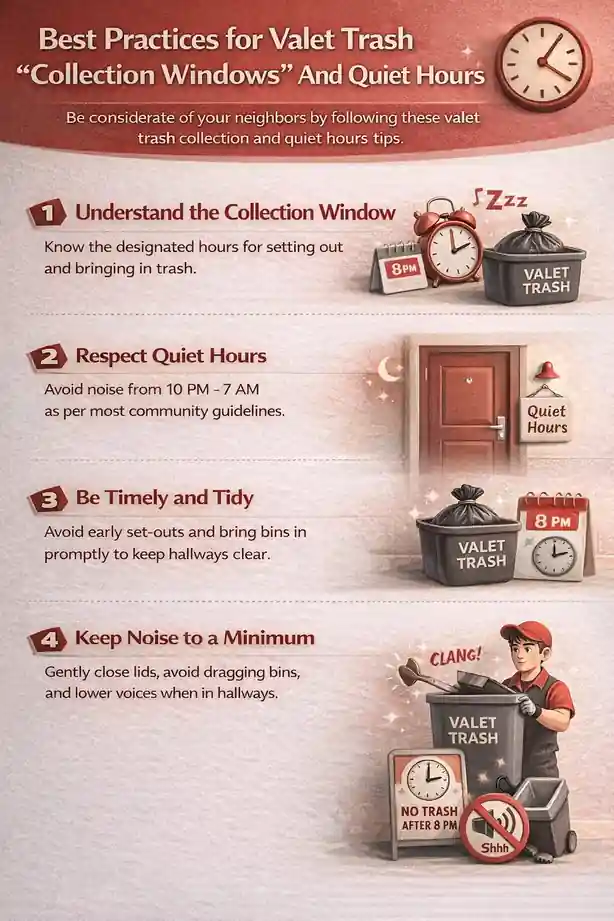
In valet trash service, the collection window is the approved time period when residents are allowed to set trash outside their door for pickup. This system exists to:
prevent trash from sitting out all day
keep breezeways and hallways clear
allow valet trash teams to collect efficiently across multiple buildings
In short, collection windows are the structure that makes valet trash service possible at scale.
Best Practice: Set Trash Out Only During the Approved Set-Out Window
The most common reason valet trash gets skipped is timing. Trash placed out too early can violate community rules. Trash placed out too late may miss the route entirely.
To stay compliant and avoid missed pickups:
set trash out close to the start of the window
avoid leaving bags outside hours ahead of time
never leave trash out overnight unless your community allows it
This keeps valet trash service consistent and reduces resident complaints.
Best Practice: Use Quiet-Hours-Friendly Trash Placement
Valet trash service often involves pickup teams moving through shared spaces like hallways and breezeways. Even when residents do everything right, poor placement can create noise and safety issues.
Best placement habits include:
place bags neatly against the wall
keep trash out of walking paths
avoid placing bags near stairs or door swings
use the approved bin or container if required
This helps keep the service discreet and prevents noise caused by spills or re-handling.
Best Practice: Understand How Quiet Hours Affect Valet Trash Pickup
Quiet hours typically exist to reduce noise in shared living spaces. If valet trash collection runs later than expected, quiet hours can become a problem quickly.
For valet trash service to respect quiet hours, pickup teams and properties usually aim to:
schedule routes to avoid late-night collection
reduce unnecessary door banging or loud handling
avoid dragging bins across concrete
keep communication low-volume in residential corridors
This is why many properties set collection windows earlier in the evening.
Best Practice: Avoid High-Noise Trash That Triggers Complaints
Some trash types create more noise than others—especially when pickup happens near or during quiet hours. To reduce noise complaints, residents should:
avoid loose bottles and cans
keep heavy items secured inside bags
avoid overfilled bags that rip or spill
never place glass or sharp items loosely outside
Quiet, contained trash makes valet trash pickup faster and less disruptive.
Best Practice: Communities Should Align Collection Windows With Resident Comfort
The best valet trash programs are the ones where timing rules are clear and realistic. Communities should clearly communicate:
exact set-out window start and end times
expected pickup time range
what happens if trash is placed out early
prohibited items and overflow rules
how residents should report missed pickup
When policies are clear, compliance improves and valet trash service feels like a true amenity—not a hassle.
Quick Tips for Residents Using Valet Trash Service
If you want smooth service with fewer issues:
set trash out only during the approved window
use sealed, leak-proof bags
place trash neatly and safely
avoid noisy loose items
remove trash promptly if pickup is missed
When these best practices are followed, valet trash service stays what it’s meant to be: convenient, clean, and respectful—without forcing residents to think about dumpster rental prices as an alternative—so everyone in the community benefits.
“From what we’ve seen firsthand, valet trash service succeeds or fails based on timing. When collection windows are clear and residents follow them, pickups stay clean, discreet, and consistent. But when trash is set out too early or left out past quiet hours, the same issues always show up—odor, clutter, missed pickups, and noise complaints.”
Essential Resources
Valet trash service sounds simple on the surface, but the details matter. At Jiffy Junk, we’ve seen that the difference between a smooth, complaint-free program and a frustrating one usually comes down to clear rules, realistic collection windows, and the right provider expectations.
Use the resources below to research valet trash service the smart way—so you understand how it works, what residents must follow, how fees are handled, and what property managers should look for before committing.
1) Multifamily Valet Trash Service Overview
Benefit: Understand how valet trash works at the apartment-community level
This guide explains how valet trash is structured for multifamily properties, including pickup routines, operational expectations, and why communities adopt it.
https://www.trashbutler.com/valet-trash-for-multifamily-residences/
2) Valet Trash Basics and Pickup Workflow
Benefit: Learn the full process from doorstep pickup to disposal
A clear breakdown of what valet trash service is, how collection windows work, and what is typically included in a standard program.
https://www.trashbutler.com/what-is-valet-trash/
3) Resident-Friendly Explanation of Valet Trash in Apartments
Benefit: Know what residents should expect from valet trash service
This resource explains valet trash as an apartment amenity, including how pickup schedules are typically structured and why properties offer it.
https://www.apartmentguide.com/blog/valet-waste/
4) Why Communities Add Valet Trash Service
Benefit: Understand the real property-level value behind the amenity
This guide highlights the operational benefits valet trash can provide, including cleaner common areas, improved resident satisfaction, and stronger community appeal.
https://verdantservice.com/apartment-valet-trash-service-how-it-works-and-why-communities-love-it/
5) Mandatory Valet Trash Fees and Tenant Rights
Benefit: Understand how fees work and what should be transparent in the lease
A legal-focused perspective on mandatory valet trash fees, tenant rights, and what renters should review before signing.
https://legalclarity.org/tenant-rights-and-mandatory-valet-trash-fees-in-apartments/
6) How to Choose a Valet Trash Service Provider
Benefit: Compare vendors and avoid unreliable service
This decision guide helps property managers evaluate valet trash providers, including what questions to ask, what service standards matter, and what to confirm in contracts.
https://propertymanagerinsider.com/choosing-a-valet-trash-service/
7) Valet Trash Business Launch and Operations Guide
Benefit: Learn what it takes to run valet trash service successfully
This resource covers strategy and operational basics for launching a valet trash service, including staffing, pricing, and route planning.
https://valethero.org/blog/launch-your-valet-trash-service-a-friendly-guide-to-success
Taken together, these resources show how clear rules, realistic timelines, and the right expectations keep valet trash service running smoothly, and the same structured approach applies to a garage cleanout, where understanding the process upfront helps prevent clutter, delays, and avoidable issues.
Supporting Statistics
At Jiffy Junk, we’ve seen valet trash rules exist for practical reasons. In multifamily communities, high waste volume and prohibited items can quickly create safety and service problems. These U.S.-based stats support that reality.
1) Waste volume is high, so collection windows matter
EPA reports the U.S. generated 292.4 million tons of municipal solid waste in 2018.
That equals 4.9 pounds per person per day.
Jiffy Junk insight: timing rules and sealed bags prevent trash from sitting out too long and keep service manageable.
2) Batteries in trash are linked to real fires
We often see batteries and small electronics thrown into regular trash.
EPA analysis identified 64 waste facilities with 245 fires (2013–2020) linked to lithium batteries.
Fires occurred across 28 states.
Jiffy Junk insight: this supports why valet trash programs prohibit batteries and e-waste.
Source: https://www.epa.gov/system/files/documents/2021-08/lithium-ion-battery-report-update-7.01_508.pdf
3) Outside trash fires happen every year
NFPA estimates 9,440 outside trash or rubbish fires per year (2014–2018 average) caused by “playing with fire.”
Jiffy Junk insight: limiting how long trash sits out reduces unnecessary risk exposure, especially overnight.
Final Thought & Opinion
Valet trash service can be a great amenity, but it only works when it runs on clear standards. Collection windows, sealed bags, correct placement, and prohibited item rules are not “extra.” They are what make the service clean and consistent in a shared community.
What we see at Jiffy Junk
In our first-hand experience, valet trash programs fail for one main reason: lack of structure.
When rules are unclear or inconsistently enforced, small problems multiply fast:
trash set out too early or too late
leaking bags in breezeways and hallways
prohibited items mixed into pickup
quiet hours turning into noise complaints
Our opinion
Valet trash is only “premium” when it is predictable.
The best programs:
communicate rules clearly
enforce collection windows consistently
make compliance easy for residents
When those basics are followed, valet trash stays:
clean
discreet
reliable
worth the cost
FAQ on Valet Trash Service
Q: What is valet trash service?
A: Valet trash service is scheduled doorstep trash pickup for apartment communities.
Residents set out tied trash bags during a set window
A valet team collects bags and takes them to the dumpster/compactor
Jiffy Junk insight: it works best when it runs like a system, not a casual drop-off.
Q: What time do residents usually set out trash?
A: Most properties use an evening set-out window (often 6 PM–8 PM).
Exact times vary by community
Trash outside the window may be skipped
Q: Why does valet trash get missed or rejected?
A: Most issues happen due to:
Trash set out too early or too late
Bags not sealed or leaking
Trash placed in the wrong pickup location
Prohibited items included
Q: What items are not allowed in valet trash service?
A: Most valet trash programs do not accept:
Bulky items (furniture, mattresses)
Hazardous waste (paint, chemicals, batteries, medical waste)
Electronics/appliances
These items usually require bulk pickup or a separate removal option.
Q: Why do apartments charge for valet trash service?
A: Many communities include valet trash as a paid amenity in the lease.
Fees should be disclosed upfront
Following rules helps avoid violations and extra charges