Inside, you’ll learn how to clean out your garage using a clear sequence that keeps the process manageable. The goal isn’t perfection—it’s reclaiming functional space, knowing which areas to tackle first, and avoiding the common missteps that cause garage cleanouts to stall before they’re finished.
Quick Answers
Garage Cleanout
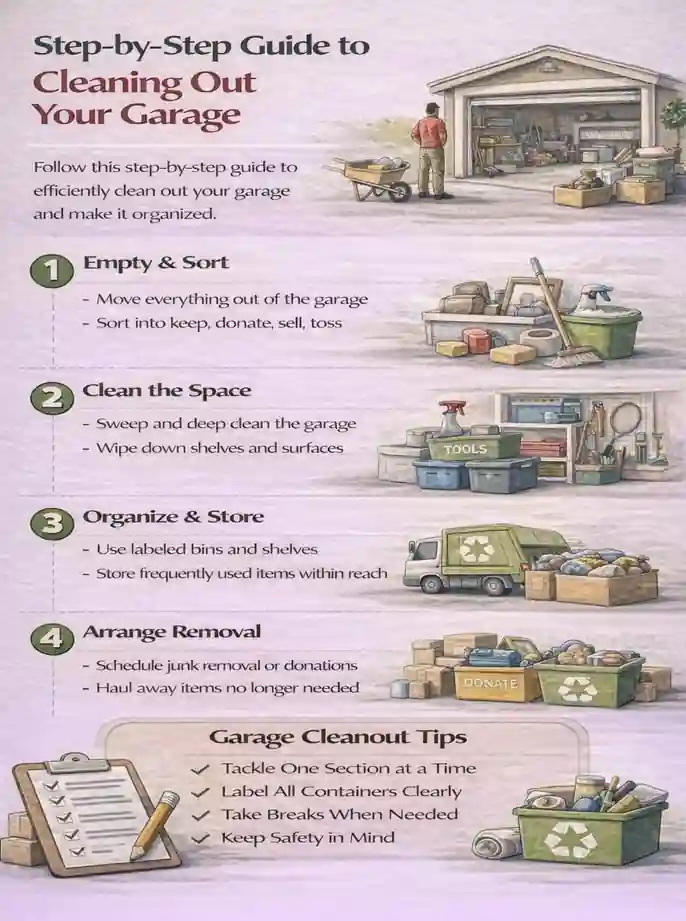
Cleaning out your garage means systematically removing unwanted items, restoring access, and setting up a layout that actually works. From our experience, the most successful cleanouts follow a clear sequence: clear access points first, make quick decisions, and remove items as you go.
Top Takeaways
A step-by-step approach prevents overwhelm and wasted effort.
Clearing access areas first creates instant progress.
Simple decision rules keep the process moving.
Removing items immediately locks in results.
Small, consistent steps outperform one-time overhauls.
The Right Order to Clean Out Your Garage Efficiently
Step 1: Start With Access, Not Organization
Many people begin by buying bins or shelving, but that often slows progress. Based on real garage cleanouts we handle, the most effective first step is restoring access. Focus on opening pathways, clearing the garage door area, and making the space navigable. Once you can move freely, every next step becomes easier.
Step 2: Identify the Largest Obstacle Zone
Almost every garage has one section that creates most of the frustration—a wall of boxes, a collapsed shelving unit, or a corner filled with bulky items. Targeting this single zone first delivers the biggest visual and functional payoff, while also reducing hidden risks including bed bug infestation, even if the rest of the garage remains untouched for now.
Step 3: Make Fast, Functional Decisions
Cleanouts stall when every item turns into a debate. A simple decision framework works best:
Frequently used items stay
Broken or unused items go
Uncertain items get set aside temporarily
This keeps momentum high and prevents mental fatigue.
Step 4: Remove Items as You Go
One of the most common cleanout failures we see is delayed removal. Donation piles and junk stacks often linger for months and slowly migrate back into the garage. Scheduling removal or planning drop-offs immediately ensures progress doesn’t reverse.
Step 5: Repeat in Short, Planned Sessions
You don’t need to finish your garage in one day. What works consistently is repeating short, focused sessions that fit into real schedules. Each session builds on the last, turning a daunting project into a manageable routine.
“In our experience handling garage cleanouts every day, including those tied to an estate cleanout, the turning point is almost always access—not organization. Once pathways are clear and decisions are kept simple, progress accelerates and garages stop feeling stuck.”
Essential Resources for Garage Cleanout
1. Plan the Cleanout Before You Lift
Step-by-Step Garage Cleanout Planning Guide — NewSouth Waste
A practical breakdown of how to plan, sort, and execute a garage cleanout efficiently.
https://newsouthwaste.com/garage-cleanout-success-waste-management-plan/
2. Understand the Full Cleanout Process
Complete Garage Cleanout Guide — JunkSmiths
Explains what happens during a full garage cleanout so expectations stay realistic.
https://junksmiths.com/garage-clean-outs-guide/
3. Declutter With Clear Decision Rules
Garage Cleanout & Decluttering Tips — Home Sidekick
Helps simplify keep-or-remove decisions to avoid overthinking.
https://homesidekick.com/blog/garage-cleanout-guide.html
4. Use a Printable Checklist
Garage Cleanout Checklist Printable — Zopago
Keeps the process structured and easy to follow.
https://zopago.com/your-printable-garage-cleanup-plan/
5. Prepare the Space Properly
Garage Cleaning & Prep List — Angi
Outlines supplies and prep steps to prevent delays.
https://www.angi.com/articles/garage-cleaning-checklist.htm
6. Dispose of Items Responsibly
Garage Cleanout Strategies — Waste Removal USA
Covers recycling, donation, and disposal best practices.
https://wasteremovalusa.com/blog/garage-cleanout/
7. Organize After the Cleanout
Step-by-Step Organization Guide — Hello Garage
Focuses on preventing clutter from returning.
https://www.hellogarage.com/blog/step-by-step-guide-to-your-garage-cleanout/
These resources help homeowners plan and complete garage cleanouts efficiently by covering preparation, sorting, disposal, and organization, reflecting how structured cleanup practices align with the evolution of the pest control industry, where access, prevention, and proactive maintenance play a growing role.
Supporting Statistics
At JiffyJunk, real cleanouts align closely with national data on waste, safety, and storage habits.
Household waste adds up fast
The U.S. produces 292.4 million tons of waste annually.
Garages often become overflow storage when removal is delayed.
Source: https://www.epa.gov/facts-and-figures-about-materials-waste-and-recycling/national-overview-facts-and-figures-materials
Most items never get recycled
Only 32.1% of U.S. waste is recycled or composted.
Cleanouts are a key opportunity to redirect usable items.
Source: https://www.epa.gov/facts-and-figures-about-materials-waste-and-recycling/frequent-questions-regarding-epas-facts-and
Garages store hidden hazards
99% of lead-acid batteries are recyclable, yet many sit unused.
Cleanouts help identify and remove these safely.
Source: https://www.epa.gov/electronics-batteries-management/battery-collection-action-case-study-lead-acid-battery-collection
Clutter impacts safety
Over 344,000 residential fires occur annually in the U.S.
Garages often contain blocked exits and flammables.
Source: https://www.usfa.fema.gov/statistics/residential-fires/
Electrical clutter is common
30,000+ home fires involve electrical equipment each year.
Garages frequently hide damaged cords and overloaded outlets.
Source: https://www.nfpa.org/education-and-research/home-fire-safety/electrical-safety-in-the-home
Final Thought & Opinion
From our experience, successful garage cleanouts are built on structure, not motivation. Motivation fades quickly, but a clear process keeps progress moving—even when time and energy are limited.
What we consistently see work:
Cleanouts move faster when homeowners follow a clear, step-by-step order instead of tackling random areas
Restoring access early reduces frustration and makes every next step easier
Simple, practical decisions prevent burnout and stalled projects
Why structure matters more than timing:
Waiting for the “right weekend” often delays cleanouts for months or years
Short, planned sessions fit real schedules better than all-day efforts
Progress builds confidence, which fuels continued action
Our perspective:
A garage cleanout is not about perfection or picture-perfect organization
It’s about restoring usable space, improving safety, and regaining control of an overlooked area of the home
Each clear step forward makes the garage more functional and easier to maintain
Bottom line:
A structured approach turns a garage cleanout from an overwhelming idea into a manageable process, while also creating opportunities to achieve quality air at home once clutter is removed. One clear step at a time is what creates lasting results.
FAQ on Garage Cleanout
Q: How long does it take to clean out a garage?
A:
Many cleanouts take a few focused hours.
Others work best over multiple short sessions.
Q: What’s the first step in cleaning out a garage?
A:
Restore access.
Clear entry points and walkways first.
Q: What should I do with unwanted items?
A:
Sort into donate, recycle, and dispose.
Remove items immediately.
Q: When should I hire help?
A:
When time is limited.
When heavy lifting or fast removal is needed.
Q: How do I keep my garage organized afterward?
A:
Use simple storage rules.
Schedule regular check-ins.
Address clutter early.