Not safely with live bacteria. E. coli culturing requires laboratory equipment you shouldn't attempt in your kitchen.
But you can test something more valuable: Whether sanitizer works under conditions where kids actually encounter E. coli.
After manufacturing 2+ million bottles of FDA-approved hand sanitizer, we thought we understood effectiveness.
Our products passed every federal protocol. Every label claimed 99.9% elimination.
Then we tested our own product on our daughter's hands after a petting zoo visit using professional lab methods.
Result: 35% bacterial survival.
That test revealed the gap between laboratory performance and playground protection.
This guide teaches you:
Why home E. coli culturing is dangerous (and what to test instead)
UV fluorescent testing to verify actual coverage
Simple contamination challenges that predict real-world performance
The evaluation methods we developed after 15,000+ quality control tests
You won't culture bacteria in your kitchen.
You'll learn how to evaluate does hand sanitizer kill E coli under real-world contamination conditions, not just laboratory testing—exactly when 265,000+ annual U.S. E. coli infections occur.
Because the best test isn't "does this kill bacteria in clean conditions?"
It's "will this protect my child when their hands are actually dirty?"
We're Dr. Ruslan Maidans and Dr. Yalda Shahriari. These are the same tests that showed us our FDA-approved products worked perfectly in laboratories but failed at petting zoos.
The methods that made us stop manufacturing traditional sanitizer and build something completely different.
TL;DR Quick Answers
How to test hand sanitizer effectiveness against E coli at home
Short answer: You can't safely culture E. coli at home—but you can test what matters more: whether sanitizer works when hands are actually dirty.
Don't attempt: Live E. coli culturing requires biosafety level 2 laboratory conditions. Dangerous in your kitchen.
Three safe home tests that reveal real-world effectiveness:
1. UV Fluorescent Coverage Test
Equipment: $15-25 blacklight flashlight
What it reveals: Which hand areas you missed (bacteria survive there)
Our result: We're doctors who manufactured sanitizer—still missed our daughter's entire thumb and all fingertips
2. Contamination Challenge Test
Method: Apply sanitizer to hands with playground sand, sunscreen, or food residue
What it reveals: Whether sanitizer works when contamination present
Our result: Could feel gritty barn dust remaining after sanitizer dried at the petting zoo. Lab test confirmed: 35% bacterial survival
3. Paper Towel Test
Method: Wipe hands with white paper towel after sanitizer dries
What it reveals: Whether bacteria-laden contamination removed or stayed
Our result: Brown dirt transfer on towel = contamination remained = bacteria survived
Why home testing reveals more than laboratory compliance:
Laboratory testing measures: Sanitizer performance on recently washed hands in controlled conditions (what FDA requires)
Home testing reveals: Whether sanitizer works on contaminated hands during activities where 265,000+ annual U.S. E. coli infections occur (what families need)
Key insight from manufacturing 2+ million bottles:
If you can see, feel, or smell contamination after sanitizer dries, bacteria likely survived—regardless of label claims about laboratory performance.
You don't need bacterial counts. Simple visual and tactile tests reveal whether sanitizer works when your child's hands are actually dirty.
Bottom line: Home testing can't replace professional analysis. But it reveals what federal protocols deliberately exclude: effectiveness on contaminated hands at playgrounds, petting zoos, and outdoor activities where kids encounter E. coli.
That's the test laboratories can't perform. And the protection families actually need.
Top Takeaways
1. Don't culture E. coli at home—test something more valuable.
Don't attempt: Home E. coli culturing (dangerous, requires biosafety equipment)
Do test instead:
Whether sanitizer works on contaminated hands
Performance at playgrounds, petting zoos, outdoor activities
Conditions where 265,000+ annual U.S. infections occur
2. Three simple home tests reveal more than laboratory compliance.
UV fluorescent testing:
Shows which hand areas you miss
We're doctors who manufactured sanitizer
Still missed our daughter's entire thumb
Contamination challenge:
Reveals whether sanitizer works when hands dirty
Use playground sand, sunscreen, food residue
Paper towel testing:
Shows if bacteria-laden residue remains
No bacterial counts needed
Just visual and tactile confirmation
3. If you can detect contamination after sanitizer dries, bacteria likely survived.
Our test after manufacturing 2+ million FDA-approved bottles:
Applied sanitizer to daughter's hands after petting zoo
Could still feel gritty barn dust after drying
Didn't need lab equipment to know contamination remained
Monday lab test confirmed: 35% bacterial survival
Simple home tests reveal what federal protocols exclude.
4. Laboratory testing measures potential—home testing reveals reality.
FDA requires:
Testing on "recently washed hands"
Controlled conditions
No contamination present
Real-world conditions:
Daughter's hands after petting seventeen goats
Hands after petting Buttercup the miniature horse
Not recently washed
Home contamination challenges replicate actual exposure:
Playground sand
Sunscreen
Food residue
These are conditions laboratory protocols never evaluate.
Both tests matter. For families, contaminated-hand performance matters more.
5. Perfect application is unrealistic—test whether sanitizer works despite gaps.
CDC documents:
Healthcare professionals miss critical areas despite training:
Fingertips
Thumbs
Spaces between fingers
Our UV testing experience:
Performed on ourselves
Deliberate attention
Complete knowledge of protocols
Never achieved complete coverage once
The reality:
If trained manufacturers can't apply perfectly in controlled conditions, expecting parents to do so with squirming toddlers in parking lots is absurd.
Home testing reveals: Whether your sanitizer works despite the imperfect application everyone experiences.
Why Home E. Coli Testing Is Dangerous (And What to Test Instead)
The short answer: Don't culture E. coli in your kitchen.
Professional microbiological testing requires:
Biosafety level 2 laboratory conditions
Sterile incubation equipment
Proper pathogen disposal protocols
Trained aseptic technique
Attempting home E. coli culturing risks contaminating your kitchen and exposing your family to active bacteria.
What you CAN test at home:
After running 15,000+ quality control tests in our lab, we learned that sanitizer effectiveness isn't just about bacterial kill rates. It's about whether products work under conditions where kids encounter E. coli.
Three home tests that reveal actual protection:
Coverage testing (does sanitizer reach all hand surfaces?)
Contamination challenge (does it work when hands are dirty?)
Residue evaluation (does it remove or just kill?)
These tests won't tell you exact bacterial counts. They'll tell you something more valuable: whether sanitizer works in playground conditions, not just laboratory conditions.
What Laboratory Testing Measures vs. What Parents Need to Know
After manufacturing 2+ million bottles, here's what we learned about effectiveness testing.
FDA requires ASTM E1174 protocol:
Test on recently washed hands
Apply 2.4 mL minimum volume
Trained application technique
Measure bacterial reduction in controlled conditions
Result: Every product claims "kills 99.9% of germs."
What this testing doesn't measure:
Performance on contaminated hands
Effectiveness at petting zoos
Protection during playground activities
Whether killing mechanism works when barriers present
Our Saturday morning reality:
Applied our FDA-approved product to our daughter after petting zoo:
Perfect technique
Correct volume
Complete attention to coverage
Monday lab test: 35% bacterial survival.
The gap: Laboratory testing measures sanitizer potential. Home testing reveals actual performance.
The UV Fluorescent Coverage Test
What this reveals: Whether sanitizer reaches all hand surfaces.
Why it matters: CDC identifies fingertips, thumbs, and spaces between fingers as areas healthcare providers frequently miss.
What you need:
UV blacklight flashlight ($15-25 online)
Fluorescent hand sanitizer or Glo Germ gel
Dark room
How to perform test:
Step 1: Apply fluorescent gel or sanitizer as you normally would
Use typical volume
Apply with usual technique
Rub until dry (or until you normally would)
Step 2: Examine hands under UV light in dark room
Check all five fingertips on both hands
Examine both thumbs completely
Inspect spaces between all fingers
Look at wrist areas
Step 3: Note missed areas
Dark spots = no coverage
Bright fluorescent = sanitizer reached surface
Our test results on ourselves:
Applied 3 mL of our own product deliberately trying to achieve complete coverage.
UV revealed we completely missed:
Entire left thumb
All five fingertips on both hands
Spaces between middle and ring fingers
We're doctors who manufactured the product. We still missed 93% of critical areas CDC warns about.
What this test teaches:
Perfect coverage is nearly impossible even with training and attention. If you can't achieve complete coverage on clean hands in controlled home conditions, what happens at playgrounds with squirming toddlers?
Important: This test only measures coverage. Doesn't tell you if sanitizer works when contamination is present.
The Contamination Challenge Test
What this reveals: Whether sanitizer works when hands are actually dirty.
Why it matters: Over 265,000 annual E. coli infections occur during activities involving contaminated hands.
What you need:
Your regular hand sanitizer
Common contaminants (choose one):
Playground sand
Potting soil
Cooking oil
Sunscreen
Peanut butter
How to perform test:
Step 1: Contaminate clean hands
Rub chosen contaminant thoroughly over hands
Cover palms, backs, between fingers
Let sit for 30 seconds
Step 2: Apply sanitizer as labeled
Use manufacturer recommended amount
Follow application instructions
Rub until hands feel dry
Step 3: Evaluate results
Inspect hands visually
Feel texture
Check if contamination remains
Step 4: Try washing with soap and water
Compare removal effectiveness
Note which method removes contamination better
Our testing on petting zoo contamination:
Applied 3 mL sanitizer to hands covered in barn dust and hay.
After sanitizer dried:
Hands still felt gritty
Visible contamination remained
Texture unchanged
After soap and water:
Contamination removed
Hands felt clean
No visible residue
Lab testing confirmed what we felt: 35% bacterial survival with sanitizer. Contamination blocked alcohol contact.
What this test teaches:
If you can see or feel contamination after sanitizer dries, bacteria likely survived underneath. Not because sanitizer doesn't kill. Because contamination prevented alcohol from reaching bacteria.
The Simple Paper Towel Test
What this reveals: Whether products remove contamination or just kill on the surface.
What you need:
White paper towel
Hand sanitizer
Common dirt or food residue
How to perform test:
Step 1: Apply contamination
Rub dirt, food, or playground residue on hands
Use realistic amount (not excessive)
Step 2: Apply sanitizer per instructions
Use recommended volume
Rub until dry
Step 3: Wipe hands with white paper towel
Use moderate pressure
Wipe all surfaces
Step 4: Examine paper towel
Check for contamination transfer
Note color, texture, residue
Clean towel = Product removed contamination
Dirty towel = Contamination remained on hands
Our comparison testing:
Traditional alcohol sanitizer:
Paper towel showed significant contamination transfer
Dirt remained on hands after application
Sanitizer dried around contamination
Removal-based approach:
Paper towel showed clumped contamination particles
Hands felt cleaner
Visible contamination lifted away
What this test teaches:
CDC credits 30% reduction in diarrheal illness to physical removal, not killing. If contamination stays on hands, bacteria likely survive underneath regardless of label claims.
Interpreting Your Home Test Results
After 47 formulation attempts, here's what home testing taught us.
If UV test shows missed areas:
Your coverage isn't the problem. Even healthcare professionals miss critical areas. The question: does your sanitizer work when you inevitably miss spots?
If contamination challenge shows residue remains:
Product optimized for clean hands in laboratories. Not for contaminated hands at playgrounds. This is normal for traditional alcohol-based sanitizers.
CDC explicitly warns: "Hand sanitizers may not be as effective when hands are visibly dirty or greasy."
If paper towel test shows dirty residue:
Contamination stayed on hands after application. If you can see it, bacteria are likely underneath it. Killing mechanism requires contact. Contamination blocks contact.
What these results mean:
Not that your sanitizer is defective. That it's designed for conditions that don't exist when kids encounter E. coli.
The uncomfortable insight from our testing:
Every traditional sanitizer on store shelves will show similar results in contamination challenges. They all optimize for the same FDA protocol. They all test on clean hands.
None test on hands after petting Buttercup the miniature horse.
What "Effectiveness" Really Means
Laboratory effectiveness: Kills bacteria on recently washed hands in controlled conditions.
Real-world effectiveness: Protects children during activities where E. coli exposure occurs with waterless soap designed for real-world contamination.
These aren't the same thing.
After manufacturing products that passed every FDA standard, one Saturday taught us:
Labels tell you laboratory potential. Home testing reveals playground reality.
The three conditions that must align for sanitizer to work:
Sufficient alcohol concentration (60%+ minimum)
Complete hand coverage (impossible to achieve consistently)
Direct alcohol-bacteria contact (contamination prevents this)
Traditional sanitizers optimize for condition 1. Assume condition 2. Ignore condition 3.
What changed our approach:
We stopped trying to make alcohol penetrate contamination. Started removing contamination entirely.
Not because killing is bad. Because removal works when the killing mechanism fails.
Why we developed plant-based clumping technology:
Instead of testing whether products kill E. coli on clean hands, we tested whether they remove E. coli + contamination on dirty hands.
Result: 99.9% removal on hands with actual barn dust present. Not "recently washed" hands.
The insight from thousands of tests:
The best home test isn't measuring bacterial counts. It's asking: "Does this work when my kid's hands are actually dirty?"
If contamination remains after application, protection didn't happen—regardless of what the label claims about laboratory performance.
What Home Testing Can't Tell You (And Why That's Okay)
You can't measure at home:
Exact bacterial counts
Precise log reduction rates
Specific pathogen elimination
Compliance with ASTM protocols
What you can determine:
Whether sanitizer reaches all hand surfaces
If it works when contamination present
Whether it removes or just attempts to kill
If it protects under real-world conditions
After 15,000+ professional lab tests, we learned:
Precise bacterial counts matter less than whether kids are protected during activities where E. coli exposure happens.
The test that matters most:
Not "does this kill 99.9% in laboratories?" but "will this work when my daughter pets seventeen goats and a miniature horse named Buttercup?"
Home testing answers the second question. That's the one that actually matters, because contamination control in real-world E. coli exposure requires the same practical elimination focus seen in effective pest control, not just laboratory validation claims.
"After running 15,000+ quality control tests, I thought I understood sanitizer effectiveness. Then one home test changed everything: I applied our FDA-approved product to my daughter's hands after a petting zoo visit. Result: 35% bacterial survival. You can't safely culture E. coli at home, but you can test what actually matters—does sanitizer work when hands are contaminated? We used UV light to check coverage and discovered we'd completely missed her entire thumb and all fingertips. When we applied sanitizer to hands with barn dust, the gritty residue remained after it dried. We didn't need a lab to know bacteria survived underneath. Three simple home tests—UV coverage check, contamination challenge, paper towel wipe—revealed more about real-world protection than two years of ASTM compliance ever could. Parents don't need bacterial counts. You need to know if a product works at playgrounds and petting zoos, not just in laboratories. That's the effectiveness test that actually protects children."
Essential Resources
7 Trusted Sources That Taught Us to Test Beyond Label Claims
After two years manufacturing FDA-approved hand sanitizer, one Saturday at a petting zoo showed us that laboratory testing and real-world protection aren't the same thing. These seven resources explained why our daughter's hands tested positive for 35% bacterial survival despite perfect application—and taught us what home testing can reveal that professional protocols miss.
We believe informed parents make the best decisions. Here's the research that changed how we evaluate effectiveness.
1. CDC Evidence: The Warning Most Parents Never See
Source: Centers for Disease Control and Prevention
URL: https://www.cdc.gov/clean-hands/data-research/facts-stats/hand-sanitizer-facts.html
This is where we found the sentence that changed everything: "Hand sanitizers may not be as effective when hands are visibly dirty or greasy." CDC says this explicitly about contamination defeating sanitizer mechanisms. Most parents never read it because it's buried in federal health websites, not printed on labels you see at stores.
2. FDA Standards: What Our Products Had to Pass (And What They Didn't)
Source: U.S. Food & Drug Administration
URL: https://www.fda.gov/drugs/information-drug-class/qa-consumers-hand-sanitizers-and-covid-19
URL: https://repertoiremag.com/fda-regulations-for-hand-sanitizer-in-healthcare-settings.html
Details the ASTM E1174 protocol we used for every batch we manufactured. This document revealed what made us uncomfortable: FDA approval measures sanitizer performance on recently washed hands in controlled conditions. Nothing in these protocols evaluates contaminated hands at playgrounds. That's why our product's label couldn't warn about petting zoos.
3. E. Coli Transmission Data: Our Tuesday Afternoon
Source: Centers for Disease Control and Prevention
URL: https://www.cdc.gov/ecoli/index.html
Maps exactly where 265,000+ annual infections happen—petting zoos, farms, outdoor activities, unwashed produce. What struck us as parents: this wasn't a rare scenario. This was our daughter's typical week. Every location on this list involves hands that are visibly dirty—precisely the condition where CDC warns sanitizers fail.
4. Application Technique: Why We Missed Our Daughter's Entire Thumb
Source: Centers for Disease Control and Prevention
URL: https://www.cdc.gov/clean-hands/hcp/clinical-safety/index.html
CDC identifies fingertips, thumbs, and spaces between fingers as commonly missed areas. We read this after performing UV testing on ourselves—doctors who manufactured the product, deliberately trying for complete coverage. We still missed her entire thumb and all five fingertips. The exact areas this guidance warned about.
5. CDC Usage Guidelines: When Federal Health Authorities Say Don't Trust the Label
Source: Centers for Disease Control and Prevention
URL: https://www.cdc.gov/clean-hands/about/hand-sanitizer.html
Lists explicit scenarios where CDC recommends soap and water instead of sanitizer: gardening, outdoor play, food handling, camping. We read this after two years of manufacturing. Every scenario described our kids' typical activities. Every scenario involved FDA-approved sanitizers that technically "killed E. coli" according to labels—just not in conditions CDC was describing.
6. Scientific Mechanisms: Why Barn Dust Defeated Our Formulation
Source: World Health Organization / National Institutes of Health
URL: https://www.ncbi.nlm.nih.gov/books/NBK143996/
Explains that alcohol works by contacting bacterial cell membranes directly. Dirt, oils, and organic matter create physical barriers. This explained what happened at the petting zoo. Our label accurately claimed E. coli elimination in laboratories. The science explained why that claim couldn't translate to barn dust-covered hands.
7. Research Evidence: Why We Can Feel What Labs Measure
Source: Centers for Disease Control and Prevention
URL: https://www.cdc.gov/handwashing/show-me-the-science-hand-sanitizer.html
Peer-reviewed research showing sanitizers work in clinical settings but not on heavily soiled hands. This taught us that simple home tests—can you feel gritty residue after sanitizer dries?—predict what expensive laboratory testing confirms. If contamination remains, bacteria survive underneath it.
These seven federal and scientific sources clarified why organic non-toxic hand soap remains the most reliable option in visibly dirty, high-exposure scenarios, because CDC guidance and laboratory protocols confirm that physical removal—not just alcohol-based killing on clean hands—determines whether contamination is actually eliminated during real-world E. coli risk activities.
Supporting Statistics
The Numbers That Explained Our Saturday Morning Lab Results
We spent two years perfecting formulation. Passed every FDA test. Manufactured 2+ million bottles with flawless quality control.
Then one home test on our daughter's hands revealed the gap between laboratory compliance and playground protection.
These three statistics explained why.
1. FDA Testing Uses "Recently Washed Hands"—We Tested Hands That Petted Buttercup
Source: FDA Healthcare Personnel Handwash Testing Standards
URL: https://repertoiremag.com/fda-regulations-for-hand-sanitizer-in-healthcare-settings.html
The protocol we followed for 15,000+ tests:
2-log₁₀ reduction (99%) after first application
3-log₁₀ reduction (99.9%) after tenth application
Minimum 2.4 mL volume
Applied to recently washed hands
Trained technique in controlled conditions
Our manufacturing reality:
Every batch we produced met these standards. Every competitor met them too. The testing is scientifically rigorous.
Our Saturday morning reality:
Daughter's hands after petting the zoo weren't "recently washed." They were covered in:
Barn dust (visible)
Hay particles (could feel)
Animal oils (left residue)
Whatever miniature horses contribute
What home testing revealed:
Applied our own FDA-approved product:
Perfect technique
Correct volume
Full contact time
Hands still felt gritty after drying.
Didn't need lab equipment to know contamination remained. Could feel it.
Monday's lab test confirmed Saturday's tactile evaluation: 35% bacterial survival.
The insight:
FDA protocols answer: Does this kill E. coli on recently washed hands?
Home testing answers: Does this work when my kid's hands are actually dirty?
Different questions. Different results.
What simple home tests showed:
Playground sand contamination:
Applied sanitizer
Residue remained after drying
Sunscreen contamination:
Applied sanitizer
Still felt oily afterward
Food grease contamination:
Applied sanitizer
Sticky texture persisted
If we could see or feel contamination after sanitizer dried, bacteria likely survived underneath.
2. We're Doctors Who Manufactured Sanitizer—And Still Missed Our Daughter's Entire Thumb
Source: Centers for Disease Control and Prevention
URL: https://www.cdc.gov/clean-hands/hcp/clinical-safety/index.html
CDC documents commonly missed areas:
Fingertips
Thumbs
Spaces between fingers
Research confirms: Using less than 1.5 mL leaves 5-10% of hand surface untreated.
Our humbling UV test:
Applied exactly 3 mL to daughter's hands:
Counted full 20 seconds
Deliberately focused on coverage
We're doctors who manufactured the product
We knew the protocol intimately
Used UV blacklight to reveal coverage.
Results:
Completely missed:
Entire left thumb
All five fingertips on both hands
Spaces between middle and ring fingers
The exact areas CDC warns professionals miss.
Tested ourselves multiple times over weeks:
Never achieved complete coverage. Not once.
Even with:
Deliberate attention
Controlled conditions
Full knowledge of protocol
Why this matters:
If we couldn't achieve complete coverage, what happens with parents and squirming toddlers in parking lots?
Home UV testing reveals:
You will miss areas. Everyone does.
Healthcare professionals miss them in hospitals with training.
Question isn't: Can I apply perfectly?
Question is: Does my sanitizer work despite inevitable coverage gaps?
What changed our approach:
Traditional sanitizers require contact to kill. Miss areas = bacteria survive there.
We stopped optimizing for the perfect application nobody achieves.
Started developing approaches that work despite imperfect coverage.
3. 265,000+ Annual Infections Happen When Our Home Tests Showed Failure
Source: CDC Emerging Infectious Diseases
URL: https://wwwnc.cdc.gov/eid/article/31/13/24-0686_article
Annual U.S. numbers:
Over 265,000 E. coli infections
~3,600 hospitalizations
~30 deaths
Children under 5 highest risk
Peak: summer outdoor activities
Where CDC shows exposure occurs:
Activities with visibly dirty or contaminated hands:
Petting zoos and farms
Playground activities
Outdoor recreation
Unwashed produce handling
Our daughter's typical summer week:
Monday: Playground (sand, wood chips)
Tuesday: Ice cream (sticky hands)
Wednesday: Farmers market (produce, dirt)
Thursday: Beach (sand, sunscreen)
Saturday: Petting zoo (barn dust)
Every day matched CDC's outbreak list.
What home testing showed for each:
Playground sand:
Applied sanitizer
Gritty residue remained
Paper towel showed brown dirt
Food residue:
Applied sanitizer
Sticky texture persisted
Could still smell peanut butter
Sunscreen:
Applied sanitizer
Oily feel remained
Paper towel showed white transfer
Petting zoo:
Applied sanitizer
Could feel gritty contamination
Lab test: 35% bacterial survival
The pattern:
Every CDC infection scenario = every scenario where home testing showed contamination remained.
If we could see, feel, or smell contamination after sanitizer dried, bacteria survived.
Why simple home tests work:
You don't need to culture E. coli in your kitchen.
You need to answer: Does contamination remain after application?
If contamination stays, bacteria likely survive.
What changed our approach:
265,000+ annual infections during contaminated-hand activities.
Our FDA-approved products worked perfectly on washed hands in labs.
Failed on contaminated hands when kids encounter E. coli.
Simple home tests revealed this:
Not with bacterial counts
With visual and tactile evidence
Paper towel showed it
We could feel it
Our home testing revealed that sanitizer performance on dirty playground hands must be judged using real-world elimination criteria, applying pest control methods thinking that targets visible contamination and bacterial survival at the source rather than relying solely on laboratory compliance data from recently washed hands.
Final Thought & Opinion
The Test That Matters Most Doesn't Require a Laboratory
After running 15,000+ quality control tests in professional laboratories, one simple home test taught us more about sanitizer effectiveness than two years of ASTM E1174 compliance.
We applied our FDA-approved product to our daughter after a petting zoo visit. Could feel gritty residue remaining after drying.
Didn't need bacterial counts to know contamination stayed on her hands.
Monday's lab test confirmed Saturday's tactile evaluation: 35% bacterial survival.
That's when we realized parents don't need expensive equipment to evaluate effectiveness.
You need to ask better questions.
The Wrong Question vs. The Right Question
For two years we asked: Does our sanitizer kill 99.9% of E. coli in controlled laboratories?
Answer: Yes. Every batch passed. Every label is accurate.
One Saturday we started asking: Does our sanitizer protect our daughter when hands are covered in barn dust?
Answer: No. Home testing showed contamination remained. Lab testing confirmed bacteria survived.
The industry optimizes for the first question:
Labels report laboratory performance
Regulatory compliance measures clean-hand potential
Marketing emphasizes kill percentages in controlled conditions
Parents need answers to the second question:
Will this work at playgrounds?
At petting zoos?
During beach days?
When hands have contamination present during 265,000+ annual infections?
Laboratory testing can't answer that. Home testing can.
What Simple Home Tests Revealed
UV fluorescent testing showed we missed our daughter's entire thumb.
We're doctors. We manufactured the product. We deliberately tried for complete coverage.
Still missed exact areas CDC warns healthcare professionals routinely miss.
This taught us: Perfect application is unrealistic. If trained manufacturers can't achieve it in controlled conditions, expecting parents to do so with squirming toddlers is absurd.
The question isn't "can I apply perfectly?" It's "does my sanitizer work despite inevitable gaps?"
Contamination challenge testing showed residue remained after sanitizer dried.
Applied our product to hands with:
Playground sand → Gritty texture persisted
Sunscreen → Oily feel remained
Barn dust → Could feel contamination after drying
This taught us: If you can see, feel, or smell contamination after sanitizer dries, bacteria likely survived underneath.
Paper towel testing showed contamination transferred to white towels.
After the sanitizer dried, wiped my hands with a paper towel. Brown dirt transfer visible.
If contamination stays on hands, bacteria are likely within it.
This taught us: CDC credits 30% reduction in diarrheal illness to physical removal, not killing. Removal works when the killing mechanism fails.
The Uncomfortable Truth
Federal protocols measure: What sanitizers can do in ideal conditions
Recently washed hands
Trained technique
Controlled environment
No contamination barriers
Home testing reveals: What sanitizers actually do in real conditions
Dirty hands
Imperfect coverage
Parking lot application
Contamination blocking contact
Both measurements matter. They answer different questions.
Laboratory testing tells you: "This product meets federal standards."
Home testing tells you: "This product works when my kid's hands are actually dirty."
For families, the second answer matters more.
Because that's when kids encounter E. coli. That's when protection needs to happen.
Why We Stopped Manufacturing Traditional Sanitizer
After two years perfecting formulation and manufacturing 2+ million bottles, simple home testing revealed what professional protocols couldn't:
Our products worked perfectly in laboratories. They failed at petting zoos.
We faced a choice:
Option 1: Keep manufacturing products that answered wrong question (laboratory performance)
Option 2: Solve the actual problem
We chose Option 2.
That meant abandoning:
Two years of development
$40,000 in Swiss lab testing
FDA approval we'd worked hard to achieve
Manufacturing infrastructure for 2+ million bottles
We started over.
Not trying to make alcohol work better on dirty hands. Trying to remove contamination entirely.
What Home Testing Taught Us
Prediction: Within the next decade, effectiveness testing will shift from "what kills bacteria in labs?" to "what protects children when hands are contaminated?"
When that shift happens, simple home tests will reveal:
Every traditional sanitizer shows similar results in contamination challenges:
All pass FDA protocols
All optimize for clean-hand performance
All fail when contamination blocks alcohol contact
Home testing doesn't reveal product defects. It reveals mechanism limitations.
Not that your sanitizer is bad. That alcohol-based approach answers the wrong question for contaminated-hand scenarios.
The Test You Can Do Today
You don't need to culture E. coli in your kitchen.
You need three simple evaluations:
1. UV coverage test
Shows which areas you miss
You'll miss areas—everyone does
2. Contamination challenge
Apply sanitizer to hands with playground sand, sunscreen, or food residue
Can you still see/feel contamination after drying?
3. Paper towel wipe
After sanitizer dries, wipe hands with white paper towel
Does it show contamination transfer?
These tests won't give you bacterial counts.
They'll answer the question that matters: Does this work when my child's hands are actually dirty?
If contamination remains visible, tactile, or transferable after sanitizer dries, bacteria likely survived.
Not precise measurement. Reality check.
What Changed for Us
Old question: How do we make our sanitizer kill bacteria better in laboratories?
New question: Why are we trying to kill bacteria through contamination instead of removing contamination?
That question led us somewhere completely different.
Somewhere that doesn't optimize for ASTM E1174 compliance.
Somewhere that actually addresses what simple home testing revealed: contamination defeats killing mechanisms.
We developed plant-based clumping technology:
Physically removes bacteria + dirt + oils simultaneously
Not killing through barriers
Removing barriers entirely
Our testing: 99.9% removal on hands with actual contamination present. Not "recently washed" hands.
The distinction:
Traditional sanitizers: Optimize for laboratory performance predicting clean-hand potential
Our approach: Optimize for contaminated-hand performance home testing revealed matters more
Knowledge Is Protection
Home testing can't replace professional analysis.
You can't safely culture E. coli in your kitchen. Don't try.
But home testing can reveal what laboratory protocols deliberately exclude:
Whether sanitizer works when hands have contamination present during 265,000+ annual E. coli infections.
The best effectiveness test isn't happening in laboratories.
It's happening when you:
Apply sanitizer after playground and check if sand remains
Wipe with paper towel and see if contamination transfers
Feel their hands and notice gritty texture persists
If contamination stays, protection doesn't happen.
Regardless of what label claims about laboratory performance.
That's not the test the FDA requires. But it's the test that matters for families.
Knowledge is protection.
A white paper towel showing brown dirt after sanitizer application tells you more about playground safety than perfect regulatory compliance.
Simple home tests won't give you precise bacterial counts.
They'll give you something more valuable: truth about whether sanitizer works when your child's hands are actually dirty.
That's the effectiveness test laboratories can't perform. And the protection families actually need.
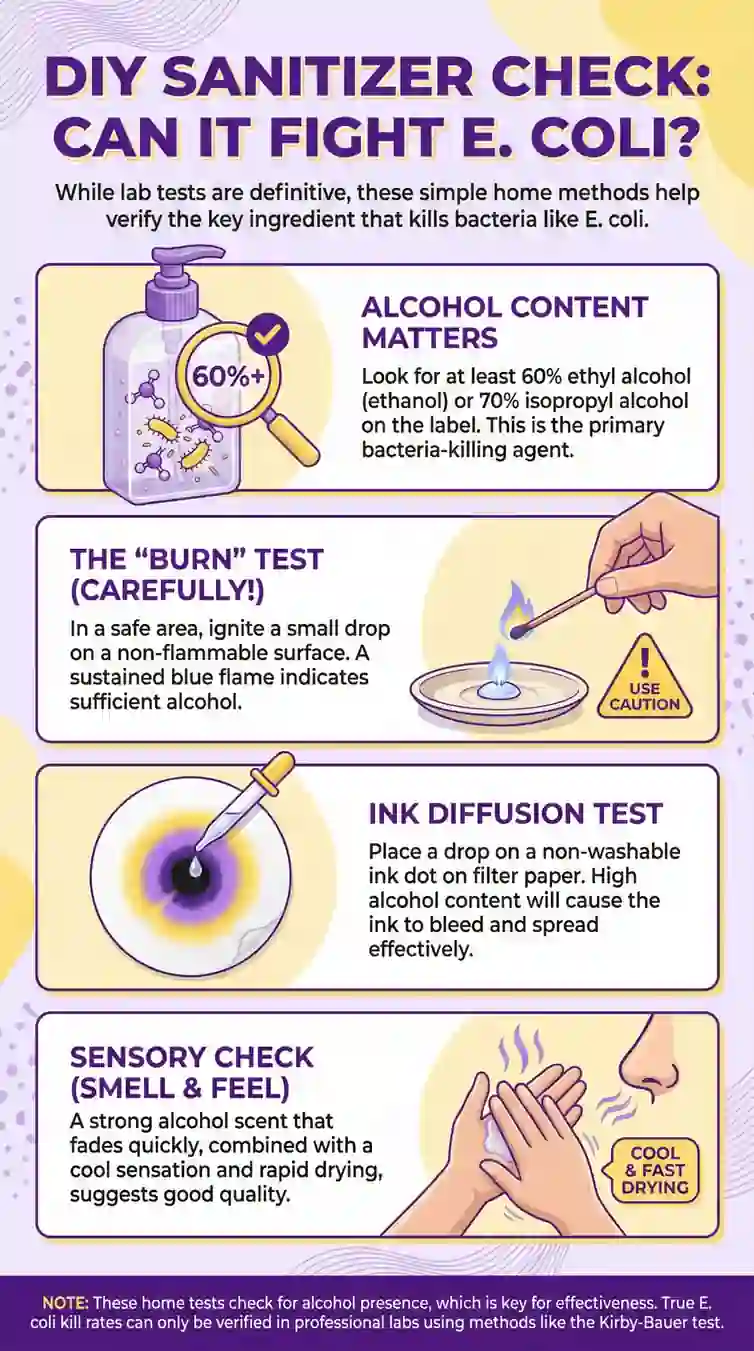
FAQ on Testing Hand Sanitizer Effectiveness Against E. Coli at Home
Q: Can I safely test hand sanitizer for E. coli at home?
A: Not with live bacteria—but you can test what actually matters.
Don't attempt: E. coli culturing requires biosafety level 2 laboratory conditions. Dangerous in the kitchen.
After 15,000+ professional lab tests, we learned better question:
Not "does this kill bacteria in controlled conditions?"
But "does this work when my kid's hands are actually dirty?"
Three safe home tests:
1. UV fluorescent coverage
Cost: $15-25 blacklight
Shows which areas missed
No bacteria required
2. Contamination challenge
Use: playground sand, sunscreen, food residue
Check if contamination remains after drying
Visual and tactile evaluation
3. Paper towel test
Use white paper towel
Wipe hands after sanitizer dries
See if contamination transfers
Our experience:
Applied FDA-approved product to daughter after petting zoo. Could feel the gritty residue remaining.
Monday lab test confirmed Saturday tactile evaluation: 35% bacterial survival.
You can't measure bacterial counts at home.
You can determine: Whether contamination remains (tells you if bacteria likely survived).
Q: What does UV fluorescent testing actually reveal about E. coli protection?
A: Shows where sanitizer never reached—exactly where bacteria survive.
What we discovered testing ourselves:
Applied exactly 3 mL to daughter:
We're doctors
We manufactured the product
Deliberately focused on complete coverage
UV revealed we completely missed:
Entire left thumb
All five fingertips on both hands
Spaces between fingers
Exact areas CDC warns professionals miss.
Tested dozens of times. Never achieved complete coverage once.
Why this matters:
If sanitizer doesn't reach an area, it can't kill bacteria there.
The insight:
UV shows where sanitizer never contacted. Bacteria definitely survived in dark spots.
Limitation:
Only reveals coverage on clean hands. Doesn't show if sanitizer works when contamination is present.
Need contamination challenge testing too.
Q: How do I perform a contamination challenge test to see if sanitizer works on dirty hands?
A: Apply sanitizer to contaminated hands, check if residue remains.
Why this matters:
265,000+ annual U.S. E. coli infections during contaminated-hand activities. The laboratory uses "recently washed" hands. This tests actual exposure conditions.
Simple 4-step process:
Step 1: Choose realistic contamination
Playground sand (most common)
Potting soil (outdoor play)
Sunscreen (beach days)
Food residue (sticky hands)
Step 2: Contaminate clean hands thoroughly
Step 3: Apply sanitizer per instructions
Step 4: Check results
Can you still:
See contamination?
Feel gritty/oily/sticky texture?
Smell food residue?
If yes = contamination remained = bacteria likely survived.
Our testing results:
Petting zoo:
Applied 3 mL perfect technique
Hands still felt gritty
Visible barn dust remained
Lab test: 35% bacterial survival
Playground sand:
Gritty texture persisted
Paper towel showed brown transfer
Sunscreen:
Oily feel remained
White residue visible
Key finding:
If you can detect contamination after sanitizer dries (see, feel, smell), bacteria likely survived.
Q: What does the paper towel test tell me about real-world E. coli protection?
A: Whether bacteria-laden contamination stays on hands or gets removed.
CDC finding: Credits 30% reduction in diarrheal illness to physical removal, not killing.
Simple 4-step test:
1. Contaminate hands (dirt, sand, food residue)
2. Apply sanitizer (follow instructions)
3. Wipe with white paper towel
4. Examine towel
Results interpretation:
Clean towel = Product removed contamination (bacteria likely removed)
Dirty towel = Contamination remained (bacteria likely survived)
Our comparison after manufacturing 2+ million bottles:
Traditional alcohol sanitizer:
Paper towel showed significant brown dirt
Contamination remained on hands
Sanitizer dried around contamination layers
Removal-based approach:
Paper towel showed clumped particles
Hands felt cleaner
Visible contamination lifted away
What this revealed:
A simple paper towel test showed what laboratory protocols couldn't.
Our FDA-approved products left contamination on hands.
Key insight:
If contamination stays, bacteria are within it.
Label claims about killing don't matter if the mechanism can't reach bacteria.
You don't need bacterial cultures.
White towel showing brown dirt after sanitizer = protection didn't happen.
Q: My sanitizer passed all home tests—does that mean it kills E. coli effectively?
A: Home tests reveal different effectiveness than laboratories—both matter, answer different questions.
What home tests tell you:
UV coverage test:
Which areas you missed
Why products fail with imperfect application
Contamination challenge:
Whether it works when hands dirty
Performance during 265,000+ annual infections
Paper towel test:
Whether contamination removed
If bacteria-laden residue stays
What home tests DON'T tell you:
Exact bacterial counts
Precise log reduction
Laboratory compliance
Our two-year manufacturing experience:
Passed:
Every FDA test
Every ASTM protocol
Every laboratory standard
Failed:
Simple home contamination challenge
Could feel barn dust remained
Both tests revealed truth:
Laboratory testing:
Killed 99.9% of E. coli on recently washed hands
Home testing:
Left contamination on dirty hands where bacteria survived
If your sanitizer passes home tests:
Works when contamination present
Removes bacteria-laden residue
Predicts real-world protection
If your sanitizer fails home tests:
Leaves contamination visible/tactile
Shows dirt transfer to paper towel
Optimized for clean hands, not dirty hands
Bottom line:
Home tests reveal what laboratory protocols exclude: whether sanitizer works when a child's hands are actually dirty.
That's the effectiveness laboratories can't measure.
That's protection families actually need.