TL;DR Quick Answers
Junk Removal Nassau County
Junk removal in Nassau County means a crew comes to your home or business, hauls away what you no longer want, and leaves the space clean. At Jiffy Junk, we take the whole job off your hands, from a single couch to a full-property cleanout, so the heavy lifting is never yours.
We do it all ourselves. Our team carries everything out of the attic, basement, garage, or office. You never drag a thing to the curb.
Fast turnaround. Same-day and next-day pickup across most of Nassau County.
Upfront pricing. Free, no-obligation estimate online or in person, priced by how much space your items fill.
Licensed and insured. Your property stays protected from the first knock to the last load.
Greener by default. We donate and recycle first, sending only what's left to the landfill.
Top Takeaways
Get the certificate of insurance in hand before work starts, covering general liability and workers' comp.
Insist on written, volume-based pricing so the cost holds from quote to final invoice.
Favor crews with real commercial references for office, retail, or property turnovers.
Lock in a pickup window that fits your business hours, including evenings or weekends.
Ask where your material ends up. In Nassau County, responsible disposal means knowing the town transfer station, the recycler, or the donation route.
What to Look for in a Commercial Cleanout Company
A commercial cleanout isn't a bigger version of clearing out the garage. The job runs on deadlines tied to leases and closings. It brings building rules into play, like loading docks and freight-elevator windows. And it carries real liability the moment a worker steps on site. The right company absorbs all of that so you never have to manage it for them. Here's what we'd tell you to check before you sign anything.
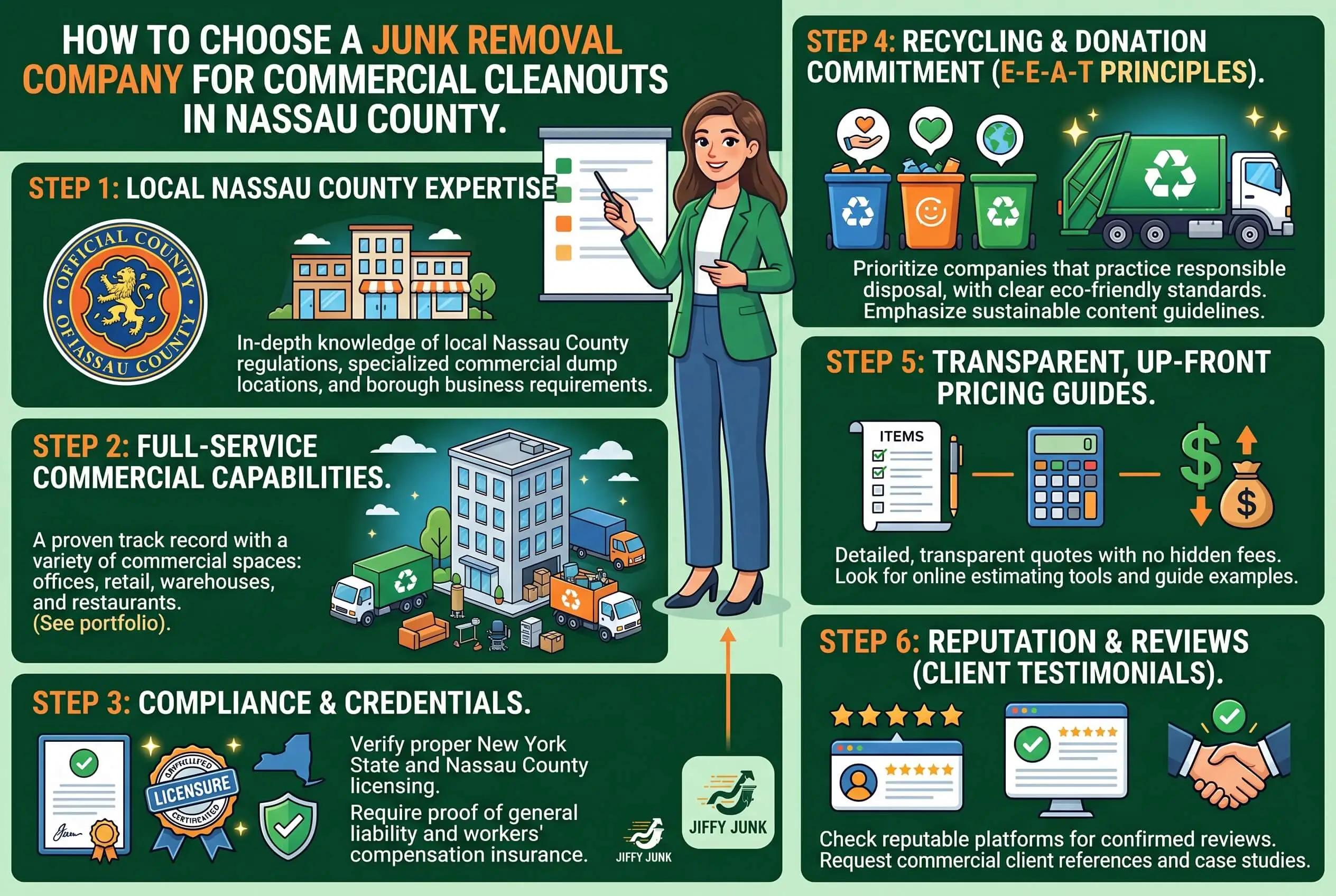
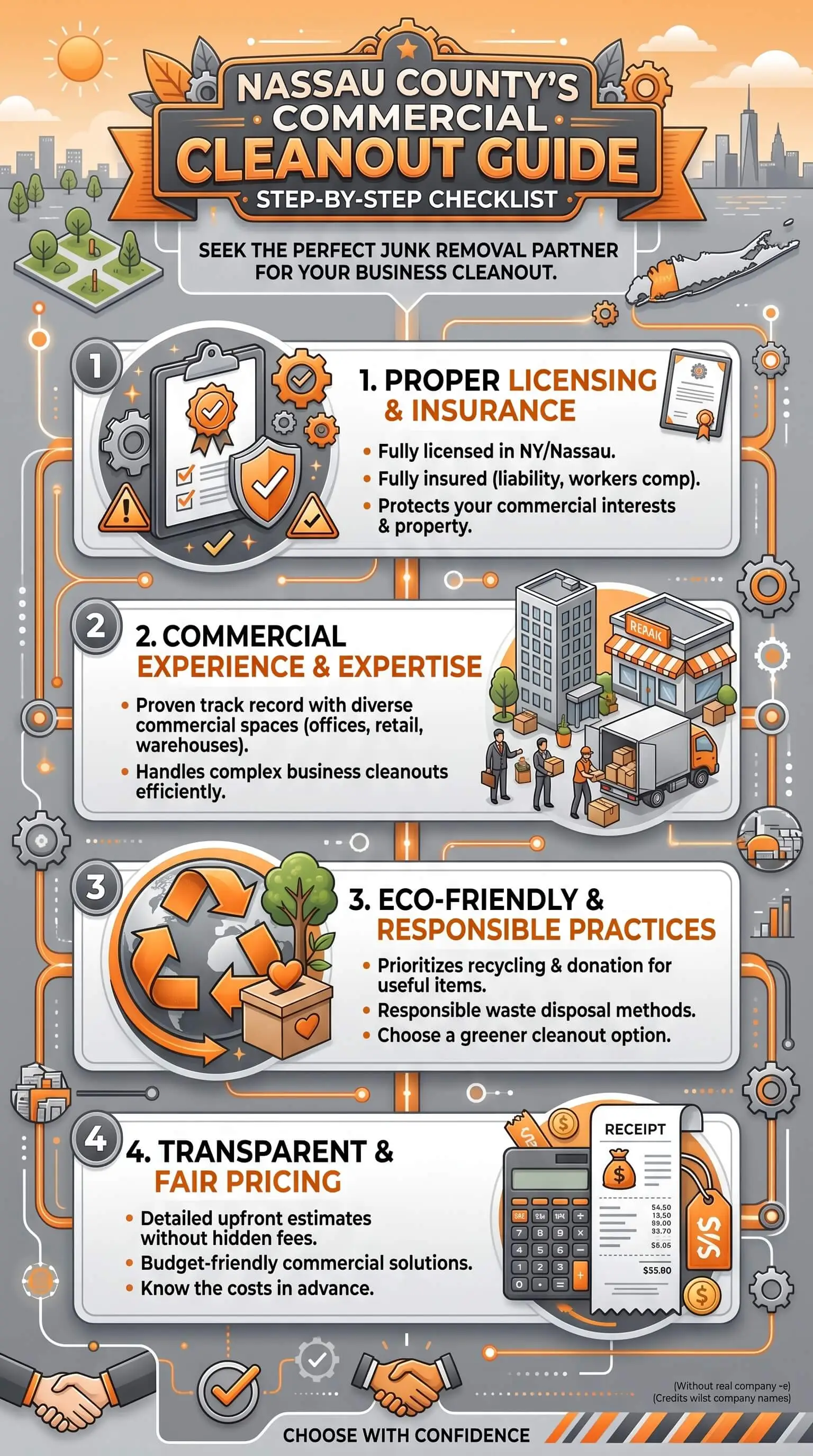
Licensing and insurance. Ask for a certificate of insurance covering general liability and workers' comp before anyone lifts a box. That paperwork protects your property and your business, not just theirs.
Real commercial experience. Office, retail, and property-turnover jobs come with quirks a residential-only crew won't see coming. Ask for references from work like yours.
Pricing you can see up front. The companies worth hiring price by volume, the share of the truck your material fills, and put that number in writing so it holds once the truck arrives.
Scheduling that respects your hours. Plenty of businesses need an early-morning, evening, or weekend window so the work never interrupts staff or customers. Confirm it before you book.
Responsible disposal. A good crew sorts for donation and recycling first, and can tell you exactly which transfer station or recycler your material is headed to.
A crew and truck sized to the job. Volume, stairs, tight access, and heavy items all change what the work takes. Make sure the team matches the scope.
A clear scope. Know what they will and won't haul. Electronics, paint, and certain construction debris follow separate rules.
One more thing that's easy to miss: Nassau County's three towns each run their own disposal systems, and the rules shift from town to town and even between sanitary districts. For junk removal Queens projects that involve crossing into Nassau County, local disposal rules can change fast. Drop a container on a public street and you may need a permit first. A junk removal Queens service that already knows the local transfer stations and the access headaches moves faster and cleaner than one figuring it out on your clock.
What We've Learned on the Job
The lessons that matter never came from a brochure. They came from the cleanouts that almost went sideways.
"The biggest mistake we see businesses make is treating a cleanout like a favor instead of a contract. Ask for the certificate of insurance before the truck shows up, not after. We've watched that one document turn a tense handoff into a smooth one more times than we can count. The crews worth hiring expect the question. We hand you the COI without being asked, we price by volume in writing, and we tell you which transfer station or recycler your old furniture is going to. When a company gets cagey about any of those three, that vagueness is your answer."
7 Essential Resources
Before you hire anyone, get familiar with where your material can legally go. These are the official sources we check when we plan a Nassau County cleanout.
Town of Hempstead Department of Sanitation — disposal sites, special-pickup rules, and electronics handling for the county's largest town.
Town of North Hempstead Solid Waste Management — transfer-station drop-off, recycling guidance, and hazardous-waste programs.
Town of Oyster Bay Environmental Resources – Recycling — the Old Bethpage disposal complex, recycling, and S.T.O.P. collection details.
New York State's Solid Waste Program (NYSDEC) — how the state defines C&D debris, and what actually counts.
NYSDEC: Construction & Demolition Debris Handling and Recovery Facilities — how permitted C&D facilities operate, handy when you want to know where a hauler dumps.
EPA: Sustainable Management of Construction and Demolition Materials — practical ways to keep renovation and demolition debris out of landfills.
EPA: National Overview on Materials, Wastes and Recycling — the national picture on what gets made, recycled, and buried.
Supporting Statistics
Renovation and demolition throw off serious tonnage. The EPA estimates about 600 million tons of C&D debris hit the U.S. waste stream in 2018, more than double the country's household trash. Where your hauler takes all that matters as much as how fast they load it.
Old office furniture clogs landfills. Americans threw out roughly 12.1 million tons of furniture and furnishings in 2018, sending about 80% to landfills, according to the EPA. A crew that donates and recycles keeps usable desks and chairs in service instead of in a hole, while also reducing the clutter that can attract pest control problems.
Locally, debris leads the pile. NYSDEC reports New York State generated about 42.2 million tons of total waste in 2018, with C&D debris the single largest share at 46%. A hauler that reuses and recovers material directly shrinks what gets buried.
Final Thought & Opinion
If we had to boil this down to one rule, here it is: hire the company that's straight with you before you've paid a cent. The certificate of insurance, the written volume-based quote, and a real answer about where your stuff goes are the floor you should expect, not a premium add-on. The cheapest bid often turns into the priciest job once you add up change orders, a scuffed corridor, and a deposit the landlord won't return. In a county where the rules change block by block, local know-how earns its keep. Hire the crew that treats your deadline like their own.
Frequently Asked Questions
How do I choose a commercial junk removal company in Nassau County?
Look for five things: proof of licensing and insurance, real commercial references, written volume-based pricing, scheduling that fits your hours, and a clear plan for donation and recycling. A crew worth hiring answers all five without dodging.
What's the difference between commercial and residential junk removal?
Commercial jobs usually mean bigger volumes, deadlines tied to leases or renovations, building rules like loading docks and freight elevators, and a real need for liability and workers' comp coverage. Residential work tends to be smaller and more flexible.
Should a junk removal company be licensed and insured for commercial work?
Yes. Ask for a certificate of insurance naming general liability and workers' comp before the job starts. Without it, you're exposed if a worker gets hurt or your property takes damage.
How is commercial cleanout pricing calculated?
Most reputable crews price by volume, the share of the truck your material fills, plus labor, access difficulty, material type, and disposal fees. Get the estimate in writing so the number holds.
Can junk removal companies work around business hours in Nassau County?
Many do, with early-morning, evening, and weekend windows for offices and retail spaces. Confirm after-hours availability and any added cost when you ask for your quote.
What happens to the items after a commercial cleanout?
A responsible crew sorts for donation, recycling, and proper disposal, and can tell you which transfer station or recycler takes your material. That matters for the environment and for your own records.
Ready to Clear the Space?
You've got better things to do than wrangle a cleanout. Get a free, no-obligation estimate online or by phone, confirm the certificate of insurance, and pick a window that works around your hours. Our Nassau County crew shows up on time, does the heavy lifting, and leaves the space broom-clean. No mess. No stress. That’s what you should expect from a top junk removal company.