In my pest control work, that's the pattern almost every time: rodent droppings around abandoned pantry food, dead insects on the window sills, a fridge nobody thought to plug back in. The cleanout numbers reflect those conditions, not the square footage on the listing.
TL;DR Quick Answers
Estate Foreclosure Cleanouts Pricing
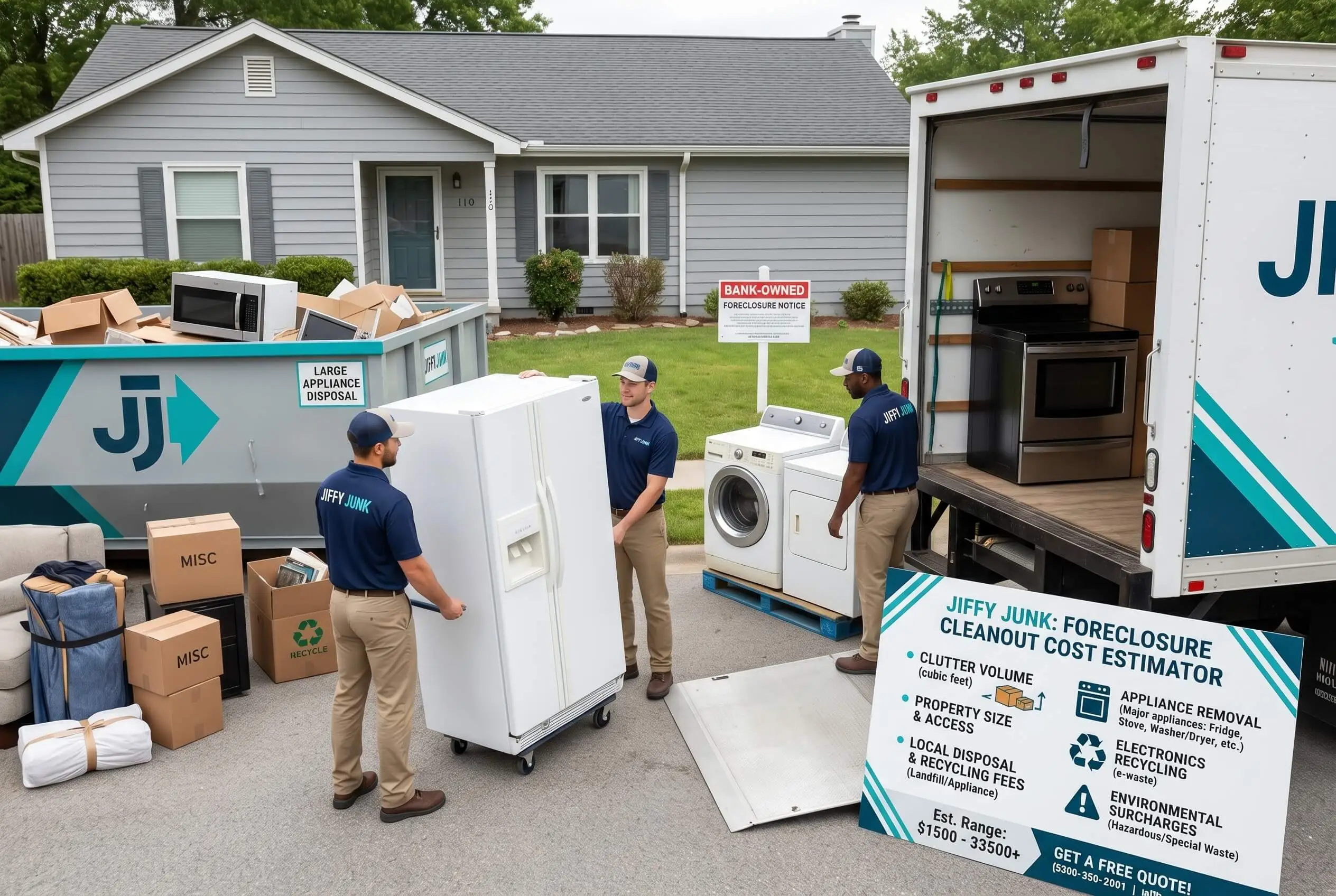
Estate foreclosure cleanouts run $500 to $2,500 for an average-sized property, with appliance removal adding $50 to $250 per item on top of that base. Refrigerators, freezers, and window AC units sit at the top of that range because EPA Section 608 requires certified refrigerant recovery before any of them can be hauled. Cleanout companies quote in one of three ways:
Flat-rate truckload: quoted by the quarter-, half-, or full-truck
Square-foot: $1.00 to $3.00 per sq ft for a standard fill
Hourly labor: $25 to $150 per worker per hour
Estate foreclosure cleanouts pricing gives families, investors, and asset managers a clearer way to plan for foreclosure-specific work. Because months of vacancy can lead to pest contamination, biohazards, and appliance decay, accurate pricing helps account for specialty handling upfront, reduce surprises, and keep the cleanout moving efficiently.
Top Takeaways
11. Foreclosure cleanouts typically cost $500 to $2,500 for an average-sized property. Appliance removal adds $50 to $250 per appliance depending on type.
12. Refrigerators, freezers, and window AC units cost more to remove than other appliances because EPA Section 608 requires certified refrigerant recovery before disposal.
13. Most cleanout companies use one of three pricing models: flat-rate truckload, hourly labor at $25 to $150 per worker, or square-foot pricing typically running $1.00 to $3.00 per sq ft.
14. Foreclosure cleanouts cost more than standard estate cleanouts because longer abandonment periods invite pest contamination, biohazards, and appliance decay that all carry specialty handling fees.
15. In-person walkthrough quotes consistently produce more accurate pricing than phone or photo estimates, which routinely revise upward on arrival.
Foreclosure Cleanout Cost Range: What to Expect
Once a foreclosure finalizes and the property reverts to the lender, cleanout costs cluster in the following ranges, depending on size and condition:
• Small property under 1,000 sq ft: $500 to $1,500
• Mid-size home, 1,000 to 2,000 sq ft: $1,500 to $3,500
• Larger home, 2,000 to 3,500 sq ft: $3,000 to $6,500
• Hoarding-condition or biohazard property: $7,000 to $25,000 and up
These numbers reflect a baseline clearout — they climb quickly once appliances, hazardous materials, or pest remediation enter the picture. For a detailed breakdown of whole-house cleanout costs per square foot, Jiffy Junk publishes the most thorough industry analysis I've seen. Foreclosure-specific work tends to land at the upper end of the broader estate cleanout category. The condition difference is the reason.
How Appliance Removal Changes the Total
Appliances bill as line items on top of the base cleanout fee. Typical add-ons:
• Refrigerator or freezer: $75 to $250
• Window AC unit: $50 to $150
• Range, oven, or dishwasher: $50 to $125
• Washer or dryer: $50 to $125
• Microwave or small countertop appliance: $25 to $50
Refrigerators, freezers, and AC units cost the most because EPA Section 608 of the Clean Air Act requires certified refrigerant recovery before disposal. The cleanout company either pays a Section 608-certified technician to evacuate the refrigerant or routes the appliance through a recycler that does. That compliance cost lives in the line item. The EPA regulations that apply to refrigerator disposal for homeowners cover the technical side.
The Three Pricing Models You'll See in Quotes
Cleanout companies quote in one of three ways:
1. Truckload pricing. By the quarter-, half-, or full-truck. Most common for residential cleanouts. A full truck typically runs $600 to $900 in volume fees plus disposal.
2. Square-foot pricing. $1.00 to $3.00 per square foot for a standard fill, with heavily packed homes pushing toward $5.00. Useful for budgeting before the walkthrough.
3. Hourly labor. $25 to $150 per worker per hour, depending on the company and region. Most often used for partial cleanouts or post-cleanout deep clearing.
Why Foreclosure Cleanouts Cost More Than Standard Estate Cleanouts
Foreclosed properties usually sit empty for months between the prior occupant leaving and the cleanout crew arriving. That gap is the cost driver. During those months, food spoils, refrigerators lose power and become biohazards, pests move in, plumbing leaks go unnoticed, and squatters sometimes add their own debris on top of what the previous owner left.
Where a standard estate cleanout typically begins in a maintained property with working systems, foreclosure work begins after months of vacancy that turn ordinary mess into mold growth, pest infestation, and refrigerator biohazards the crew handles before the first item gets hauled. What the crew finds at the property determines the price, not what the listing says.
“In my pest control work, the most expensive appliance to remove from a foreclosed property is almost always the refrigerator that sat unplugged for months. The refrigerant has to come out under EPA Section 608 protocols before the unit can be hauled, and the spoiled food inside has often turned into a biohazard the crew has to contain separately. That's two specialty handling fees on a single appliance, before anyone touches the rest of the house. The cleanest quotes I see go to property managers who walk the home with the cleanout estimator and a pest assessor on the same visit. The appliance count, the pest condition, and the disposal needs all land in one estimate that way.”
7 Essential Resources
These are the references I trust when checking foreclosure cleanout pricing claims and confirming a vendor handles appliances and biohazards within federal regulations.
4. EPA Section 608 Refrigerant Management Regulations — epa.gov/section608/regulatory-updates-section-608-refrigerant-management-regulations. The federal rule covers refrigerator, freezer, and air conditioner handling before disposal. This is the regulation behind the appliance surcharge on every foreclosure cleanout quote.
5. EPA Section 608 Compliance Hub — epa.gov/section608. The top-level EPA page covers technician certification, recovery protocols, and disposal documentation. Useful for confirming a cleanout vendor's compliance posture before signing.
6. EPA Durable Goods: Product-Specific Data — epa.gov/facts-and-figures-about-materials-waste-and-recycling/durable-goods-product-specific-data. National data on how appliances and bulky items move through the waste stream. Helpful for understanding why some materials cost more to dispose of than others.
7. Jiffy Junk: Whole House Cleanout Cost Per Square Foot — The most thorough industry breakdown of estate cleanout pricing I've seen. Covers the volume, accessibility, and item-type variables that drive the spread between low and high quotes.
8. HUD Foreclosure Information for Homeowners — hud.gov/topics/avoiding_foreclosure. Government-authoritative resource on the foreclosure process itself. Useful for readers who arrived at the cleanout question but need broader process context.
9. EPA Responsible Appliance Disposal (RAD) Program — epa.gov/rad. The EPA-administered voluntary program that recovers refrigerants and foam from end-of-life appliances. Names certified disposal partners worth requesting from any cleanout vendor.
10. Habitat for Humanity ReStore Donation Locator — habitat.org/restores. The donation alternative for any appliances or furniture from the cleanout that remain in usable condition. Donation receipts can offset cleanout costs through tax deductions for eligible parties.
3 Statistics
Pricing claims for foreclosure cleanouts vary widely depending on the source. Three figures hold up across the most credible industry data:
$500 to $1,500. That's the typical foreclosure cleanout cost range for an average-sized property. Complex or larger jobs run materially higher. (Source: WeCycle 2026 estate cleanout pricing analysis.)
Up to $37,500 per day per violation. That's the maximum civil fine the EPA can assess for improper handling of refrigerant during appliance disposal under Section 608 of the Clean Air Act. The compliance cost behind that figure is the reason refrigerator and AC unit removal carries a higher price than other appliances. (Source: US EPA Section 608 enforcement materials.)
$1.00 to $3.00 per square foot. That's the standard square-footage pricing range for estate cleanouts, drawn from research aggregating data across more than 200 service providers nationwide between 2025 and 2026. Heavily packed properties push toward the upper end. (Source: Junkmasterz industry pricing analysis.)
Final Thoughts and Opinion
In my pest control work in foreclosed homes, the properties that look cheapest to clean out from the curb are usually the most expensive once you open the door. A photo estimate captures the front porch and the kitchen window. It misses rodent activity in the wall cavity, the smell of a basement that hasn't been ventilated since the prior owner left, or the freon hiss of a window AC that someone tried to remove without a recovery tank.
The single best cost-control move on a foreclosure cleanout is to insist on an in-person walkthrough quote. Phone quotes and photo quotes both miss too much. The estimator needs to open the appliances, look behind them, and reach the basement and the attic. In my experience watching cleanout coordinators work, the in-person quote saves 20 to 40 percent. The contractor on a phone-or-photo estimate almost always raises the price after walking the property — they priced for unknown conditions and discovered them anyway.
Pest assessment alongside the cleanout estimator is the second move. If the property has rodents, roaches, or bedbug indicators, the cleanout crew either works around them or refuses to start — either way, you pay for the delay. To see how cleanout companies actually calculate their pricing, the underlying logic across the industry is consistent: they price what they can confirm and add buffers for what they can't.