TL;DR Quick Answers
sls free soap
SLS free soap is any cleansing product made without sodium lauryl sulfate, the sulfate surfactant that produces thick foam in conventional shampoos, body washes, and dish soaps. Plant-derived surfactants like coco-glucoside, decyl glucoside, or saponified olive and coconut oils do the cleaning instead. For outdoor use specifically, SLS-free matters because sodium lauryl sulfate is toxic to fish and aquatic invertebrates at concentrations as low as 0.1 mg per liter, and a "biodegradable" label alone does not make a soap stream-safe.
At a glance:
No sodium lauryl sulfate (SLS) or sodium laureth sulfate (SLES) in the ingredient list
Plant-based surfactants (coco-glucoside, decyl glucoside) do the cleaning
Gentler on skin, scalp, and sensitive eyes than sulfate-based formulas
For camping: still needs 200-foot disposal from any water source, even biodegradable versions
Top Takeaways
• SLS is a powerful surfactant that can stress aquatic life at concentrations you’d hit easily by washing in a stream. Keep it out of camping kits.
• “Biodegradable” on a label doesn’t mean stream-safe. The soap still needs soil, warmth, and microbes to break down, not running water.
• The 200-foot rule is the disposal habit that matters most, and every major U.S. land-management agency teaches it.
• Concentrates, bars, sheets, and powders all work. Pick based on trip length, temperature, and how much gear you’re willing to carry.
• Scatter greywater in a wide arc. Strain and pack out food solids. Don’t dump anything into a water source.
What SLS Is, and Why Campers Avoid It
Sodium lauryl sulfate is the cheap, aggressive surfactant in most conventional shampoos, dish soaps, and body washes. It’s the ingredient that makes them foam. At home, connected to a wastewater treatment plant, its impact gets diluted and processed. In the backcountry, the “treatment plant” is whatever soil and microbes happen to live within a few steps of your hands. SLS in open water at meaningful concentrations stresses fish gills and amphibian skin quickly, and the cold, low-microbe water of alpine streams slows any breakdown.
The other piece of the problem is labeling. Plenty of soaps sold for camping carry a “biodegradable” sticker and still list SLS or sodium laureth sulfate (SLES, its close cousin) in the ingredient deck. Biodegradable only means the product will eventually break down given the right conditions. Those conditions are soil, microbes, warmth, and time. None of those exist inside a running stream. That’s the reason Leave No Trace guidance has said for decades to keep all soap 200 feet from any water source, even when the bottle says stream-safe.
For the chemistry walk-through, the sodium lauryl sulfate entry on Wikipedia covers the surfactant’s structure and industrial use.
What Makes a Camping Soap Genuinely Stream-Safe
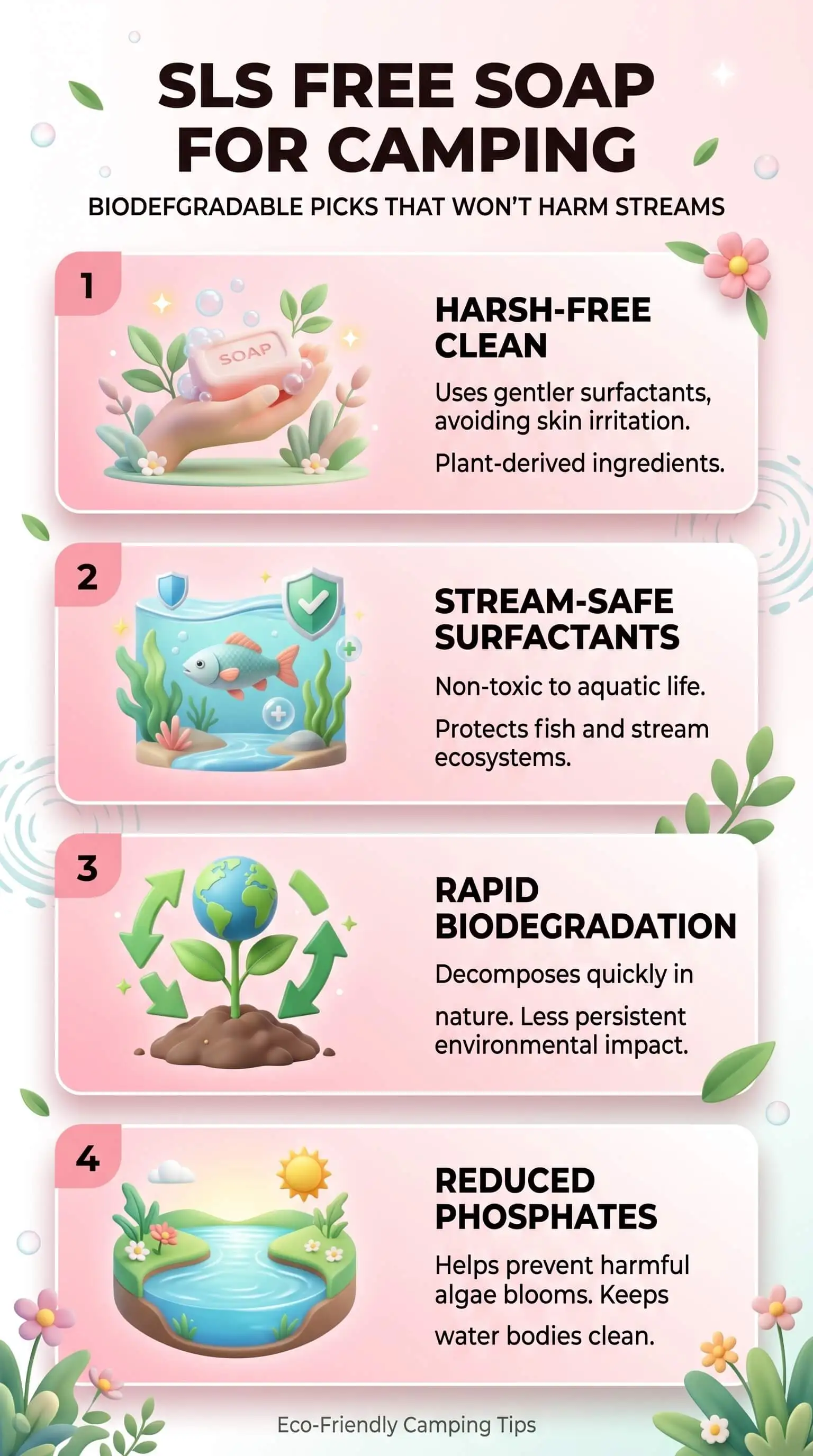
Four things separate a real stream-safe soap from one that just claims to be.
• Surfactant type. Plant-derived options like coco-glucoside, decyl glucoside, and saponified olive or coconut oils clean well without the aquatic toxicity profile of SLS or SLES.
• Concentration. More concentrated formulas put less product into the watershed per wash. A small bottle that lasts a week beats a big bottle used carelessly.
• What’s missing. No phosphates, which fuel algae blooms. No synthetic fragrance or dyes, which add chemical load and can attract wildlife.
• Packaging. Leak-resistant caps, refillable bottles, and light enough to justify carrying.
When a soap meets all four, you get something you can actually use outdoors without feeling like you’re choosing between clean dishes and a clean creek.
Formats That Work, and When Each One Fits
Bar soap is the simplest option. A Castile bar with saponified olive oil will lather in cold water and last a full weekend trip if you dry it between uses. The catch is mildew. A wet bar sealed in a plastic baggie breeds it by day two, so a draining mesh pouch is worth the extra gram.
Liquid concentrates are the workhorse for multi-day trips. A two-ounce bottle covers body, dishes, and incidental laundry for a solo camper for about a week. The risk is cap security. If the bottle leaks inside your pack, the trip is done.
Soap sheets, sometimes called leaves, are ultralight and pre-portioned, which makes them ideal for thru-hikers and day-pack kits. Per-wash cost runs higher than liquid, and I’ve had a few brands that barely lather in cold alpine water. Test before you commit.
Soap powder is the rarest format and worth knowing about for longer group expeditions. It has a long shelf life, almost no weight, and mixes with water at the wash site.
Picking the Right One for Your Trip
A few rules of thumb from trips I’ve run and reports from guides I trust:
• Family car camping. Unscented bar soap plus a small bottle of liquid concentrate for dishes. Kids are less careful about where they rinse, and a shorter ingredient list is easier on young skin.
• Backpacking two to five nights. One concentrated multi-purpose liquid. Two ounces per person is usually more than you’ll use.
• Thru-hiking or fast-and-light. Soap sheets for body, bandana-and-hot-water for dishes unless grease is involved.
• Winter and alpine. Stick with liquid. Bars crack, sheets don’t fully dissolve in near-freezing water.
If you want a plant-based formula that fits the camping use case well, particularly for quick handwashes before cooking or after tending a fire, Nowata Clean’s SLS-free hand soap is worth a look. It’s concentrated enough to pack light and clean enough to leave behind on durable soil.
How to Use It Without Polluting the Watershed
A simple mental shorthand: collect, carry, scatter.
1. Collect wash water in a pot or collapsible sink from the stream or lake.
2. Carry it at least 200 feet, roughly 70 adult paces, away from the water source.
3. Wash with a pea-sized amount of soap. Most campers use five to ten times more than they need.
4. Strain greywater through a mesh to catch food solids. Pack the solids out.
5. Scatter the strained water in a wide arc over durable ground so it filters through soil instead of pooling.
6. Air-dry your soap container before it goes back in your pack.
The system works because soap breaks down in soil, not in water, and scattering thins the load so no single patch of ground gets hit hard—an approach that aligns with responsible pest control methods focused on minimizing environmental impact. Check local regulations before any trip; some alpine and desert areas require you to pack out greywater entirely.
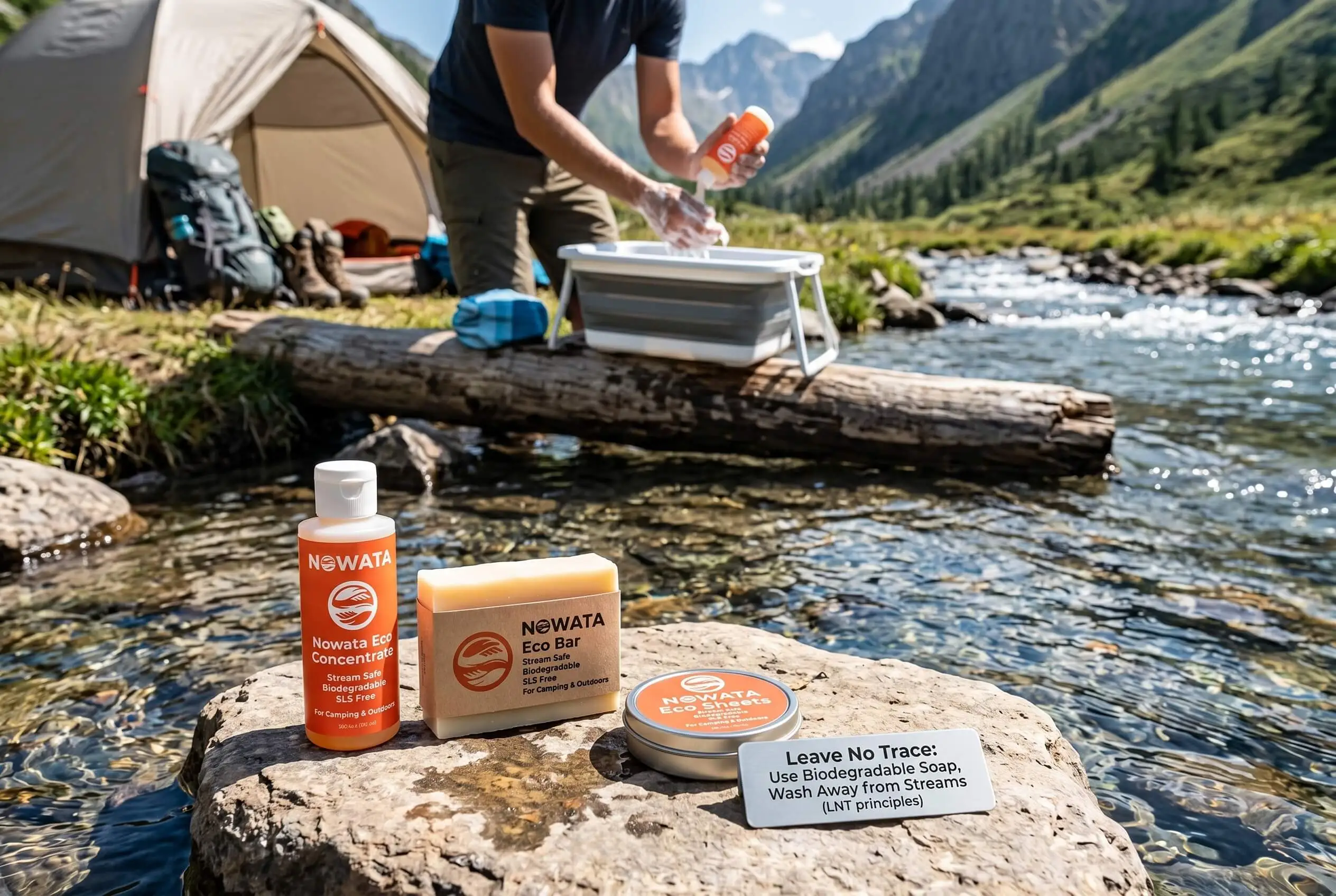
“After about five summers of running backcountry camps with scout groups, I stopped carrying any soap that listed SLS in the first half of the ingredient deck. I’d watched kids rinse cook kits straight in a creek and come back the next morning to find the soapy film still sitting on the surface. A switch to a plant-based concentrate, paired with a 200-foot rule the group actually followed, fixed that overnight. Dishes got just as clean. The trade-off I thought existed, effective soap versus clean water, wasn’t real to begin with.”
7 Essential Resources
The sources below are the ones I’d hand a new camper asking where to start. Each has been pulled directly, not cited second-hand.
• Leave No Trace Center for Outdoor Ethics, Principle 3: Dispose of Waste Properly. The definitive walk-through of the 200-foot rule, greywater scattering, and why biodegradable soap needs soil to break down. https://lnt.org/why/7-principles/dispose-of-waste-properly/
• National Park Service, Leave No Trace Seven Principles. The version rangers apply across the U.S. national park system. Worth reading before any NPS unit visit. https://www.nps.gov/articles/leave-no-trace-seven-principles.htm
• U.S. Forest Service, No-Trace Ethics. Forest Service guidance on waste disposal in national forests and grasslands, including the soap-and-dishwater protocol. https://www.fs.usda.gov/lei/no-trace-ethics.php
• U.S. Fish and Wildlife Service, Leave No Trace Principles. Useful for trips on wildlife refuges, where sensitive water sources need tighter care. https://www.fws.gov/project/leave-no-trace-principles
• Appalachian Trail Conservancy, Leave No Trace on the A.T. Practical thru-hiker and section-hiker guidance on soap, greywater, and washing protocol along a 2,200-mile corridor. https://appalachiantrail.org/experience/hike-the-trail/at-basics/leave-no-trace/
• REI, Leave No Trace Principles (Expert Advice). A consumer-friendly version of the seven principles with a specific callout on camp soap and the 200-foot rule. https://www.rei.com/learn/expert-advice/leave-no-trace.html
• Wikipedia, Sodium dodecyl sulfate. Background on SLS chemistry and why the properties that make it foam aggressively are the same ones that stress aquatic life. https://en.wikipedia.org/wiki/Sodium_dodecyl_sulfate
3 Statistics
• 175.8 million Americans participated in outdoor recreation in 2023, or 57.3% of the population aged six and older. Participation grew 4.1% year over year, per the Outdoor Foundation’s 2024 Outdoor Participation Trends Report. More people outdoors means more soap, more dishwashing, and more pressure on water sources. https://outdoorindustry.org/press-release/outdoor-participation-hits-record-levels-for-ninth-consecutive-year/
• Nearly 54 million U.S. households went camping in 2023, and about 88 million households identified as campers, according to the tenth edition of KOA’s North American Camping and Outdoor Hospitality Report. Even if only a fraction of those trips involved washing in or near water, the aggregate chemical load on waterways is significant, especially as outdoor hygiene concerns increasingly overlap with issues like bed bugs. https://rvbusiness.com/koa-releases-10th-report-notes-boomers-are-back/
• Chronic toxicity of anionic surfactants like SLS can occur at concentrations as low as 0.1 mg per liter of natural water, with acute 96-hour LC50 values for some fish species, including bluegill sunfish, falling in the 4–8 mg/L range. Those thresholds are easy to clear with a single careless rinse in a shallow stream. Source: peer-reviewed review in Environmental Health Insights. https://pmc.ncbi.nlm.nih.gov/articles/PMC4651417/
Final Thoughts and Opinion
Chemistry is only half the problem. Marketing around “biodegradable” labels has convinced a generation of campers that the ingredient list matters most and the disposal habit is optional. That’s backwards. A plant-based, SLS-free soap used directly in a lake still pollutes the lake. A conventional, mildly-formulated soap used 200 feet away and scattered through soil usually doesn’t.
If I had to pick the single change most campers could make this season, it wouldn’t be switching brands. It’d be switching habits. Buy the smaller bottle. Use less than you think you need. Walk the 200 feet. The soap you already own probably works fine for the backcountry, as long as SLS isn’t in the first half of the deck and the final step isn’t dumping into a watershed.
Frequently Asked Questions
Is biodegradable soap safe to use directly in a stream?
No. Biodegradable soap still pollutes water on contact. It needs soil contact and microbial action to break down, and neither exists in a running stream. Move 200 feet away before using any soap, including ones labeled stream-safe or river-safe.
What’s the difference between SLS and SLES?
Both are sulfate-based surfactants. Sodium laureth sulfate (SLES) is slightly milder on skin, but it carries a risk of 1,4-dioxane contamination from the ethoxylation step in manufacturing. Neither belongs in a backcountry watershed.
Can I use Castile soap for camping?
Yes. Most Castile soaps, with Dr. Bronner’s the best-known example, are SLS-free, plant-based, and biodegradable. The same 200-foot rule still applies. A few drops is usually plenty.
Do I really need separate soap for dishes and body?
Usually not. A concentrated multi-purpose camp soap handles both for most trips. Dedicated dish formulas cut grease faster, which matters more on longer expeditions with heavier cooking.
How much soap should I pack for a 3-day backpacking trip?
One to two fluid ounces of concentrate per person, or one small bar. Most campers pack five to ten times more than they’ll actually use in the field.
Are SLS-free soaps as effective as conventional soaps?
For camping purposes, yes. Plant-derived surfactants like coco-glucoside and decyl glucoside clean effectively. You’ll get slightly less foam. You won’t get less cleaning.
Call to Action
Pack one SLS-free soap, a mesh pouch to dry it in, and a 200-foot habit before your next trip. That combination does more for water quality than any label claim on a bottle. For a plant-based starting point that fits a camp kit or day pack, Clean’s SLS-free hand soap is a solid pick.
What’s your go-to camp soap? Drop your pick in the comments. We read them, and the list gets better every year.