The fine on the original owner is the smaller part of the story. Penalties for
unscheduled curbside furniture run from $50 to several thousand dollars depending on the city, and a neighborhood report or HOA citation can land before the city's enforcement does. The bigger cost is what discarded furniture does in the day or two before someone hauls it off.
Can you leave furniture on the curb? In most U.S. cities, no, and even where it is permitted, the trade-offs rarely favor you. This guide covers what your city likely allows, what it does not, and the routes that move old furniture out without creating a second problem on the way out the door. For the cap on how many bulky pickups your city offers in a year, see our breakdown of curbside furniture pickup limits.
TL;DR Quick Answers
Can I leave furniture on the curb?
In most U.S. cities, no. Unscheduled curbside furniture is treated as illegal dumping under municipal code. Fines start around $50 and reach several thousand dollars depending on the jurisdiction.
The legal risk is the smaller cost. Furniture left at a curb starts attracting bed bugs, rodents, and roaches inside 48 to 72 hours. The piece your neighbor takes home often arrives with passengers.
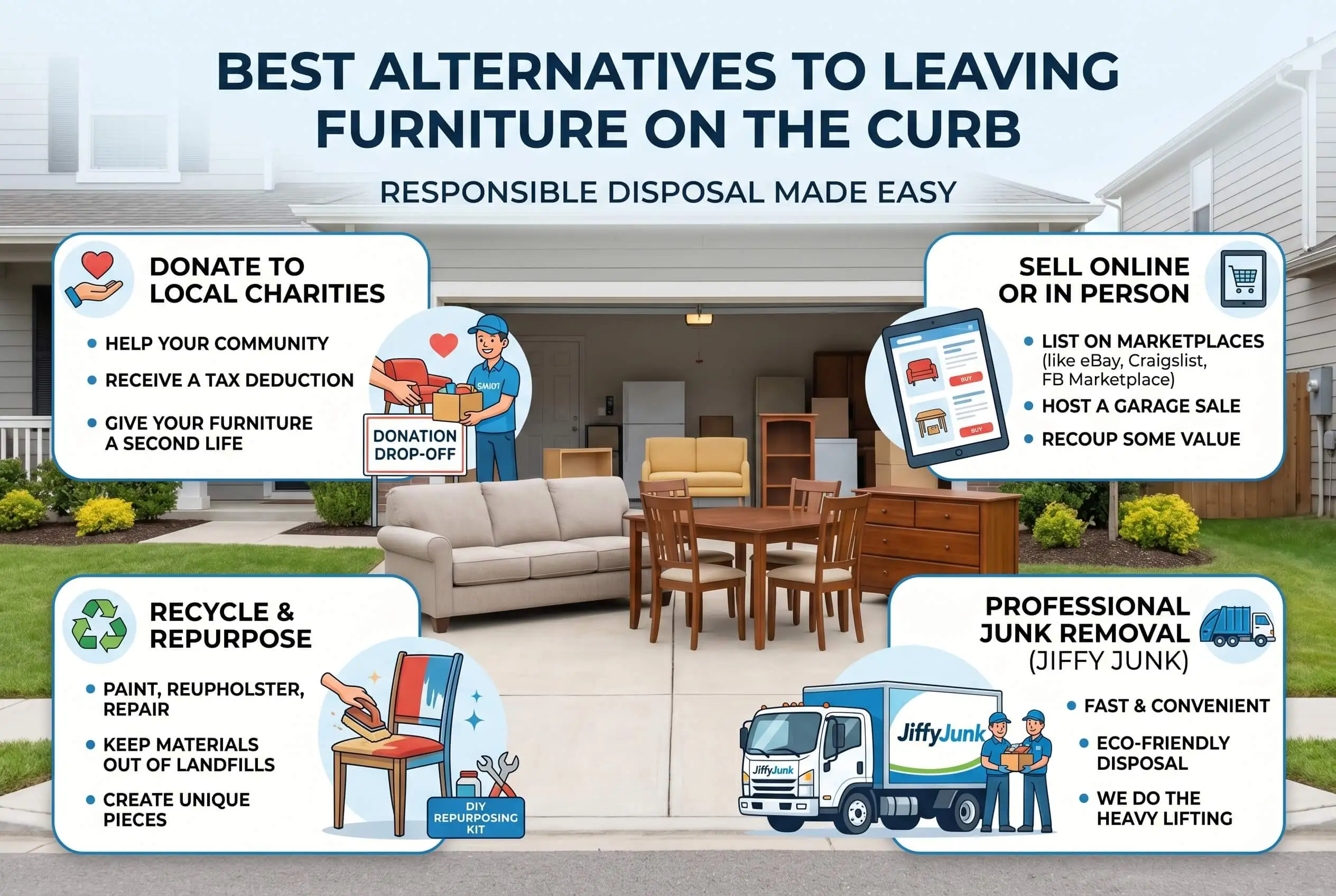
Use one of these instead:
Schedule your city's bulk-item pickup (most cities cap it at one to a few items per year)
Book a free charity pickup through Habitat for Humanity ReStore, The Salvation Army, or Goodwill
Donate through the Furniture Bank Network for placement with families in transition
Hire paid junk removal ($75 to $300 per bulky item, hauled from inside the home)
List it for resale on Facebook Marketplace, Craigslist, or OfferUp
The exception: A handful of cities allow curbside placement on scheduled bulk-pickup days only, with a tag or sticker attached. Check your sanitation department's website before assuming the rule applies to your block.
Top Takeaways
• Most cities classify unscheduled curbside furniture as illegal dumping, with fines starting around $50.
• Habitat ReStore, The Salvation Army, and Goodwill all offer free pickup for furniture in usable shape.
• A piece left curbside in summer attracts pests within 48 to 72 hours and loses donation eligibility.
• Paid junk removal averages $75 to $300 for one bulky item and includes haul-away from inside your home.
• Marketplace, Craigslist, and OfferUp move saleable furniture in hours, not days.
Why the Curb Usually Costs You More Than It Saves
The math gets unfavorable fast. Most municipal codes treat unscheduled bulk furniture as illegal dumping, and penalties start around $50 in lighter-touch jurisdictions and climb into the thousands where enforcement is active. A citation does not always come from the city, either. Neighbors photograph and report. HOAs issue violations. Once you have been logged as a repeat offender, the next mattress on the lawn costs you faster.
Then there is the weather. A rainstorm absorbs into upholstery in a single afternoon. By morning, the dresser you hoped to donate is no longer eligible. The mix of wood, fabric, and foam that makes up most modern household furniture is nearly impossible to dry properly once it has been soaked, and most charities turn away anything that has been outside overnight.
The risk most homeowners overlook is the pest one. Furniture that sits at a curb for two or three days becomes a pest depot. Bed bugs survive in upholstered seams for months. Rodents nest in box springs. Cockroaches use wood joinery and the dark spaces beneath cushions. Once a piece has hosted any of those, it is no longer something a neighbor can safely take home — and we hear from readers regularly whose curbside find started a months-long bed bug problem they did not see coming. If you are worried about what may already be inside a piece you own, our guide on what to do when furniture has bed bugs walks through the assessment and treatment steps before disposal.
Six Smarter Alternatives, in Order of What Actually Works
None of these are perfect. Each one beats the curb. Here are the routes worth your time, ordered by what most homeowners can pull off this week.
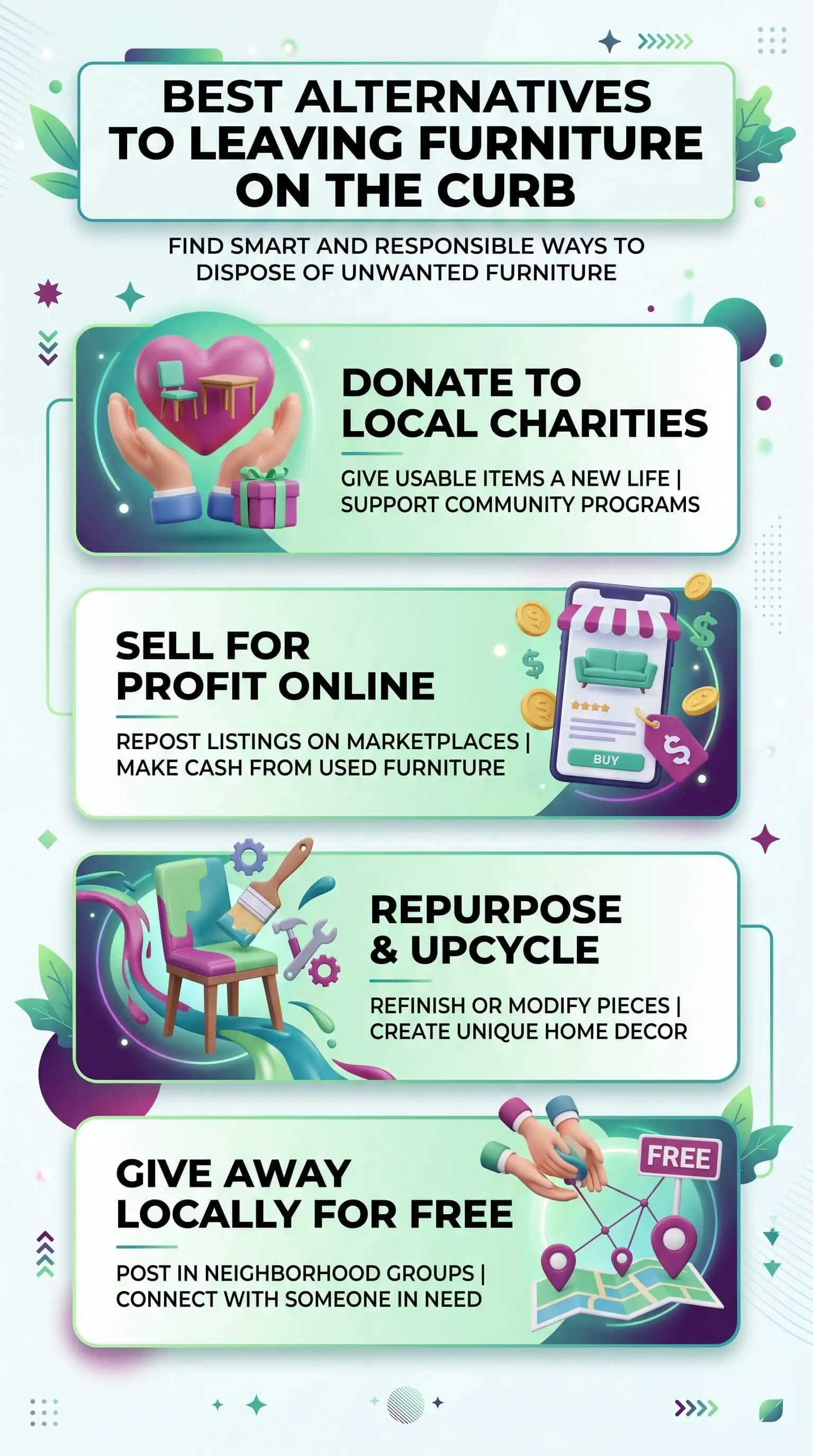
1. Schedule your municipal bulk pickup. Most U.S. cities run scheduled large-item collections on a calendar most homeowners have never read. Check your sanitation department's website for the cap on items per year and the booking lead time, which usually runs three to fourteen days.
2. Book a charity pickup. Habitat for Humanity ReStore, The Salvation Army, and Goodwill all offer free or low-cost residential pickup for furniture in usable condition. The catch is condition standards. They will not take rips, stains, or heavy wear.
3. Donate through the Furniture Bank Network. Furniture banks place donated pieces with families exiting homelessness, foster care, or domestic violence. The condition bar is similar to charity pickup, and the impact is more direct.
4. Hire a paid junk removal haul-away. Costs typically run $75 to $300 for one bulky item, and the crew lifts it from inside your home. This is the route to use when condition rules out donation, or when you need it gone today.
5. List it for resale. Facebook Marketplace, Craigslist, and OfferUp move usable furniture in days, often within hours for anything mid-century or solid wood. Free listings move fastest. The condition you photograph is the condition the buyer expects.
6. Use “curb-with-permission” tactics where allowed. A few cities and most neighborhoods tolerate a piece on the curb with a “free” sign, posted to a neighborhood app, and gone the same day. This works if you are home, watching, and willing to bring it back inside if no one takes it by sunset.
“In my experience, people underestimate how fast a discarded couch becomes infrastructure for the pests they were already trying to keep out. Forty-eight hours of warm weather plus a porous fabric is enough. The piece you set out for the city to take becomes the piece your downwind neighbor brings home, and three weeks later I am hearing about bites in their bedroom. Curbside disposal often turns out to be a transfer rather than an ending, which is why I tell every homeowner to plan the disposal as carefully as they planned the purchase.”
7 Essential Resources
Each of these is a primary source we check when researching disposal questions. Verify your local rules against the most current version of each before acting.
7. EPA Durable Goods: Furniture and Furnishings Data. Open the EPA dataset. The EPA's most recent published dataset on U.S. furniture waste, broken out by tonnage, end-of-life routing, and historical trend back to 1960. Use it to size up the scale of the problem and to find the figure cited in the statistics section below.
8. Habitat for Humanity ReStore. Find your local ReStore. A nationwide network of nonprofit home-improvement stores funded by furniture, appliance, and building-material donations. Most ReStore locations offer free residential pickup if your piece meets their condition standards, with proceeds funding affordable home builds.
9. The Salvation Army Donation Pickup Scheduler. Schedule a free pickup. Schedule a free in-home pickup for usable furniture by ZIP code. Salvation Army Family Stores resell donated furniture to fund Adult Rehabilitation Centers, with pickup generally available within one to two weeks.
10. Goodwill. Find your nearest Goodwill. Locate your nearest Goodwill drop-off, donation center, or pickup service by ZIP code. Goodwill's standards favor furniture in saleable condition, and proceeds fund job training and employment services in the local community.
11. Furniture Bank Network. Search the directory. A directory of member furniture banks across the U.S. and Canada that place donated pieces directly with families exiting homelessness, foster care, and domestic violence. Use it to find the closest furniture bank to your address and to confirm what items they currently accept.
12. FindLaw: Penalties for Illegal Dumping. Read the FindLaw overview. A plain-language overview of how illegal dumping is charged at the state level, what fine ranges look like, and what distinguishes a citation from a misdemeanor. Worth reading before you assume your city is the lenient kind.
13. EPA Facts and Figures About Materials, Waste, and Recycling. Open the EPA portal. The parent EPA portal covers U.S. solid-waste data across categories. Useful context for anyone weighing the environmental case alongside the personal logistics question.
3 Statistics
Three figures put the curbside question in scale.
12.1 million tons. That is the EPA's estimate of U.S. furniture and furnishings discarded into municipal solid waste in 2018, the agency's most recent published figure. The same dataset shows a sharp climb from 2.2 million tons in 1960. The volume reflects what “fast furniture” has done to home turnover. Source: EPA Durable Goods Product-Specific Data.
80.1% landfilled, 19.5% combusted for energy, 0.4% recycled. EPA's 2018 end-of-life routing for U.S. furniture and furnishings shows where almost all of it lands when the curbside question is answered the easy way. Recycling is technically possible for very little of it because of how mixed the materials are. Source: EPA Durable Goods Product-Specific Data.
547,000 tons per 100,000 residents. Las Vegas leads U.S. cities in furniture disposal volume per capita, ahead of Denver (363,000) and Boston (166,000), per a 2025 analysis of landfill tonnage and disposal-related search volume. The pattern follows where rental turnover is highest. Source: AOL coverage of the Pooky furniture-scavenging cities study.
Final Thoughts and Opinion
Here is the call we would make for almost any household asking can I leave furniture on the curb with a usable piece to clear out. The curb is the worst route on the menu. It risks the fine, voids the donation eligibility within a single weather event, and (in any region with active pest pressure) opens a 48-hour window where discarded upholstery turns into pest infrastructure. Every alternative we covered above clears that bar.
If the piece is resaleable, list it. If it is donatable but not worth the hassle of resale, schedule the pickup with Habitat ReStore,The Salvation Army, Goodwill, or a furniture bank. Otherwise, pay for haul-away or wait for your city's bulk window. None of those routes are as fast as dragging a sectional to the sidewalk, but every one of them protects the next decision you have to make about your home — including the call you might otherwise be making to us.
Frequently Asked Questions
Is it illegal to leave furniture on the curb?
In most U.S. cities, yes. Unscheduled curbside furniture is treated as illegal dumping under municipal code. A small number of cities run open bulk-pickup days where it is permitted on specific dates only. The safe assumption is that you need to schedule a pickup, attach a tag or sticker, or use one of the disposal alternatives covered above. Your sanitation department's website is the source of truth for your address.
What is the fine for leaving furniture on the curb?
Fines start around $50 in lighter-touch jurisdictions and run into the thousands where illegal dumping is actively prosecuted. The exact penalty depends on your state and on whether the citation is treated as an infraction, a civil violation, or a misdemeanor. Some cities double the fine for repeat offenses within a calendar year. Check your local ordinance before you assume the risk is small.
Will the garbage truck pick up a couch?
Sometimes, but rarely on your standard collection day. Most cities run bulk-item pickup as a separate service that requires advance scheduling and limits how many pieces you can put out per year. A few municipalities still include occasional bulk pickup in standard service, but those programs are shrinking as disposal costs rise. Confirm the rules with your sanitation department before assuming the truck will take it.
Who picks up old furniture for free?
Three routes typically work without payment for furniture in usable condition. Charity pickups from Habitat for Humanity ReStore, The Salvation Army, or Goodwill cover most household pieces, with condition standards varying by location. Furniture banks in the Furniture Bank Network place donations directly with families in transition, and your municipal bulk pickup is free as long as you fall within the annual cap. For pieces that do not qualify, professional haul-away services are the paid alternative — see this curbside furniture and couch disposal guide for haul-away pricing and what crews will and will not take.
How do I dispose of a couch with bed bugs?
Bag it, label it, and call pest control before you move it. A bed-bug-infested couch is not a donation candidate, and most haul-away services will refuse to load it without disclosure. Wrap the piece in heavy plastic and seal the seams before moving it through the house, or you risk seeding eggs in carpet and walls on the way out. Our guide on what to do when furniture has bed bugs covers the assessment, the labeling, and the disposal sequence.
Can I leave furniture on the curb if I put a “free” sign on it?
It depends on your municipality. A handful of cities tolerate the practice during daylight hours, while many treat the sign as immaterial and still cite it under illegal dumping. The safer version of this idea is to post the piece to your neighborhood app (Nextdoor, Facebook neighborhood groups, or local Marketplace) before you bring it outside, and to bring it back in if no one claims it by sunset. The sign alone is not legal cover.
How long can furniture sit on the curb before it becomes a problem?
Forty-eight hours is the realistic ceiling, and that assumes mild weather. Rain absorbs into upholstery in a few hours and voids donation eligibility almost immediately. In warm conditions, pests find their way into porous materials within two to three days. After roughly a week, what you set out has likely shifted from a donation candidate to a disposal one, regardless of its starting condition.
Call to Action
If your furniture is on its way out and the curb is off the table, schedule the pickup that fits your situation — bulk service from your city, free pickup from Habitat ReStore or The Salvation Army, or a paid haul-away if speed matters. If you suspect any of the pieces you are clearing have hosted pests, contact a pest control assessment first. Either way, plan disposal before the couch hits the porch.