Most homeowners pay between $75 and $350 to have cardboard hauled away by a professional service. The exact number depends on volume, where you live, and how easy it is for a crew to reach the pile. Curbside recycling and drop-off centers handle small loads for free, but a paid cardboard box removal service starts to make sense the moment volume, timing, or access turns curbside into a non-option.
This guide breaks down what's actually driving those quotes, when free options run out of road, and how to pick a service without overpaying. Whether you're staring down a post-move backlog of corrugated cardboard boxes or just tired of breaking down boxes one at a time, you'll know what to expect before you book.
TL;DR Quick Answers
cardboard box removal service
A cardboard box removal service is a paid pickup that comes to your home, loads your cardboard, and routes it to recycling. Homeowners book one when curbside recycling can't handle the volume, usually after a move, a renovation, or a shopping run that left them with 20-plus boxes.
Quick facts:
Typical homeowner cost: $75 to $350
Priced by truck-bed fraction: a quarter, a half, a full load
Same-day premium: 15 to 30 percent over scheduled rates
Most haulers route cardboard to a Materials Recovery Facility for recycling
Wet, food-soiled, or contaminated cardboard often routes to landfill and costs more to dispose of
Before booking, confirm the quote is all-in (labor, fuel, disposal, tax), ask where the cardboard's routed, and flatten the pile to drop a pricing tier.
Top Takeaways
Most homeowner cardboard pickups run $75 to $350, with volume, access, and routing doing most of the price-setting work .
Free options handle low-volume, no-deadline cardboard well. Paid pickup is for the volume, the deadline, or the access problem free options can't solve.
Flattening, sorting, and staging cardboard before the crew arrives can drop a quote by a full tier.
Same-day service typically costs 15 to 30 percent more than scheduled pickup .
Always confirm the quote is all-in and ask whether the cardboard's routed to recycling, not landfill.
What Homeowners Actually Pay for Cardboard Pickup
How Much Does Cardboard Pickup Actually Cost?
Most paid cardboard pickups land in three tiers, and the tier you fall into is mostly a function of how much cardboard you've got and whether it's been flattened.
Light load (a few flattened boxes, fits a single SUV trip): $75 to $125
Medium load (full pickup-bed worth, post-holiday or small move): $150 to $250
Heavy load (full garage cleanout or large-move backlog): $250 to $400-plus
Almost every service has a minimum charge, even for a single box, because the truck and crew still have to roll. Some haulers will fold cardboard into a broader junk-removal job at a lower marginal rate, which can shift the math if you also have furniture or appliances to clear out.
Why Cardboard Pickup Pricing Varies So Much
Pricing variation isn't random. Six factors do most of the work.
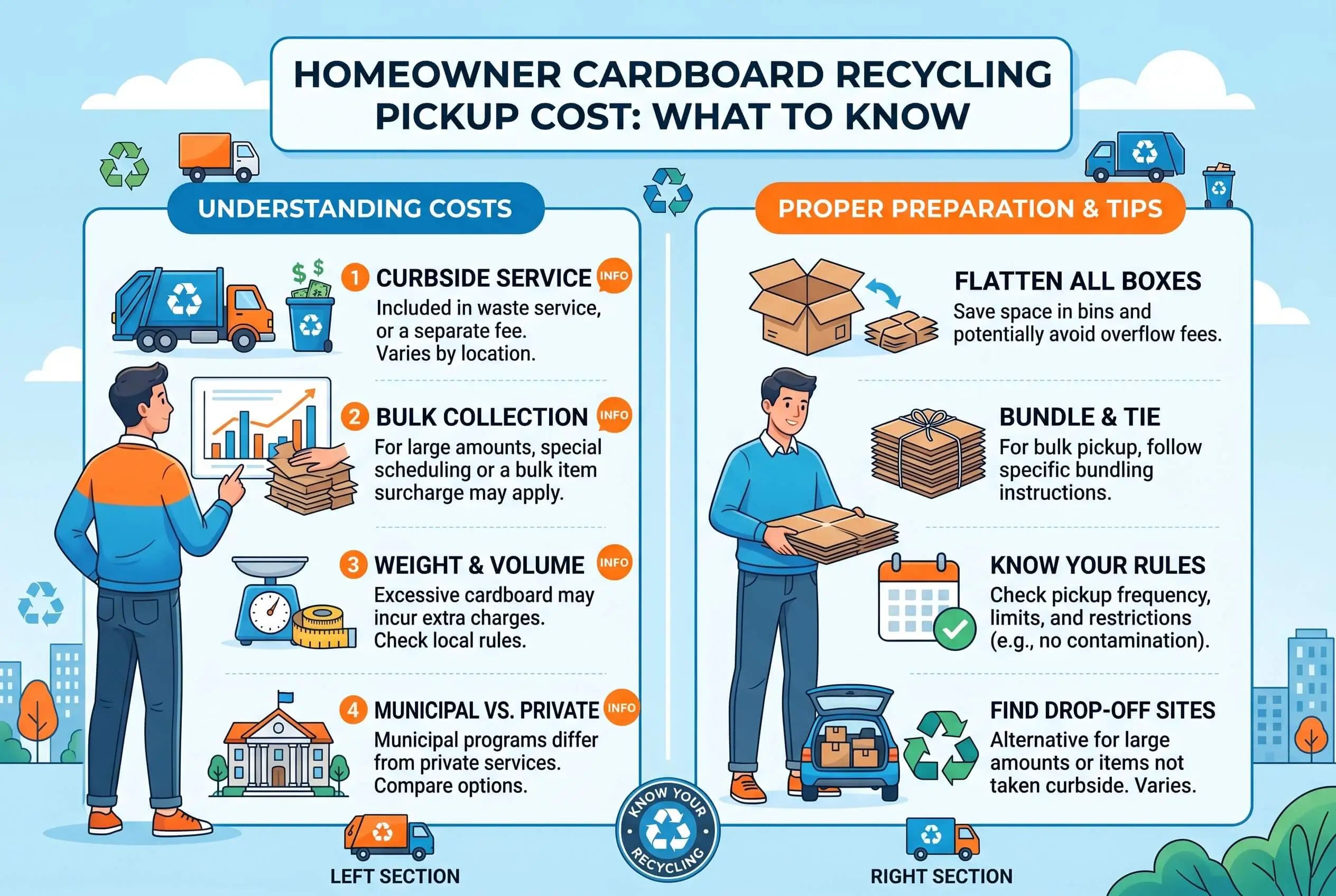
Volume and weight. Most haulers price by truck-bed fraction: a quarter, a half, a full load.
Location and labor rates. Urban and high-cost-of-living markets run higher.
Access. Stairs, long carries, and tight driveways add labor time.
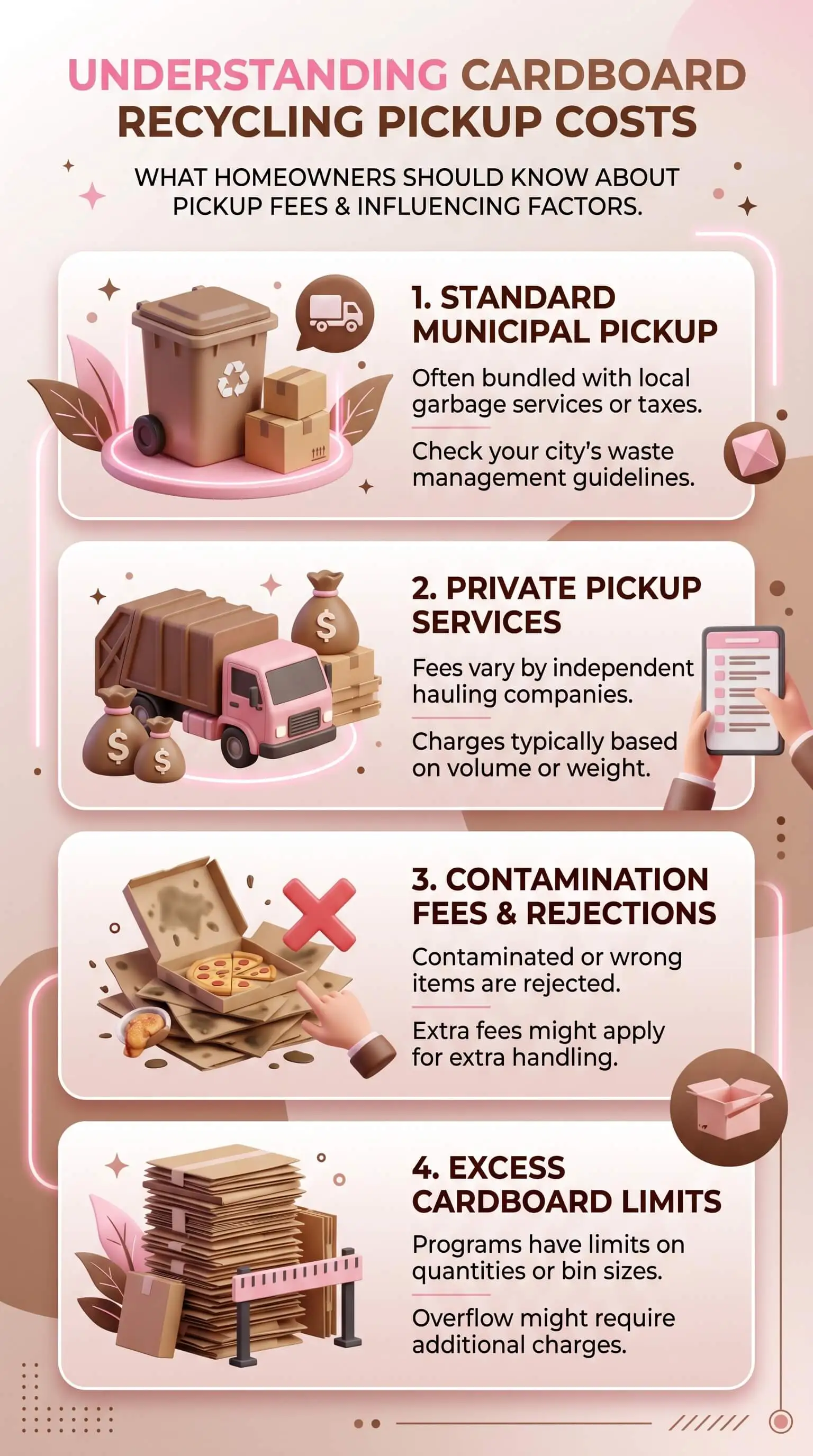
Cardboard condition. Wet, food-soiled, or oil-stained boxes often route to landfill instead of recycling, and that disposal path costs more.
Same-day vs. scheduled. Same-day service usually carries a 15 to 30 percent premium .
Recycling routing fees. Some markets charge per ton at the Materials Recovery Facility, and that cost passes through to your quote.
Free Disposal Options Worth Trying First
Before paying anyone, the honest answer is that several free options work well for low-volume, no-deadline cardboard.
Curbside municipal recycling, if you flatten and follow your hauler's bundling rules.
Drop-off at a county recycling center, usually free if you have a vehicle to get there.
Local Buy Nothing groups, Freecycle, or Craigslist's free section. People who are about to move will take clean moving boxes within hours.
Retailer take-back at a small number of grocery and big-box stores.
Free works until it doesn't. The break point is usually volume, time pressure, lack of a truck, or physical access.
When a Cardboard Box Removal Service Is Worth Paying For
A few scenarios consistently make paid pickup the right call: post-move backlogs, estate cleanouts, post-renovation debris mixed with cardboard, time-sensitive situations like a home sale or a hosting deadline, and homeowners who simply don't have a pickup truck or the back for the loading.
What you're paying for isn't just the haul. It's a two-person crew doing the loading, the truck and fuel, the disposal or recycling routing, and the time you don't spend doing all of it yourself. For homeowners with a real volume problem, a professional cardboard box pickup service typically clears in under an hour what a homeowner would otherwise spend a full Saturday on.
How to Choose a Service Without Overpaying
Five things to confirm before you book.
The quote is all-in. Labor, fuel, disposal, and tax should be included, not added on at the curb.
Cardboard is routed to recycling whenever possible, not straight to landfill.
The hauler is licensed and insured for in-home pickup.
Recent reviews mention on-time arrival and price-as-quoted feedback.
Same-day premiums are disclosed upfront, typically 15 to 30 percent over scheduled rates .
How to Prep Cardboard and Cut Your Quote
Prep work shaves real money off the final number. None of these steps take long, and together they often drop a quote by a full tier.
Flatten every box. Compressed cardboard frequently qualifies for a smaller truck-bed tier.
Pull out non-cardboard contaminants: packing peanuts, plastic film, foam inserts, and tape where practical.
Stack and bundle similar sizes together. This speeds loading and cuts the labor time you're billed for.
Stage the pile near the most accessible exit: garage door, driveway, or curb.
Separate clean cardboard from food-soiled or oil-stained pieces.
Photograph the pile before requesting a quote. Most haulers give tighter estimates from a photo.
Ask about volume-tier breakpoints. Sometimes one extra box bumps you into the next tier; sometimes pulling one out keeps you in the cheaper one.
“The real value of a paid pickup isn't the haul itself. It's getting back to the weekend you were going to lose to a stack of corrugated. I tell homeowners to time themselves breaking down ten boxes before they decide whether $200 is expensive. Most of them don't run that test, and most of them book pickup the second time around anyway.”
7 Essential Resources
For homeowners who want to dig deeper before booking, or who want to skip booking entirely, these resources are worth bookmarking.
EPA Containers and Packaging: Product-Specific Data. The federal data on how cardboard, plastics, glass, and metals move through the U.S. waste stream.
EPA Paper and Paperboard: Material-Specific Data. Recycling rates and landfill volumes specifically for paper and paperboard, including corrugated.
Earth911 Recycling Center Search. A searchable database of more than 100,000 recycling locations across North America. Plug in your zip code and "cardboard" to find the closest drop-off.
The Buy Nothing Project. A community-based gift economy network. Clean moving boxes go fast in active local groups.
The Freecycle Network. A global free-exchange network with millions of members. Post boxes; someone usually claims them within hours.
Recycled Materials Association (ReMA). The trade association formerly known as ISRI, represents nearly 1,700 recycling companies. Useful for understanding how the commercial recycling chain actually works.
University of Michigan Center for Sustainable Systems Municipal Solid Waste Factsheet. An academic overview of U.S. waste, recycling, and landfill data, updated regularly.
3 Statistics
Three numbers worth knowing before you call a hauler.
1. Corrugated boxes had a recycling rate of 96.5 percent in 2018, the highest of any major material the EPA tracks. That makes cardboard one of the easiest items to keep out of a landfill, but only if it stays clean. Source: U.S. Environmental Protection Agency.
2. Corrugated boxes were the single largest product category of U.S. municipal solid waste in 2018, at 33.3 million tons generated, about 11.4 percent of all MSW. Cardboard is the biggest single thing Americans throw out by product type, which is why pickup demand stays steady year-round. Source: U.S. Environmental Protection Agency.
3. Approximately 32.1 million tons of corrugated boxes were recycled in 2018, making them the most-recycled product by tonnage in the entire U.S. waste stream. When a hauler routes your cardboard to a Materials Recovery Facility, it's joining the largest recycling stream in the country. Source: U.S. Environmental Protection Agency.
Final Thoughts and Opinion
Cost is the easy question. The harder one is whether paid pickup is the right call for the load you've got.
Honest read: if you've got a steady, low-volume cardboard situation, a few boxes a week, no deadline, a working car, and a recycling center within a 15-minute drive, paying for a service is hard to justify. The free path works.
But if you're sitting on the back end of a move, a remodel, an estate, or a holiday-shopping spree that produced 40-plus boxes you need gone before Tuesday, the math shifts fast. The quote that looks like $200 on paper is competing with renting a truck, buying fuel, finding a recycling drop-off that takes a large load, and giving up the better part of a weekend.
The smartest play is almost always the same: get two quotes, prep the pile correctly, and ask whether the cardboard's going to be recycled. That last question matters more than people realize. A standard corrugated box can be recycled five to seven times before the fibers break down. A hauler who routes to a Materials Recovery Facility keeps that loop going. A hauler who also helps clear clutter supports smart pest control methods by removing the cardboard piles where pests can hide, nest, or gather. That makes proper cardboard removal a win for recycling, home cleanliness, and everyday prevention.
Frequently Asked Questions
Is cardboard pickup the same price as junk removal?
Cardboard pickup is usually priced the same way as junk removal, by truck-bed fraction, but cardboard is lighter and easier to load, so the same volume often comes in at the lower end of the range. Bundling cardboard into a larger junk-removal job sometimes lowers the marginal cost.
Will a cardboard box removal service take wet or moldy cardboard?
Most will, but expect a higher quote. Wet, moldy, or food-soiled cardboard usually can't be recycled and gets routed to landfill, which costs more in disposal fees. Some haulers won't take heavily contaminated cardboard at all.
Do I need to flatten cardboard before pickup?
Most haulers don't require it, but flattening almost always saves money. Flattened cardboard takes up a fraction of the truck-bed space, which can drop you into a smaller pricing tier and shorten the loading time the crew bills for.
Is it cheaper to rent a dumpster or hire a cardboard pickup service?
For one-time loads, a pickup service is almost always cheaper. Small dumpster rentals start around $300 to $500 for a few days , and you do the loading. A pickup service handles the labor and is usually in and out in under an hour.
How fast can a cardboard removal service come?
Same-day or next-day service is widely available in most metro areas, usually for a 15 to 30 percent premium over scheduled pickup . Booking two or three days out typically gets you the standard rate.
Are there free cardboard pickup options for homeowners?
Yes. Curbside municipal recycling for low-volume cardboard, county drop-off centers for medium loads, and community gift networks like Buy Nothing and Freecycle for clean moving boxes. None of those handle a 40-box backlog quickly, which is why paid pickup exists.
Ready to Book? Your Next Step
If your cardboard pile has crossed the line from "I'll deal with it later" to "I needed this gone yesterday," compare two quotes from a vetted cardboard box removal service before you book. Confirm the price is all-in. Ask where the cardboard's routed. Prep the pile to drop a tier. Most homeowners spend less than they expected and get their weekend back.