Whether you're planning a lease turnover, renovation cleanup, post-flood replacement, or a tenant move-out, this is what we've learned about pricing carpet removal services cost for small offices, and how to keep the final invoice close to the original quote.
TL;DR Quick Answers
carpet removal services cost
Small office carpet removal runs $1 to $3 per square foot fully loaded. A typical 1,500 square foot office lands between $1,500 and $4,500 once labor, haul-away, and disposal are included.
What moves the price:
Installation method: Stretch-in carpet sits at the low end. Glue-down commercial carpet roughly triples labor time and pushes the high end up.
Project size: A 500 sq ft suite runs $500 to $2,500. A 5,000 sq ft office runs $5,000 to $25,000.
Access and timing: Evening, overnight, or weekend scheduling adds a 15 to 30 percent premium.
What's included: A complete quote covers seven line items: pull-up, padding, tack strips, staples, subfloor cleanup, haul-away, and disposal.
The cheapest quote is almost never the cheapest job. We've watched too many office managers get hit with separate haul-away and disposal invoices after the original "removal" work was done.
Top Takeaways
Budget $1 to $3 per square foot fully loaded. A typical 1,500 sq ft office runs $1,500 to $4,500. Glue-down commercial-grade carpet sits in the upper half of that range.
The installation method is the biggest cost variable. Glue-down can triple labor versus stretch-in. Confirm installation type before requesting quotes.
Demand itemization in writing. That's seven separate line items: carpet removal, padding, tack strips, staples, subfloor cleanup, haul-away, and disposal.
After-hours scheduling adds 15 to 30 percent. Build that into your budget if your office sits in a shared building or has tenant-disruption concerns.
Furniture moving is the number-one surprise charge. Clear the space yourself, or get the moving line item quoted explicitly upfront.
Ask the disposal question. Specific answers, with named processors and CARE-affiliated routing, signal a vendor worth hiring. Vague answers usually mean default-to-landfill.
What “Commercial-Grade” Actually Means For Carpet Removal
Manufacturers engineer commercial-grade carpet for high-traffic environments: low pile, dense fiber construction, almost always installed with glue-down or double-glue-down adhesive. Designers spec it to last 10 to 15 years under heavy foot traffic, which is exactly why removing it costs more than removing the plush residential carpet most contractors see day to day.
Installers usually stretch residential carpet over tack strips with thick padding underneath, and it comes up in long, satisfying sheets. Commercial carpet doesn't behave that way. Our crews have scraped adhesive for hours on jobs where the visible square footage was modest but the labor was anything but. That's why a per-square-foot rate that looks reasonable on a spreadsheet can climb fast in the field.
Small Office Carpet Removal Cost: The Real Numbers
Pricing for small offices, generally 500 to 5,000 square feet, falls within these ranges depending on installation method:
500 sq ft (small suite): $500 to $1,000 for tack-strip / stretch-in; $1,500 to $2,500 for glue-down commercial.
1,500 sq ft (typical small office): $1,500 to $3,000 for tack-strip / stretch-in; $4,500 to $7,500 for glue-down commercial.
3,000 sq ft (medium office): $3,000 to $6,000 for tack-strip / stretch-in; $9,000 to $15,000 for glue-down commercial.
5,000 sq ft (upper small-office tier): $5,000 to $10,000 for tack-strip / stretch-in; $15,000 to $25,000 for glue-down commercial.
Note: ranges synthesized from HomeGuide, Angi, Bob Vila, and HomeAdvisor pricing data current as of early 2026; Bob Vila reports commercial carpet removal at approximately $1 per square foot fully loaded, with glue-down work running $3 to $5 per square foot per HomeGuide and Angi.
These ranges assume the quote includes haul-away, disposal, tack-strip and staple removal, and basic subfloor cleanup. Strip any of those out and the per-square-foot rate looks deceptively low. That's the bait-and-switch we see most often.
Four Variables That Move The Price
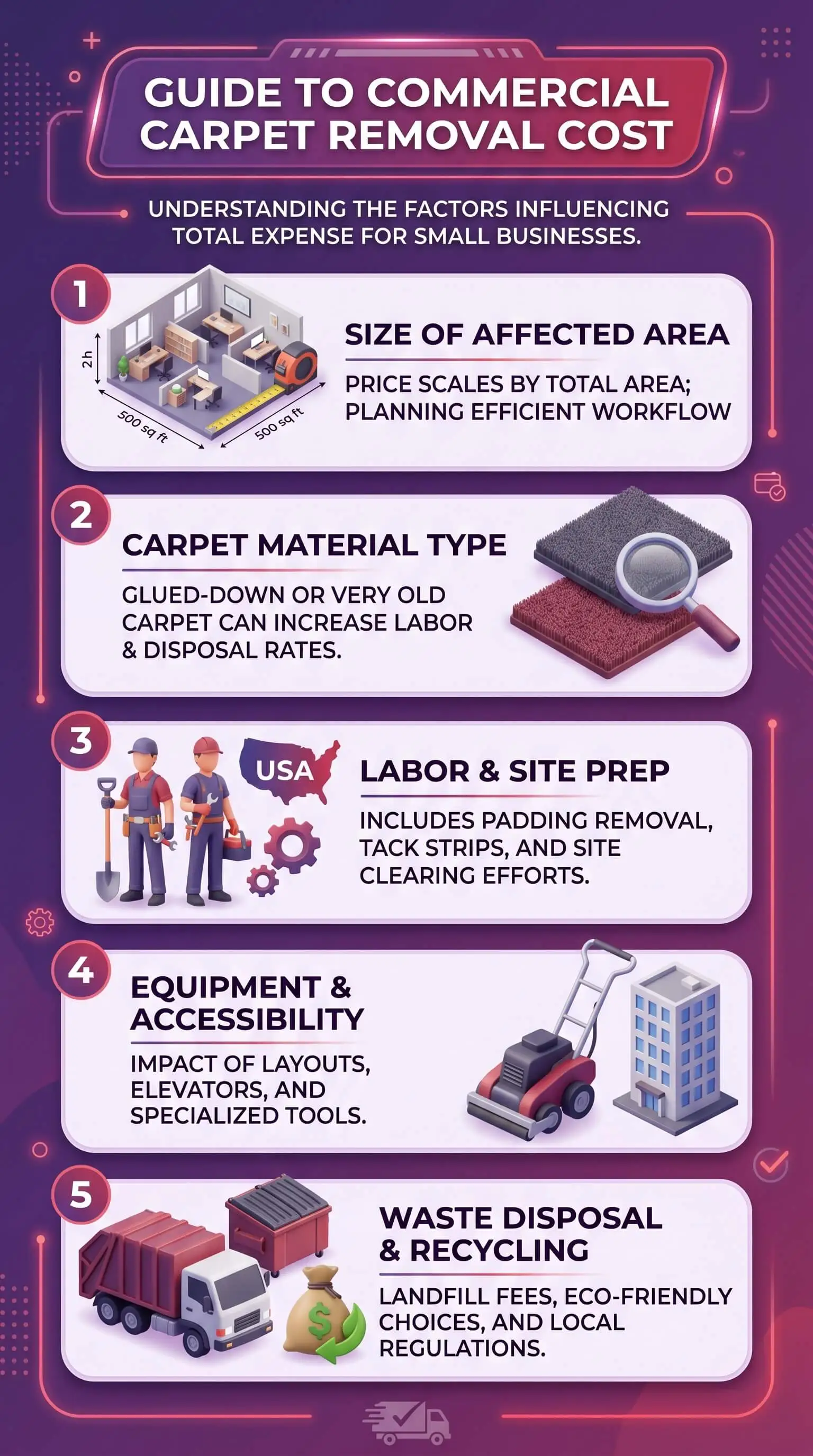
Installation method. This is the biggest cost lever. Glue-down adhesive can roughly triple labor time compared to stretch-in installation, which is why a 1,500 square foot office with stretch-in carpet often comes in around $1,500 while the same office with glue-down can land at $4,500 or higher. Carpet tiles fall somewhere in between, depending on adhesive condition. Tiles with intact adhesive come up fastest. Tiles where the adhesive has degraded can take longer than full broadloom of the same footprint, because each tile needs to be pried free individually.
Subfloor condition and what's underneath. Older offices sometimes have layers we don't discover until we start pulling: new carpet glued over old, or commercial carpet over VCT. Each surprise layer adds time. If the subfloor itself needs repair before new flooring goes down, the contractor handling the new flooring quotes that separately.
Access and after-hours scheduling. Offices in elevator-access buildings, with loading-dock restrictions, or that require overnight work to avoid disrupting tenants typically see surcharges of 15 to 30 percent above baseline daytime rates. This is where small offices in shared buildings differ most from standalone suites.
Furniture and IT equipment. Ask the vendor to quote cubicles, server racks, and bolted workstations as a separate line item, or coordinate them yourself before the crew arrives. This is the most common source of surprise charges we hear about from clients who used another service first.
What A Complete Commercial-Grade Quote Should Include
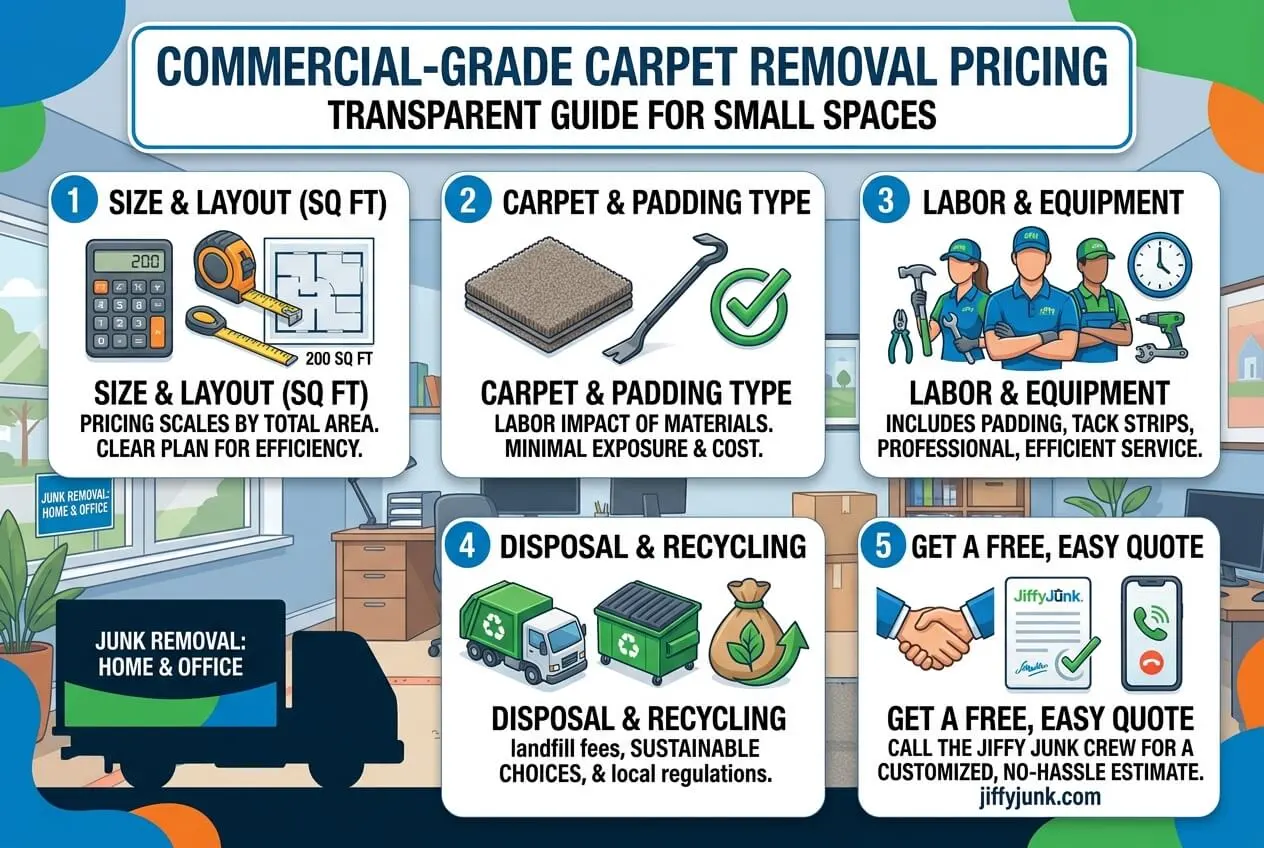
A reputable commercial carpet removal quote includes carpet pull-up, padding or adhesive scraping, full tack-strip and staple extraction, basic subfloor cleanup, haul-away, and responsible disposal. Don't accept a quote that bundles everything under “removal.” For a full breakdown of carpet removal service pricing across both commercial and residential contexts, Jiffy Junk's pricing guide is one of the cleaner industry references for what transparent quoting should look like.
Red Flags When Comparing Quotes
“Removal-only” quotes that don't specify haul-away, which almost always means a separate disposal invoice later
Vague “per-room” pricing for offices, which doesn't translate the way it does for residential spaces
No mention of insurance certificates, COIs, or licensing
Refusal to provide a written, itemized estimate
How To Lower Your Cost Without Cutting Corners
Clear the space before crews arrive. Moving office furniture is one of the highest-cost line items, and a vendor quoting it as a separate fee will price it the way an expensive moving company would.
Bundle removal with new flooring installation. Many flooring contractors discount the removal portion to win the install contract.
Schedule outside peak demand seasons. Avoid May through August in most regions.
Ask whether the vendor recycles through CARE-affiliated processors. Recyclable material sometimes carries lower disposal pass-through fees.
“After enough small office carpet removal jobs, the pattern becomes obvious. The biggest cost surprises rarely come from the carpet itself. They come from what's underneath, what's nearby, and what the previous installer left behind: old glue-down adhesive concealed under newer carpet, hundreds of staples someone never bothered to pull, bolted cubicle bases the tenant assumed weren't theirs to handle, or hidden issues that may even call for pest control before the space can be properly cleared. The vendors who flag those conditions before signing anything are the ones whose final invoice matches their original quote. Transparency at the estimate stage is the single best predictor of a clean final invoice. We've yet to find a counterexample.”
7 Essential Resources
These resources cover pricing benchmarks, recycling logistics, and removal techniques. We've vetted each one for accuracy and currency.
1. HomeGuide's Carpet Removal Cost Guide
Resource: homeguide.com/costs/carpet-removal-cost
HomeGuide breaks pricing down by carpet type, installation method, and project size. It's a useful sanity check when you're comparing quotes from multiple vendors. The figures align with what we see for both stretch-in and glue-down small office work.
2. Angi's Carpet Removal Cost Breakdown
Resource: angi.com/articles/how-much-does-carpet-removal-cost.htm
Angi covers regional variation and hourly labor benchmarks, which matter more than national averages when you're sourcing locally. Pay attention to the section on stair pricing if your office has any.
3. Homewyse Cost Calculator (ZIP-Code Specific)
Resource: homewyse.com/services/cost_to_remove_carpet.html
Homewyse lets you plug in your ZIP code and square footage to get a localized estimate based on current labor rates. The output isn't a quote, but it's a fast way to know whether a vendor's bid sits in the right ballpark before you push back.
4. U.S. EPA Guide to Identifying Greener Carpet
Resource: epa.gov/greenerproducts/identifying-greener-carpet
The EPA explains carpet's environmental footprint and the disposal options available to commercial property owners. If your tenant or corporate lease has sustainability obligations, this is the source to point to in your RFP language.
5. Carpet America Recovery Effort (CARE)
Resource: carpetrecovery.org
CARE maintains a national database of carpet recycling drop-off locations and processor partners. Asking your removal vendor whether they route material through a CARE-affiliated processor is one of the fastest ways to separate companies that recycle from companies that just say they do.
6. This Old House: How To Remove Carpet
Resource: thisoldhouse.com/flooring/21097110/how-to-remove-carpet
This walks through the steps your vendor's crew is actually performing. If your office is small enough that DIY is on the table, somewhere under 200 square feet of stretch-in carpet, this guide covers the realistic time and tool requirements.
7. Bob Vila on Carpet Removal Cost
Resource: bobvila.com/articles/carpet-removal-cost
Bob Vila is one of the few sources that addresses commercial carpet specifically, with notes on per-square-foot pricing for larger projects. Worth reading before you negotiate volume pricing for anything above 2,500 square feet.
3 Statistics
1. Over 4 Billion Pounds Of Carpet Enter The U.S. Waste Stream Annually
Source: U.S. Environmental Protection Agency, Identifying Greener Carpet
The volume isn't theoretical. A single 1,500 square foot office generates roughly 400 to 600 pounds of carpet waste at turnover. Multiplied across a commercial real estate market that turns over millions of square feet annually, it's why landfills increasingly resist accepting carpet without separation. For office managers, the practical implication is that vendors without a recycling pathway are passing rising tipping fees back to you.
2. Roughly 73% Of Discarded Carpet Still Ends Up In Landfills
Source: Carpet America Recovery Effort (CARE)
Despite over 4.6 billion pounds of carpet diverted from U.S. landfills since 2002, the majority of office carpet still goes straight to disposal. That's a vendor-selection question more than an infrastructure question. Recycling capacity exists. Most removal companies don't use it. If sustainability shows up in your lease, your ESG report, or your tenant agreements, verifying disposal routing in writing is worth the extra step.
3. Textile Waste In The U.S. Increased More Than 50% Between 2000 And 2018
Source: U.S. Government Accountability Office (GAO-25-107165)
The trajectory matters because shorter commercial carpet replacement cycles, driven by tenant turnover, design refreshes, and faster-aging modular tile, mean offices are generating disposal demand more frequently than the 10-to-15-year design lifespan would suggest. Plan disposal as part of your standard turnover budget, not as a one-off line item, and treat it as an opportunity to build smarter facility habits, the same way teams review refrigerator disposal options in advance to choose cleaner, safer, and more responsible removal solutions.
Final Thoughts and Opinion
After enough commercial removal jobs, the pattern becomes obvious. The carpet itself is the easy part. What separates a clean, predictable office turnover from a budget-blowing one is whether the vendor quotes transparently and handles disposal responsibly. Both protect the tenant or business that has to operate around the work.
Here's our honest opinion, having watched the small office segment of this market for years: the cheapest quote is almost never the best value. Low estimates either exclude critical line items, including haul-away, disposal, and tack-strip extraction, or they're built around landfill-default disposal that pushes environmental cost onto someone else. Neither saves money in the long run. The first costs you a surprise invoice. The second costs you a tenant relationship or a sustainability claim you can't substantiate.
If we could give office managers one piece of advice, it would be this: get three written quotes, demand each one itemize the same seven line items, ask how each vendor meets carpet removal service quality standards, and ask the recycling question out loud. The vendors who can answer the recycling question specifically, naming their processor and describing where the material goes, are nearly always the same vendors who quote transparently and arrive on time. The two correlate more tightly than most people realize.
Frequently Asked Questions
How much does it cost to remove carpet from a small office?
Expect $1 to $3 per square foot fully loaded. A typical 1,500 square foot small office runs $1,500 to $4,500 once labor, haul-away, and disposal get included. Glue-down commercial carpet pushes the high end up. Stretch-in residential-grade carpet sits at the low end.
What is commercial-grade carpet, exactly?
Commercial-grade carpet is built for high-traffic environments: low pile, dense fiber construction, almost always installed via glue-down or double-glue-down adhesive. Designers spec it to last 10 to 15 years under heavy foot traffic, and the dense construction plus the adhesive make removal labor meaningfully different from residential carpet.
Is it cheaper to remove carpet tiles or broadloom?
It depends on the adhesive condition. Carpet tiles with intact adhesive are usually slightly faster and cheaper to remove than broadlooms of the same square footage. Carpet tiles with failed or degraded adhesive, common in older offices, can actually take longer because each tile has to be pried individually.
Does carpet removal include moving the office furniture?
Sometimes, but often as a separate line item. Always confirm in writing. This is the most common source of surprise charges office managers report. Vendors typically price bolted cubicle bases, server racks, and large conference tables separately even when basic furniture moving is part of the quote.
Can carpet removal be scheduled after business hours?
Yes. Most commercial-grade removal vendors offer evening, overnight, and weekend scheduling. Expect a 15 to 30 percent premium over standard daytime rates. The premium is usually worth it for offices in shared buildings or anywhere tenant disruption is a concern.
What happens to the old office carpet after removal?
It depends on the vendor. A responsible removal company routes recyclable material through CARE-affiliated processors when fiber type allows, sends donatable material in good condition to local centers, and uses landfill disposal only as a last resort. Vague answers to this question usually mean the vendor defaults to landfill regardless of recyclability.
Ready To Get An Honest Carpet Removal Quote?
Don't let a vague estimate become a surprise invoice. Before signing any office carpet removal contract, get at least three written quotes with all seven line items itemized, and ask each vendor to name the processor that will handle your old carpet.
For a transparent benchmark of what fair commercial and residential carpet removal pricing looks like, tap here to compare full-service carpet removal options with Jiffy Junk. Their pricing breakdown is one of the cleaner industry references for office managers planning a turnover.