Twenty cubic yards is a useful middle ground for residential work. It's the size most rental companies recommend by default, and most of the time, that recommendation lands. Other times, scope or materials or driveway clearance break the formula and you end up sized wrong. This guide highlights the practical advantages of 20 yard dumpster size, including what fits inside a 20 yarder, the projects it handles especially well, the weight capacity to keep in mind, and a quick way to confirm whether this versatile dumpster size is the right fit for your specific project.
TL;DR Quick Answers
20 yard dumpster size
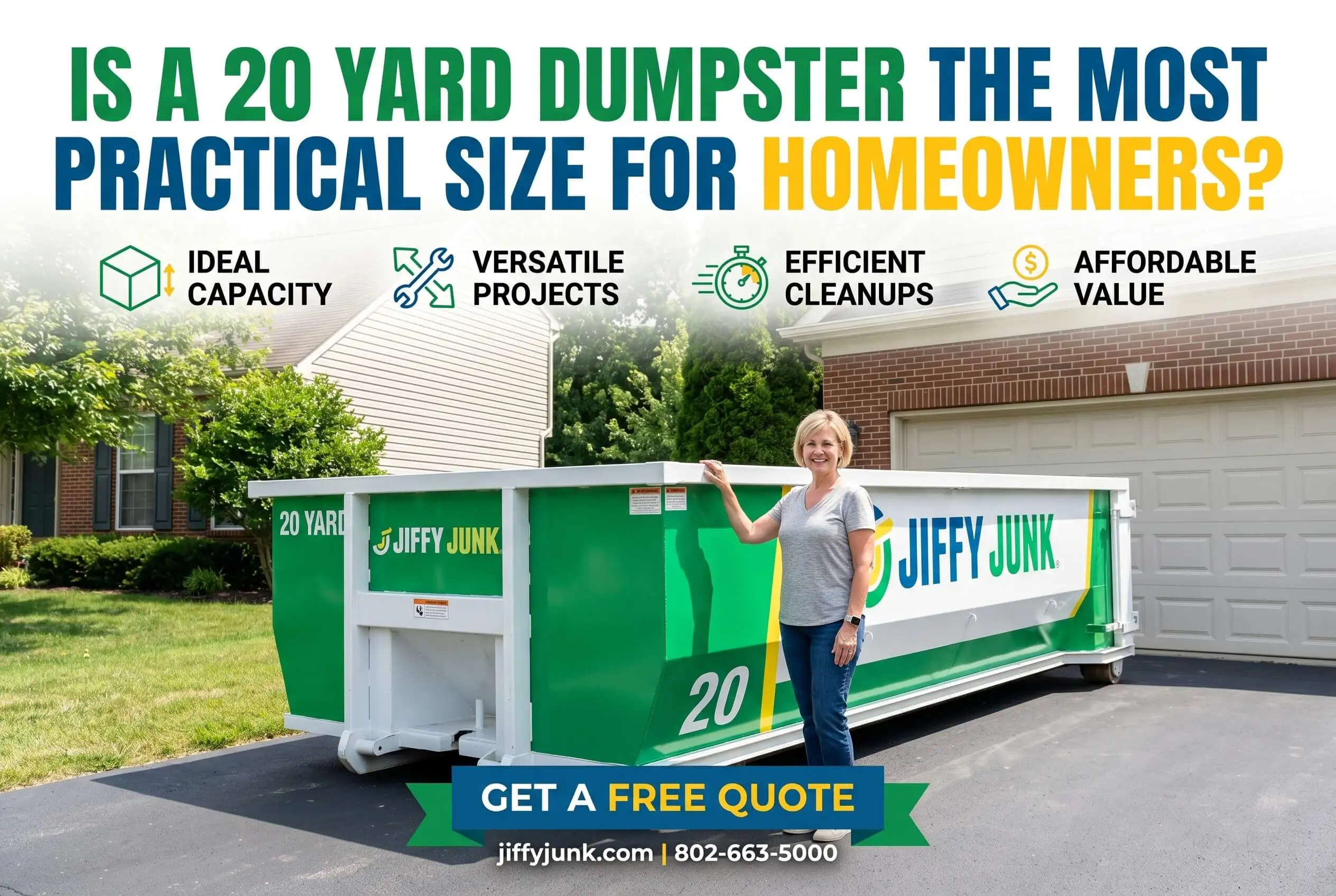
A 20 yard dumpster measures roughly 22 feet long, 8 feet wide, and 4 feet tall, about the footprint of a single parking space stacked chest-high. It holds 20 cubic yards of debris, equal to about 6 pickup truck loads or 110 to 130 standard 33-gallon trash bags.
Quick specs:
Length: ~22 ft
Width: ~8 ft
Height: ~4 ft
Volume: 20 cubic yards
Capacity: ~6 pickup loads or 110–130 trash bags
Weight cap: 2–4 tons (varies by provider and region)
The 4-foot sidewall is what makes this size practical for most homeowners. It sits low enough to load without a ladder and tall enough to hold serious volume.
Top Takeaways
A 20 yard dumpster measures roughly 22 feet long, 8 feet wide, and 4 feet tall, and holds about six pickup truck loads of debris.
It fits the wide majority of residential projects: whole-home declutters, kitchen and bath remodels, 2 to 3 bedroom estate cleanouts, and roofing on smaller homes
Weight matters more than volume. A half-full container of concrete can cost more than one overflowing with furniture. Ask about the tonnage cap before booking.
Expect to pay $350 to $600 for a standard 7-day rental, with overages running $40 to $75 per ton above your weight allowance
Donate usable items first. One call to Habitat ReStore can divert hundreds of pounds and lower your final cost.
Demand a flat-rate quote with the weight limit stated in writing. Any rental company that won't put it on paper is keeping room to surprise you.
What a 20 Yard Dumpster Really Is
A 20 yard dumpster is a roll-off dumpster, the open-top metal container delivered on a hook-lift truck and rolled onto your driveway. The "20 yard" describes volume in cubic yards, not the length of the container in feet. That single point of confusion sends more homeowners to the wrong size than anything else, so I lead with it.
20 Yard Dumpster Size and Dimensions
Most 20 yard containers fall within a foot of these measurements:
Length: about 22 feet
Width: about 8 feet
Height: about 4 feet
Volume: 20 cubic yards
The 4-foot sidewall is what makes this size genuinely homeowner-friendly. It sits low enough to toss bagged debris and broken-down furniture over the edge without a ladder, and tall enough to hold serious volume. I've watched homeowners well into their seventies load these without help. That's not true of the 30-yard size, which usually requires a ramp or a younger back.
How Much a 20 Yard Dumpster Actually Holds
Twenty cubic yards translates to roughly six pickup truck loads, or about 110 to 130 standard 33-gallon trash bags. That's volume on paper. Real-world capacity depends on what's going in.
Loose, bulky stuff like couches, mattresses, broken bookcases, and cardboard eats volume fast and weighs almost nothing. Dense stuff like concrete chunks, roofing shingles, dirt, and tile packs tight but hits the weight cap long before the container looks full. Mixed loads from typical home cleanouts use volume and weight pretty evenly. Single-material loads need a closer look before booking.
If you want a deeper breakdown of how cubic yardage translates to real-world loads project by project, this practical 20 yard dumpster sizing resource walks through the math with specific examples.
Best Home Projects for a 20 Yard Dumpster
After watching hundreds of home cleanouts unfold, these are the projects where the 20 yarder consistently performs:
Whole-home decluttering across multiple rooms in a single weekend
Kitchen or bathroom remodels with cabinetry, flooring, drywall, and fixture replacement
Estate cleanouts from 2 to 3 bedroom homes, including furniture and household contents
Garage, attic, or basement deep purges with stored furniture and old equipment
Roofing replacement on homes under roughly 1,500 square feet
When a 20 Yard Dumpster Is the Wrong Size
Most rental guides go quiet on this part. I'd rather tell you straight. The 20 yarder is overkill for some jobs and undersized for others.
Go smaller, to a 10 or 15 yard, for single-room cleanouts, small landscaping work, or light decluttering. You'll save real money. Go bigger, to a 30 or 40 yard, for full-home gut renovations, large roofing jobs, or anything heavy on construction debris.
Paying for unused capacity feels harmless at the moment. It's still a wasted budget. So is paying overage fees because you guessed too small. The right size is the one that matches your scope honestly.
How Common Dumpster Sizes Compare
10 yard: 12' × 8' × 3.5', about 3 pickup loads. Best for single-room cleanouts and small landscaping jobs.
15 yard: 16' × 8' × 4', about 4 to 5 pickup loads. Best for light renovations and mid-size declutter projects.
20 yard: 22' × 8' × 4', about 6 pickup loads. Best for whole-home declutters, kitchen or bath remodels, and 2 to 3 bedroom estate cleanouts.
30 yard: 22' × 8' × 6', about 9 pickup loads. Best for full home renovations and large roofing jobs.
40 yard: 22' × 8' × 8', about 12 pickup loads. Best for major construction and commercial cleanouts.
The Hidden Factor: Weight Limits
Volume gets all the attention. Weight is what catches people off guard. A 20 yard dumpster typically comes with a 2 to 4 ton weight allowance, and that limit is regional. The same provider can offer different caps in different markets based on landfill tipping fees and road regulations.
The homeowners I've watched get hit with overage charges almost never overestimated volume. They underestimated weight. A half-full container of broken concrete can cost more than one overflowing with bedroom furniture. If your project involves shingles, tile, brick, soil, or concrete, ask about the tonnage cap before booking. Not after the truck shows up to pick it up.
Driveway, Permits, and Placement
Plan on a flat, clear surface roughly 22 feet long by 10 feet wide. The extra width gives the delivery truck clearance to maneuver. Most standard residential driveways accommodate a 20 yarder without trouble. Tight urban properties and steeply pitched driveways can be a problem, and so can low-hanging branches or wires.
Permit rules vary by city. If the dumpster has to sit on a public street rather than your driveway, expect to need one. Check with your municipality before booking, and ask the rental company whether they handle the permit or whether that's on you. A ten-minute phone call up front prevents a delivery delay later.
What a 20 Yard Dumpster Costs
A 20 yard rental runs roughly $350 to $600 for a standard 7-day period . Where your quote lands inside that range comes down to a few variables:
Local landfill tipping fees. Urban markets generally sit at the high end.
Rental duration extensions beyond 7 days, typically $10 to $25 per added day
Material type. Mattresses, electronics, and certain appliances can carry surcharges.
Weight overages, usually $40 to $75 per ton above your included allowance
My standing advice to every homeowner choosing a roll-off dumpster size: ask for a flat-rate quote with the weight cap stated in writing. Any company that won't put a tonnage limit on paper is keeping room to surprise you on the invoice.
"Most homeowners who call us with a sizing question want to know how much will fit. After years of fielding those calls, I can tell them the better question is how much it will weigh. The 20 yard dumpster is a practical residential default for good reasons. It suits a wide majority of home projects, the dimensions fit standard driveways, and the price-per-yard makes sense for weekend work. The homeowners who walk away happy are the ones who measured their driveway, named their materials, and asked about the tonnage cap before signing anything. That's the difference between a smooth weekend and a surprise invoice."
7 Essential Resources
These are the references I send to homeowners before they book. Every one is a federal agency, state agency, or established nonprofit. None of them are sales sites. Read these once, and you'll book smarter.
1. EPA Household Hazardous Waste Guidelines
The EPA's plain-English breakdown of what counts as household hazardous waste — paint, batteries, solvents, pesticides, cleaning chemicals — and why none of it can go in a standard dumpster reflects the evolution of the pest control industry and broader safety standards around chemical disposal. Read this first if your cleanout includes anything from a garage workbench or under a kitchen sink.
Source: U.S. Environmental Protection Agency | epa.gov/hw/household-hazardous-waste-hhw
2. EPA Sustainable Materials Management Basics
Federal-level guidance on how renovation and construction debris should actually be handled. Useful if your project involves drywall, lumber, fixtures, or roofing materials, since rules around these vary more than homeowners realize.
Source: U.S. Environmental Protection Agency | epa.gov/smm/sustainable-materials-management-basics
3. Habitat for Humanity ReStore Donation Lookup
Before anything heavy or usable hits the dumpster, see what your local ReStore will take. Many locations accept furniture, working appliances, cabinets, and building materials, and a lot of them offer free pickup. Donating first means a lighter load and a cheaper rental.
Source: Habitat for Humanity | habitat.org/restores/donate-goods
4. Earth911 Recycling Center Search
Searchable national database of more than 100,000 recycling locations, sortable by zip code and material type. The fastest way to find legitimate disposal options for electronics, tires, batteries, scrap metal, and old appliances that shouldn't go in the dumpster.
Source: Earth911 | search.earth911.com
5. EPA Construction & Demolition Debris Data
If you're trying to size a renovation project honestly, this is the federal source for understanding how much debris a remodel actually generates. The EPA's annual reporting puts realistic numbers behind "how much will this kitchen remodel produce." Usually more than homeowners expect.
Source: U.S. Environmental Protection Agency | epa.gov/facts-and-figures-about-materials-waste-and-recycling/construction-and-demolition-debris-material
6. EPA Sustainable Management of C&D Materials
The companion EPA resource that covers what happens to construction and demolition debris after it leaves your driveway. Recycling rates, reuse pathways, and disposal best practices. Worth reading if you want to choose a hauler that actually diverts materials rather than landfilling everything.
Source: U.S. Environmental Protection Agency | epa.gov/smm/sustainable-management-construction-and-demolition-materials
7. CalRecycle Construction & Demolition Waste Calculator
Built by California's resource recycling agency but useful nationwide. Lets you estimate the weight and volume composition of construction debris by project type. Plug in your remodel scope, and you'll get a defensible weight estimate to compare against any tonnage cap.
Source: California Department of Resources Recycling and Recovery | calrecycle.ca.gov C&D Calculator
3 Statistics
1. The U.S. Generated 600 Million Tons of Construction & Demolition Debris in 2018
That figure, from the EPA's most recent published accounting, is more than double the volume of all household municipal solid waste combined. The takeaway for a homeowner: renovation debris is heavier and bulkier than the volume of stuff that comes out of daily living. A bathroom remodel that looks manageable on day one routinely fills a 20 yarder by day three. Plan accordingly.
Source: U.S. EPA | epa.gov C&D Debris Material
2. More Than 75% of C&D Debris Is Recycled or Reused, Not Landfilled
EPA tracking shows over 455 million tons of construction and demolition material directed to recycling and reuse in 2018, with under 145 million tons sent to landfill. That ratio matters when you're picking a hauler. Companies that sort metals, divert clean wood and concrete, and pull donatable items often charge less in the long run, because diverted material costs less to process than landfill tonnage.
Source: U.S. EPA | epa.gov Sustainable Management of C&D Materials
3. Americans Discarded 12.1 Million Tons of Furniture in 2018
Most of that furniture still had useful life when it hit the curb. Couches that needed cleaning. Dining sets with years left. Dressers and desks in working condition. Before you load any of this into a 20 yarder, make a single phone call to your local Habitat ReStore or check Earth911. Diverting two pieces of furniture can shave hundreds of pounds off your tonnage and meaningfully change your final cost.
Source: U.S. EPA | epa.gov Durable Goods Data
Final Thoughts and Opinion
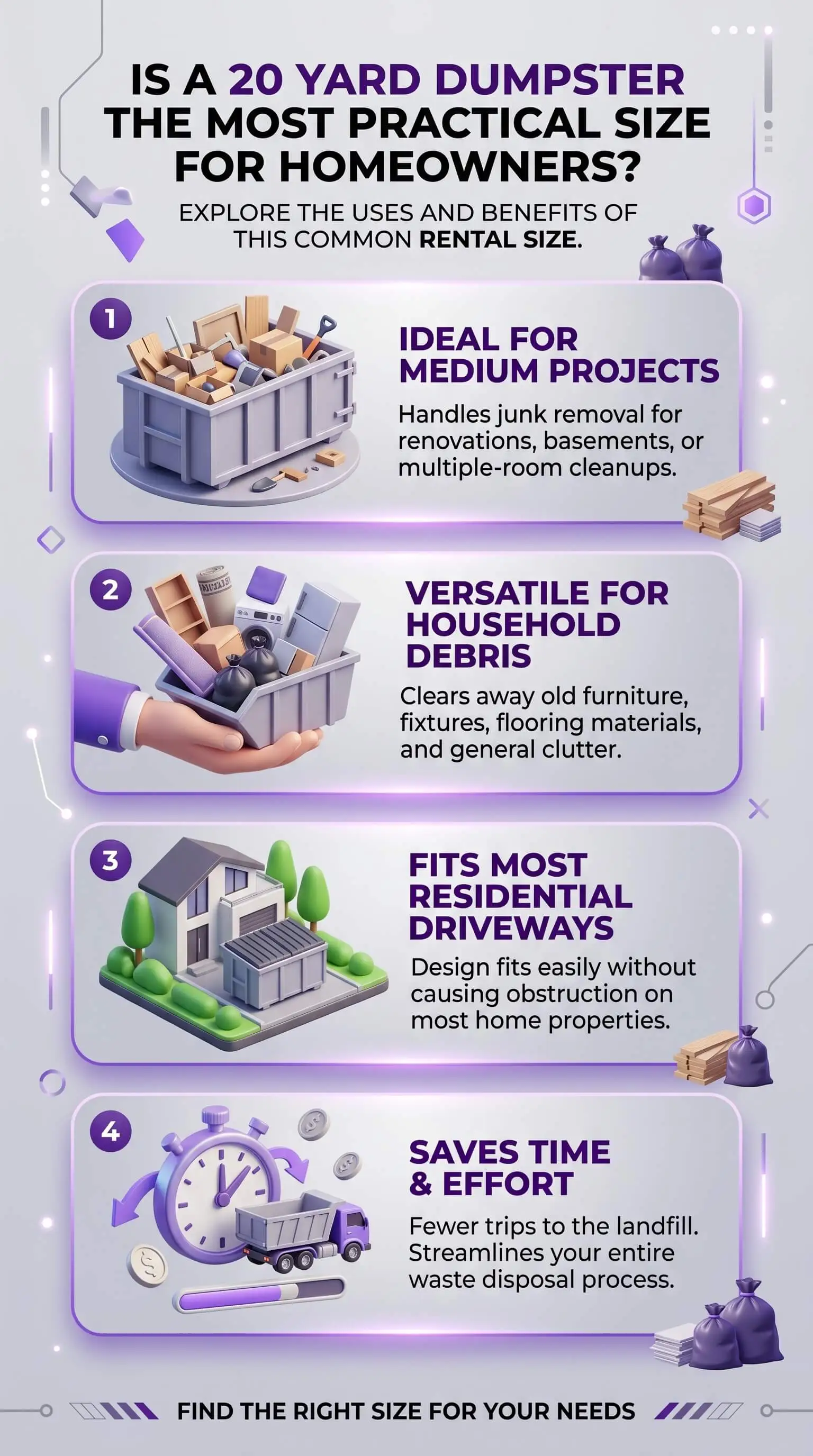
The honest answer to whether a 20 yard dumpster is the most practical size for homeowners is: usually, but not always.
In my experience, it lands in the right zone for the wide majority of residential projects I see . Whole-home declutters, mid-size remodels, average estate cleanouts, and roofs on smaller properties all sit comfortably inside that 20 cubic yard envelope. The dimensions fit a standard driveway. The 4-foot sidewall is loadable without a ramp. The price range is reasonable for a weekend project. It's a sensible default.
It isn't a universal answer though. Single-room cleanouts and light decluttering jobs are usually overserved by it, and a 10 or 15 yard saves real money. Full home renovations and heavy roofing usually need a 30 yard or multiple hauls. Any project heavy on concrete, soil, or shingles gets sized by weight, not volume.
My recommendation: don't pick a size before you've named your materials, measured your driveway, and confirmed the weight cap. Five minutes of homework before booking saves homeowners from the two most common regrets — paying for capacity they didn't use, or paying overage fees they didn't expect.
Frequently Asked Questions
What is the size of a 20 yard dumpster in feet?
A standard 20 yard dumpster measures approximately 22 feet long, 8 feet wide, and 4 feet tall. Dimensions vary slightly by provider, but most fall within a foot of these measurements. Plan on roughly the footprint of a standard parking space for placement, plus extra clearance for the delivery truck.
How much can a 20 yard dumpster hold?
A 20 yard dumpster holds about 20 cubic yards of debris, which equals roughly 6 pickup truck loads or 110 to 130 standard 33-gallon trash bags. Real-world capacity depends on what you load. Bulky furniture fills volume fast, while dense materials hit weight limits before the container looks full.
Is a 20 yard dumpster too big for one homeowner?
Not for most mid-size projects. A 20 yard dumpster is a practical fit for homeowners doing whole-home declutters, kitchen or bathroom remodels, or 2 to 3 bedroom estate cleanouts. For single-room or light cleanups, a 10 or 15 yard dumpster is usually more economical.
Will a 20 yard dumpster fit in my driveway?
Most standard residential driveways accommodate a 20 yard dumpster. You'll need a flat surface roughly 22 feet long and 10 feet wide, with overhead clearance for the delivery truck. Measure beforehand. Driveways that look long enough sometimes are not. Also check whether overhead branches or wires interfere with truck access.
How much does it cost to rent a 20 yard dumpster?
A 20 yard dumpster rental typically costs between $350 and $600 for a standard 7-day period . Final cost depends on location, materials, weight, and rental duration. Always request a flat-rate quote with weight limits documented in writing to avoid surprise overage fees of $40 to $75 per excess ton.
Ready to Decide?
Before you call a single rental company, take five minutes and do three things. Measure your driveway. List the materials going into the dumpster honestly. Write down the rough scope of your project: rooms involved, square footage, demolition versus declutter.
Then ask any provider you're considering for a flat-rate quote with the weight limit stated in writing. If they won't put it on paper, call the next one. The right rental partner makes the size decision easier, not harder. The questions you ask up front are the ones that protect your weekend, your driveway, and your final invoice.
Have a project that doesn't quite match the 20 yard profile? Drop a comment below with your scope, and I'll weigh in on whether to size up, size down, or look at full-service junk removal as the smarter call.