If you've never rented a roll-off dumpster before, the sizes can feel abstract. A 30 yard dumpster sounds enormous on paper, but the moment a king mattress, two sofas, and a pile of garage debris hit the floor of one, the available space starts disappearing fast. This guide walks through exactly what a 30 yard dumpster size means in practical terms, when it's the right call for a whole house cleanout, when it isn't, and what to do if your situation falls outside the average.
TL;DR Quick Answers
30 yard dumpster size
A 30 yard dumpster measures roughly 22 feet long, 8 feet wide, and 6 feet tall, giving you 30 cubic yards (about 810 cubic feet) of usable space.
In practical terms, that's:
About 9 pickup truck loads of debris
Roughly 170 to 190 standard 33-gallon trash bags
Enough capacity for a full cleanout of most 2,500 to 3,500 sq ft homes
A weight allowance of 3 to 5 tons in most rental agreements
It's the size haulers most often recommend for whole house cleanouts, large remodels, and downsizing projects — sitting one tier above the 20 yard (medium jobs) and one tier below the 40 yard (estates, hoarding cleanouts, heavy construction debris).
Top Takeaways
A 30 yard dumpster size (roughly 22' x 8' x 6') will hold most whole house cleanouts in the 2,500 to 3,500 sq ft range
Volume capacity is about 810 cubic feet — equivalent to ~9 pickup truck loads or 170 to 190 standard trash bags
Step up to a 40 yard for homes over 4,500 sq ft, hoarding situations, or estates with decades of accumulation
Pre-sorting donations, recyclables, and scrap before the dumpster arrives typically shrinks your fill by 30 to 40%
Weight limits (3 to 5 tons) are usually the bigger constraint than volume — heavy debris like drywall and tile hit the cap fast
Hazardous items (paint, batteries, freon appliances, tires) are prohibited and require separate disposal channels
Typical rental cost runs $400 to $700+ for 7 to 10 days — overage fees and overfill refusals are the most common surprises
What a 30 Yard Dumpster Size Actually Looks Like
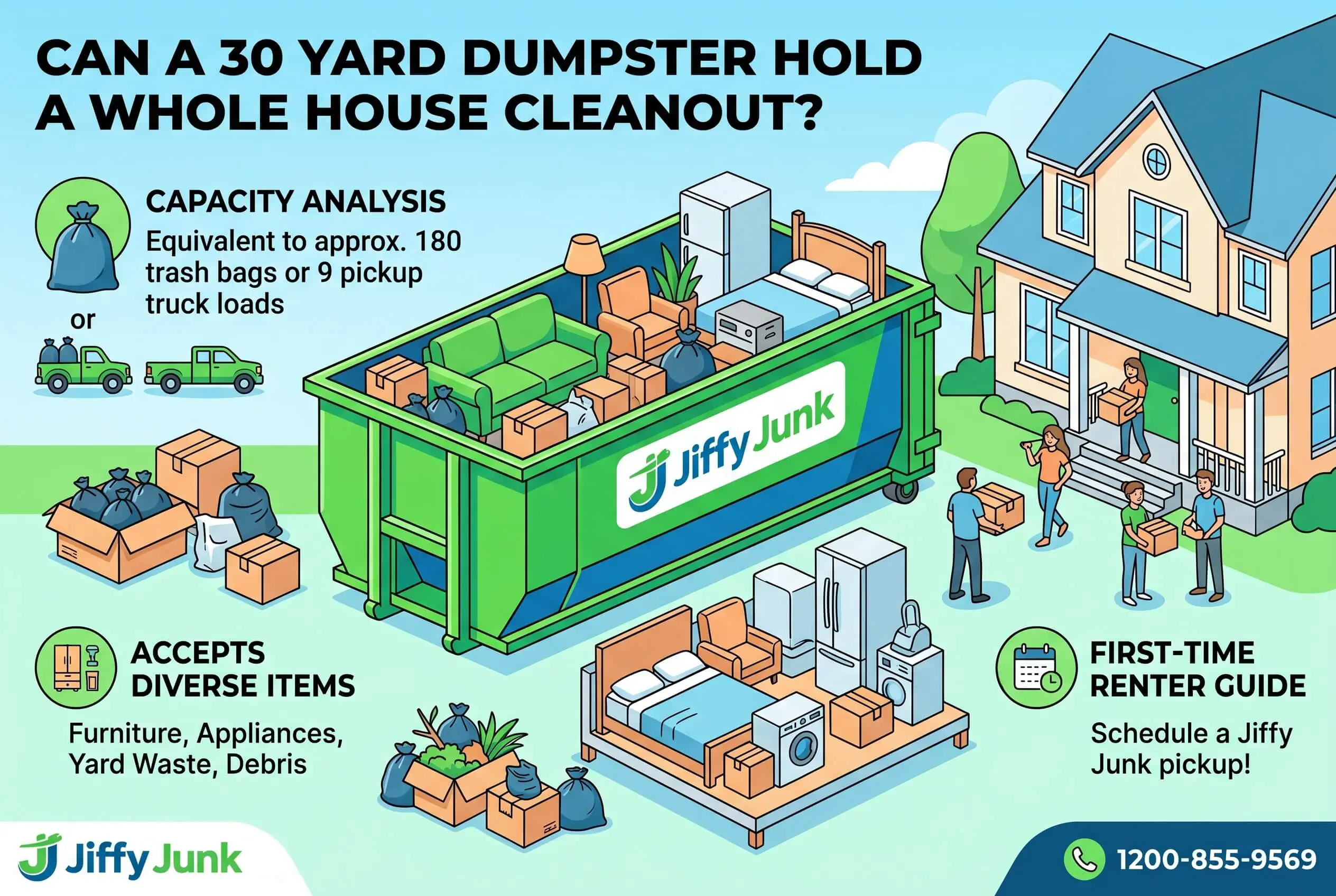
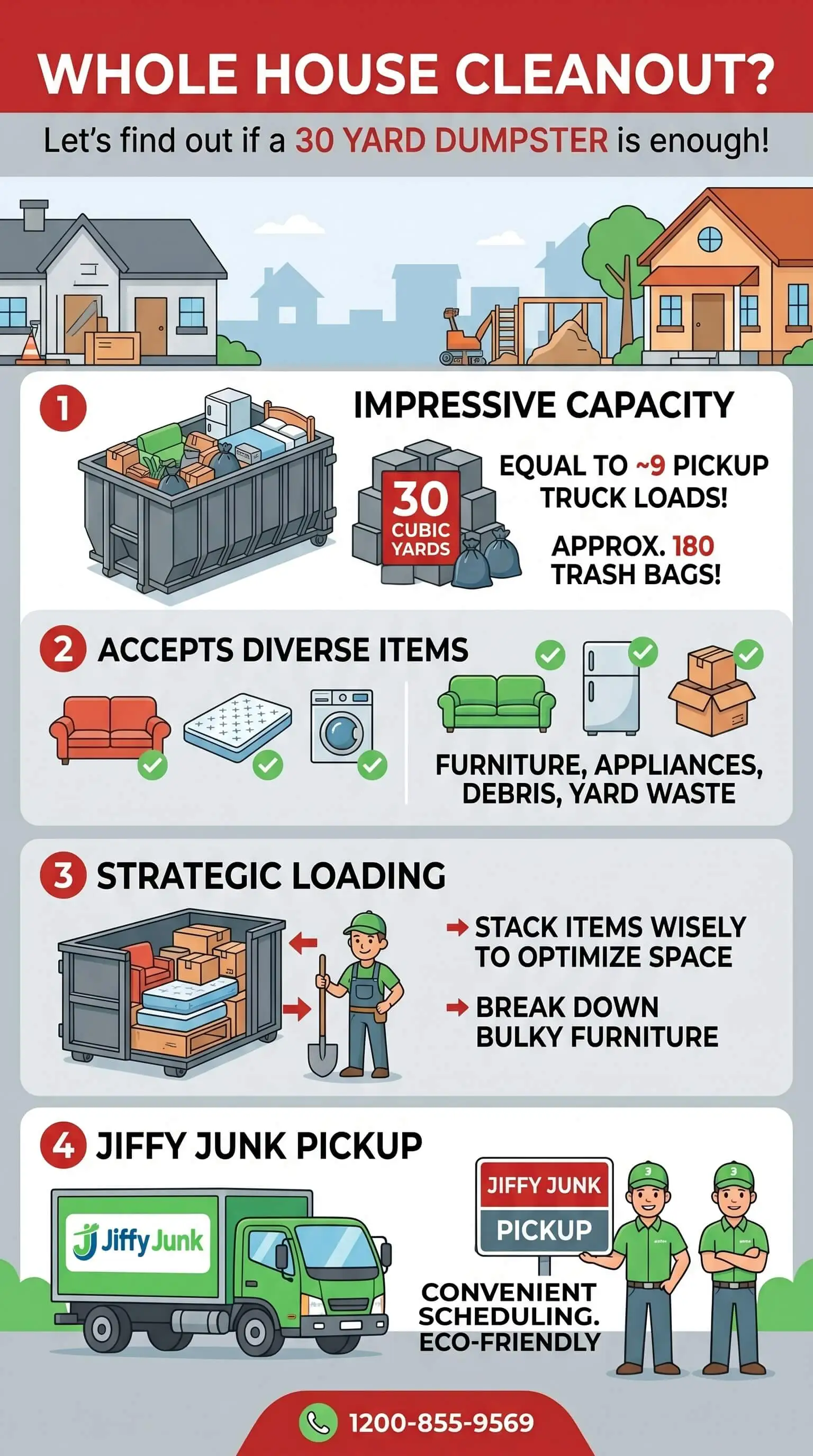
A 30 yard dumpster — sometimes called a 30 cubic yard roll-off — typically measures around 22 feet long, 8 feet wide, and 6 feet tall. That gives you 30 cubic yards of usable volume, or roughly 810 cubic feet. In real-world terms, that translates to about 9 standard pickup truck loads or 170 to 190 of the 33-gallon trash bags most people use for household cleanouts.
In the roll-off lineup, it sits between the 20 yard (good for medium projects) and the 40 yard (built for major construction or estate-scale clearouts). For most full-house cleanouts, the 30 yard is the workhorse size.
How Much Will Actually Fit Inside
Here's what a properly loaded 30 yard dumpster can typically hold from a whole house cleanout:
Living and bedroom furniture — sofas, mattresses, bed frames, dressers, dining sets
Boxed household goods, kitchenware, closet contents, and decor
Carpet and underlayment from the entire home
Old electronics like TVs and monitors (with hazardous-material caveats below)
A reasonable load of garage clutter, yard tools, and minor demolition debris
Most major appliances — though each fridge, washer, or dryer takes a serious bite out of the volume
Will a 30 Yard Dumpster Be Enough for YOUR Cleanout?
In our experience, the honest answer comes down to home size, density of belongings, and what you're keeping versus tossing.
Sizing by Home Square Footage
Under 2,500 sq ft: a 30 yard is typically more than enough — you may not even fill it
2,500 to 3,500 sq ft: this is the sweet spot — right-sized for a standard full cleanout
3,500 to 4,500 sq ft: borderline — depends heavily on how full the home is
Over 4,500 sq ft, hoarding situations, or estates with decades of accumulation: step up to a 40 yard, or plan for multiple hauls
Other Factors That Change the Math
Whether large appliances are being tossed (each one displaces real volume)
Construction debris like drywall, tile, and concrete (these hit weight limits long before they fill the box)
Pre-sorting donations, recyclables, and metal scrap — often shrinks your actual fill by 30 to 40 percent
How disciplined you are about breaking down bulky items before tossing them in
If you want a deeper breakdown of the exact dimensions, weight capacity, and rental pricing of a 30 cubic yard dumpster, Jiffy Junk's full size guide walks through the specs in detail and is a good follow-up read once you've sized up your project.
What You Can't Throw In (Even If It Fits)
This catches more people than any other rule. A 30 yard dumpster is built for general household debris, not hazardous waste. The following items are prohibited by nearly every hauler in the country, and most are regulated under EPA rules for household hazardous waste:
Paint, paint thinners, solvents, and stains (especially oil-based)
Tires (most haulers refuse them, or charge per-tire fees)
Car and household batteries
Refrigerators, freezers, and AC units containing freon (require certified refrigerant removal first)
Pesticides, herbicides, and pool chemicals
Medical waste, sharps, and pharmaceuticals
Asbestos and other regulated construction materials
If you're not sure where to take prohibited items, your local waste authority almost certainly runs a household hazardous waste collection day or has a permanent drop-off site, helping you keep roll off dumpster prices more predictable by avoiding extra disposal fees. The EPA's HHW guidance (linked in Resources below) is the right starting point.
Cost Range and Common Surprises
Rental rates vary by region and hauler, but a 30 yard dumpster typically runs $400 to $700+ for a 7 to 10 day rental. The two surprises that catch most homeowners off guard:
Weight overage fees: most rentals include 3 to 5 tons. Going over costs $50 to $100 per additional ton
Overfill refusal: if debris piles above the rim, the truck legally cannot haul it. Either pay to swap the dumpster or unload until it's level
“The single biggest predictor of whether a 30 yard dumpster will be enough isn't the square footage of the house — it's whether the homeowner pre-sorts. The cleanouts that go sideways are almost always the ones where everything goes in the dumpster by default. The ones that finish under budget are the ones where donations, scrap metal, and recyclables get pulled out first. A 30 yard handles a typical 3-bedroom home cleanout beautifully — but only if you're loading what truly belongs in a landfill, not the three decades of stuff someone could've actually rehomed.”
7 Essential Resources
These are the references I send clients and family members when they're planning a whole house cleanout. Every link is to a primary source — government agency, professional medical body, or established nonprofit — so you're getting verified information, not someone else's summary of it.
1. EPA — Household Hazardous Waste Guide. The federal definition of what counts as hazardous, why it can't go in a dumpster, and how to find local collection programs. epa.gov/hw/household-hazardous-waste-hhw
2. EPA — Construction & Demolition Debris Material Page. Material-specific data on what gets generated during home cleanouts and demolitions, including recovery rates by material. epa.gov/facts-and-figures-about-materials-waste-and-recycling/construction-and-demolition-debris-material
3. EPA — National Overview of Materials, Wastes & Recycling. The benchmark dataset for household waste generation per person per day in the US — useful context for sizing a dumpster. epa.gov/facts-and-figures-about-materials-waste-and-recycling/national-overview-facts-and-figures-materials
4. EPA — Sustainable Management of Construction & Demolition Materials. Practical guidance on deconstruction and material recovery — useful if you'd rather divert items from landfill before the dumpster comes. epa.gov/smm/sustainable-management-construction-and-demolition-materials
5. American Psychiatric Association — Hoarding Disorder. Essential reading if your cleanout involves a relative or estate where hoarding is in play. The cleanout strategy is fundamentally different in these situations. psychiatry.org/patients-families/hoarding-disorder
6. Earth911 Recycling Search. Enter any item plus your zip code to find the nearest legal disposal or recycling option. The EPA itself recommends this database for items that can't go in regular trash. search.earth911.com
7. Wikipedia — Dumpster (Reference Overview). A solid plain-English primer on roll-off and front-load containers, history, and standard sizes if you want background context. en.wikipedia.org/wiki/Dumpster
3 Statistics
These numbers help calibrate what's actually realistic when you start measuring debris volume against a 30 yard dumpster size.
Statistic 1: 600 Million Tons of C&D Debris Per Year
The EPA estimates that 600 million tons of construction and demolition (C&D) debris were generated in the United States in 2018 — more than twice the volume of municipal solid waste generated that same year. Whole house cleanouts that include any kind of demolition, renovation, or appliance removal feed directly into this stream. Source: US EPA, Construction and Demolition Debris.
Statistic 2: 4.9 Pounds of Trash Per Person, Per Day
The average American generates 4.9 pounds of municipal solid waste every single day, totaling roughly 1,789 pounds per person per year. Multiply that across a household of four over even a few years of un-decluttered accumulation, and the case for a 30 yard dumpster during a full cleanout becomes a lot more concrete. Source: US EPA, National Overview: Facts and Figures on Materials, Wastes and Recycling.
Statistic 3: 2.6% of Adults Experience Hoarding Disorder
The American Psychiatric Association estimates that hoarding disorder affects roughly 2.6% of the general population, with prevalence climbing significantly in adults over 60. If you're handling a parent's home, an inherited estate, or a long-term residence with severe accumulation, plan on a 40 yard dumpster — or multiple 30 yard hauls — and consider professional help that's trained for these specific situations. Source: American Psychiatric Association, Hoarding Disorder.
Final Thoughts and Opinion
Here's the unvarnished take after years of watching cleanouts succeed and stall: a 30 yard dumpster is the right answer for the majority of whole house cleanouts in this country, especially when small dumpster rental pricing makes it easy to compare upfront value and avoid the added cost of a second haul. It's the size that homeowners and estate executors most often need, it's the size that doesn't leave you with the regret of having ordered a 20 yard and hitting the rim halfway through the garage, and it's not so oversized that you're paying for empty air.
That said, the dumpster is a tool, not a strategy. The cleanouts that go smoothly are the ones where the homeowner spends a weekend pre-sorting before the container ever arrives — pulling donations to local charities, separating scrap metal for the recycler, setting aside electronics for proper drop-off, and identifying the household hazardous waste that legally cannot ride in a roll-off. That weekend of work routinely saves $200 to $500 in overage fees, frees up real volume in the dumpster, and keeps usable goods out of the landfill.
If pre-sorting isn't realistic — because the home is too far gone, because you're physically unable, or because you're an executor on a tight timeline — that's the moment to call a full-service junk removal team rather than rent the dumpster yourself. They'll bring the labor, the sorting expertise, and in most cases their own disposal channels for the tricky items. The cost is higher, but for the right situation it's the right call.
Frequently Asked Questions
How long is a 30 yard dumpster?
A standard 30 yard dumpster is approximately 22 feet long, 8 feet wide, and 6 feet tall, though exact dimensions vary slightly between haulers. Plan for about 60 feet of straight-line clearance for the delivery truck to drop and retrieve it.
How much weight can a 30 yard dumpster hold?
Most 30 yard dumpsters include a weight allowance of 3 to 5 tons (6,000 to 10,000 pounds). Heavy debris like concrete, brick, and tile will hit this limit before the box looks full, so haulers often steer those loads to smaller dumpsters with higher weight ratings.
Will a 30 yard dumpster fit in my driveway?
Yes — most residential driveways accommodate the 22-foot footprint without issue. The driveway material matters more than the size: dumpster trucks can crack older asphalt or stamped concrete, so professional haulers typically lay down plywood boards as protection.
Is a 30 yard dumpster big enough for a 4-bedroom house cleanout?
For a moderately full 4-bedroom home, yes, a 30 yard usually works. For a 4-bedroom with a finished basement, full attic, or 20+ years of accumulated belongings, a 40 yard is the safer choice or you'll need a second haul.
What can't I put in a 30 yard dumpster?
Common prohibited items include paint, tires, batteries, freon-containing appliances (fridges, freezers, AC units), pesticides, hazardous chemicals, medical waste, asbestos, and leftover chemical pest control products. Most regions also restrict electronics. When in doubt, check with your hauler before loading.
How much does it cost to rent a 30 yard dumpster for a week?
Pricing typically falls between $400 and $700+ for a 7 to 10 day rental, depending on region, hauler, weight included in the base rate, and seasonal demand. Always confirm what the quoted price covers — overage fees and trip fees can quickly inflate a low-looking base rate.
Do I need a permit for a 30 yard dumpster?
If the dumpster is sitting entirely on your private driveway, you usually don't need a permit. If it has to be placed on a public street, the answer is almost always yes, and your hauler can typically pull the permit on your behalf for a fee.
Ready to Tackle Your Cleanout?
If you've sized up your project and a 30 yard dumpster looks like the right fit, your next step is straightforward: confirm pricing with two or three local haulers, schedule delivery for the day before you actually start loading (so you have the full rental window), and spend the prior weekend pre-sorting donations, scrap, and household hazardous waste.
If the project feels bigger than what you want to handle yourself — whether that's because of square footage, mobility limits, an emotional estate cleanout, or a tight closing timeline — a full-service junk removal team will sort, lift, and haul on your behalf, including the prohibited items a dumpster can't accept. For most families, that one decision saves a weekend of heavy labor and the headache of orchestrating multiple disposal trips.
Whichever path you take, get a quote, get a calendar date, and get started. The hardest part of any whole house cleanout is the day you don't begin.