Learning how to dispose of an old refrigerator can be easier, safer, and more rewarding than most people expect. There are at least six legitimate ways to retire an old refrigerator without ever loading it onto a vehicle yourself. Some options are free. A couple will actually pay you. The trick is matching the right option to your situation, and knowing which EPA rules quietly apply behind the scenes so you can clear the space with confidence.
I've been writing about appliance disposal and household cleanout logistics for years, long enough to watch the same six options sort themselves into a clear hierarchy depending on what the homeowner actually needs. This guide reflects what works in 2026, not the recycled advice circulating on outdated blog posts. Here's the rundown.
TL;DR Quick Answers
How to dispose of an old refrigerator
There are six legitimate ways to dispose of an old refrigerator without owning a truck or trailer.
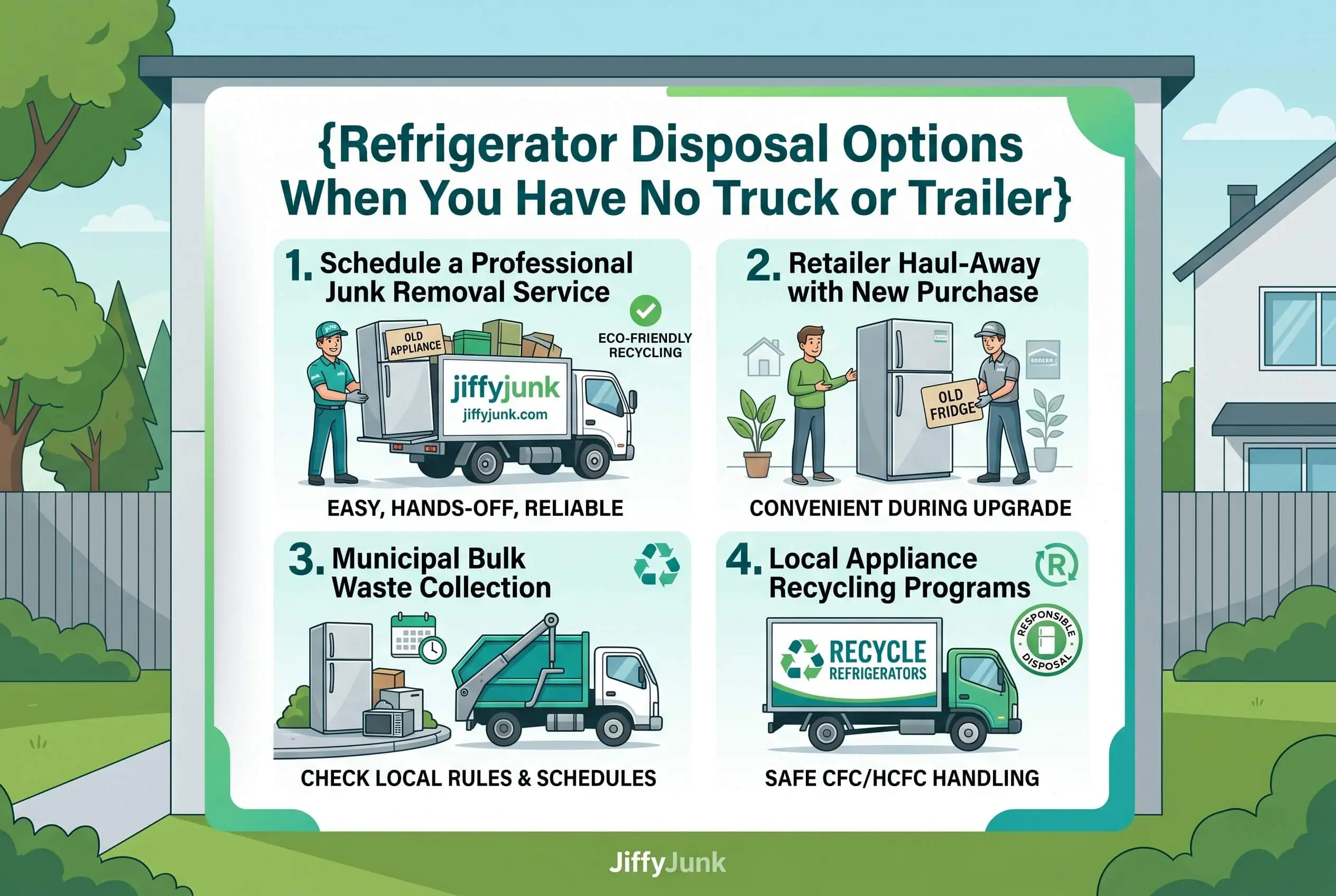
Book a junk removal service. Fastest option at $75 to $200 per unit, usually picked up within 24 to 48 hours. Crews handle the lift, the haul, and the EPA-compliant recycling chain.
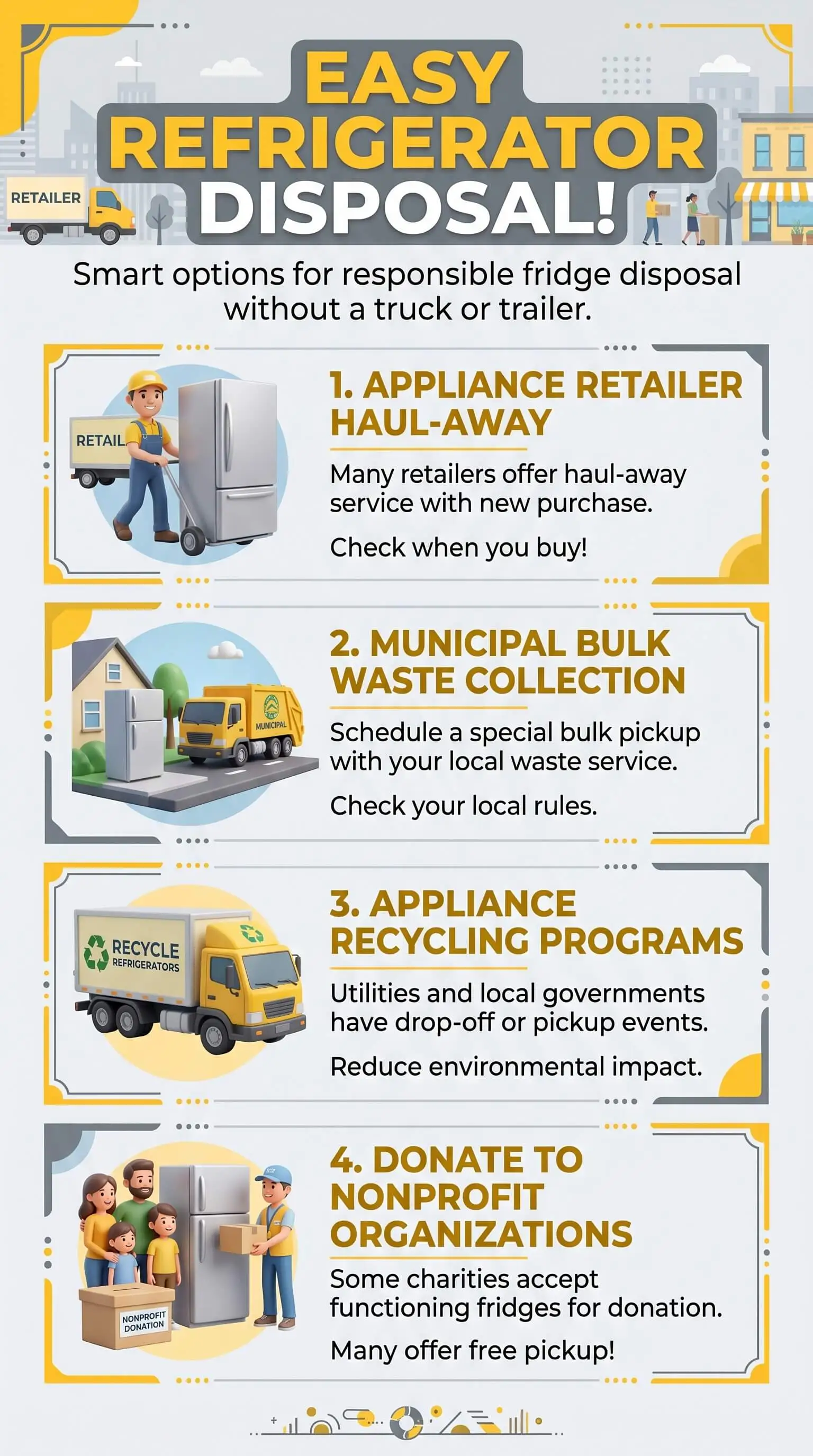
Retailer haul-away with a replacement purchase. Cheapest option at $0 to $50. Lowes, Home Depot, Best Buy, and Costco take the old unit when delivering the new one. The service has to be added at the time of purchase, not after.
Municipal bulk pickup. Free to $50. Call 311 or schedule through your city's public works website. Expect a one to four week wait.
Local recycling center or utility rebate program. Some utilities still pay $25 to $100 cash for retiring older working units. Check ENERGY STAR's recycling locator first.
Donate to Habitat for Humanity ReStore. Free pickup at most locations for working units under 10 years old, plus a tax-deductible donation receipt.
List free or low-cost on Facebook Marketplace, Craigslist, Nextdoor, OfferUp, or a local Buy Nothing group. The buyer brings the truck and the labor.
Don't leave the unit at the curb. It's a code violation in most US cities, and Section 608 of the Clean Air Act requires certified refrigerant recovery by a technician before any refrigerator can be legally scrapped.
Top Takeaways
There are at least six legitimate refrigerator disposal options that don't require you to own a truck or trailer: junk removal, retailer haul-away, municipal pickup, recycling center, donation, and local resale.
Leaving a refrigerator at the curb is illegal in most US municipalities and can carry first-offense fines of $100 to $500, with higher penalties under Section 608 of the Clean Air Act if refrigerant escapes.
Junk removal services typically run $75 to $200 per fridge, and they handle the lift, the haul, and the EPA-compliant recycling chain. Lowest-friction path when speed matters.
Retailer haul-away (Lowes, Home Depot, Best Buy, Costco) costs $0 to $50, but the service has to go on the order at the time of purchase, not after delivery.
Municipal bulk pickup runs cheap to free, but you'll need to schedule a separate appointment and wait one to four weeks.
A handful of utility companies still pay cash rebates of $25 to $100 for retiring older working refrigerators. Check ENERGY STAR's recycling locator first.
Working units less than 10 years old can go to Habitat for Humanity ReStore. Most locations pick up large appliances for free and issue a tax-deductible donation receipt.
Defrost the unit for at least 24 hours, empty completely, and tape or remove the doors before any pickup arrives.
Refrigerator Disposal Options Without a Truck
The six options sort by priority. Match yours to one of four categories: speed, cost, environmental impact, or sheer convenience. Then commit to that path.
Option 1: Schedule a Junk Removal Service
Fastest option on the list, and the one I recommend first when there's a deadline involved. A two-person crew shows up at your home, picks the refrigerator up from wherever it's sitting (kitchen, garage, basement, third-floor walkup) and hauls it away in a single trip. You don't touch the unit at all. The booking is the only piece you handle yourself. Most national operators run the EPA-compliant recycling chain on the back end, so the refrigerant gets recovered properly and you stay clear of any disposal violations.
Pricing for a single refrigerator usually lands between $75 and $200, which sounds steep until you stack it against the alternative: renting a truck, finding helpers, driving to a transfer station, and burning a Saturday. If you're working against a tight closing date, a lease handoff, or a same-week move, booking professional fridge pickup and haul-away services is the path of least resistance. Best fit: tight timelines, high-rise apartments, multi-flight stairs, and estate cleanouts where several appliances are going out at the same time.
Option 2: Retailer Haul-Away with a Replacement Purchase
If you're buying a replacement anyway, retailer haul-away is the cheapest path. Lowes, Home Depot, Best Buy, Costco, and most regional appliance dealers will take the old unit when they deliver the new one. The fee runs from free (usually included with delivery of a comparable model) to about $50. The catch is timing: the haul-away service has to go on the order at the time of purchase, not after. Day-of add-ons get refused almost every time, and the delivery crew won't accept a unit you haven't emptied, defrosted, and unplugged in advance. Best fit: one-for-one replacements.
Option 3: Municipal Bulk Pickup
Most US cities run some kind of bulk item pickup, and refrigerators usually make the eligible list, though with caveats. You'll need to schedule the pickup separately from regular trash service, and the wait runs anywhere from one to four weeks depending on the city. Costs land between free and about $50. Many cities require you to remove the doors or tape them shut for child-safety reasons before the unit goes curbside. Call 311 in most US metros, or search your city's website for 'bulk item pickup' or 'white goods collection' to confirm the current rules. Best fit: budget-conscious disposers with a few weeks of flexibility.
Option 4: Local Recycling Center & Utility Rebate Programs
A handful of regional utility companies still pay homeowners to recycle older, working refrigerators that draw excess electricity. The rebate is usually $25 to $100 per unit, sometimes with free pickup folded in. The program landscape has shrunk over the past decade, but utilities in California, Maryland, Wisconsin, and Colorado still run active programs as of 2026. Outside those, your local appliance recycling center or scrap metal yard will take the unit for free or for a small fee. Most centers will accept a drop-off but won't pick up, which means this option fits best if you can borrow a truck or pair it with a junk removal service that delivers to a recycler. The payoff is real: the refrigerant, the foam insulation, and any mercury switches all get recovered properly under EPA guidelines. Best fit: eco-priority disposers who want certainty about how the unit gets handled at end-of-life.
Option 5: Donate a Working Refrigerator
If the fridge still works and isn't more than 10 years old, donation is one of the most underused options on this list. Habitat for Humanity ReStore locations across the country accept working appliance donations, and many offer free pickup. Regional Salvation Army and Goodwill chapters often do the same depending on the area. The math is clean: a fair-market-value tax deduction for you, less load on the recycling stream, and a family who needs a fridge gets one. Best fit: clean, functional units in good cosmetic shape where the donor wants the write-off or just prefers not to scrap something useful.
Option 6: Sell or Give Away on Local Marketplaces
Facebook Marketplace, Craigslist, Nextdoor, OfferUp, and Buy Nothing groups all see steady demand for working refrigerators. Working full-size units typically move at $50 to $300 depending on age and brand. Free listings often get claimed within twenty-four hours, and the buyer handles everything from there: the truck, the labor, and the load-out. A few safety notes. Meet at the property with another adult home, make the buyer do the lifting themselves, and don't share your address with anyone you haven't already vetted through messages. Best fit: working units where the owner wants a small return or a quick zero-cost handoff.
Why You Shouldn't Just Leave It at the Curb
One quick note before moving on. Leaving a refrigerator at the curb isn't a free disposal option. In most US cities it's a code violation that carries fines of $100 to $500 for a first offense, and substantially more if the refrigerant escapes into the atmosphere. Under Section 608 of the Clean Air Act, the refrigerants in modern refrigerators have to be recovered by a certified technician before the appliance can be legally dismantled or scrapped. That includes hydrofluorocarbons like R-134a and R-600a (isobutane), and the older CFC and HCFC refrigerants found in pre-1995 units. Here's the relief: every option on this list handles refrigerant recovery for you, so this isn't something you have to think about, as long as you pick one of them.
"The biggest mistake I see homeowners make with refrigerator disposal is treating it like a garbage problem when it's really a logistics problem. People burn an entire weekend coordinating a borrowed truck, two helpers, and a transfer station run, only to find out the transfer station charges a refrigerant recovery fee they hadn't budgeted for, or that the city tagged their fridge at the curb because they didn't know an appointment was required. After watching this play out hundreds of times across cleanouts, moves, and estate handoffs, my honest read is this: pick the option that fits your actual constraint, and commit to it. If time is what matters most, book a junk removal service today. For homeowners watching the budget, municipal pickup is the right answer (even with the three-week wait). And if environmental impact is the lever you care about, route through a utility rebate program or a RAD-certified recycler. Trying to satisfy all three at once is exactly what leaves a fridge sitting in a driveway for two months."
7 Essential Resources
These are the primary-source references I keep on hand and point readers toward when they ask. Bookmark them. They're more reliable than the recycled blog posts that clog up search results.
1. EPA Responsible Appliance Disposal (RAD) Program. The federal program that sets the standard for recovering refrigerants, foam blowing agents, and hazardous components from end-of-life appliances. Includes a consumer guide and a partner directory. https://www.epa.gov/section608/appliance-disposal
2. EPA Section 608: Stationary Refrigeration and Air Conditioning. The Clean Air Act framework that governs refrigerant handling and disposal in the US. Worth reading if you want to know exactly why curbside dumping is illegal. https://www.epa.gov/section608
3. ENERGY STAR Find a Fridge or Freezer Recycling Program. A nationwide directory of refrigerator recycling programs, including utility rebate programs and retailer recycling partners. Searchable by ZIP code. https://www.energystar.gov/products/recycle/find_fridge_freezer_recycling_program
4. ENERGY STAR Flip Your Fridge Calculator. Calculates how much your old refrigerator is costing you in electricity, and how much you'd save by replacing it with a certified model. Especially useful if you're trying to decide whether to retire a working second fridge in the basement or garage. https://www.energystar.gov/products/refrigerators/flip-your-fridge
5. Earth911 Recycling Center Search. The most extensive recycling locator in North America, with over 100,000 listings and 350+ accepted materials. Drop in 'large appliances' and your ZIP code to find local drop-off and pickup options. https://search.earth911.com/
6. Habitat for Humanity ReStore Donation Locator. Find your nearest Habitat ReStore to donate a working refrigerator. Most locations pick up large appliances for free and will issue a tax-deductible donation receipt. https://www.habitat.org/restores/donate-goods
7. Earth911 Guide: How to Recycle Large Appliances. A practical, regularly updated guide to large appliance recycling. Includes state-specific landfill ban information and a clear walkthrough of how the recycling process actually works. https://earth911.com/recycling-guide/how-to-recycle-large-appliances/
3 Statistics
Three numbers that should reframe how you think about this.
Statistic 1: Between 2006 and 2025, EPA Responsible Appliance Disposal partners processed over 9 million refrigerated appliances and recycled 1.5 billion pounds of metals, plastics, and other durable materials, while safely disposing of more than 543,000 internal components containing hazardous substances such as mercury and contaminated oils. Source: U.S. EPA: Appliance Disposal
There's a built-out nationwide infrastructure for handling refrigerators responsibly. You're not the first homeowner to face this problem, and you're not on your own. The hard part has already been solved. Your only real job is picking which path into that infrastructure makes sense.
Statistic 2: There are approximately 132 million household refrigerators and 54 million stand-alone freezers in the United States, with 15 to 20 percent of households operating a second refrigerator or freezer (typically older, less efficient units kept in basements or garages). Source: ENERGY STAR: Recycling with RAD
Translation: that second fridge running quietly in your garage is almost certainly costing more in electricity than its convenience is worth. The ENERGY STAR Flip Your Fridge calculator will show you the exact annual figure, and depending on your utility, you may be eligible for a rebate when you retire it.
Statistic 3: If every US refrigerator that is fifteen years old or older were replaced with an ENERGY STAR certified model, Americans would save more than $1 billion in annual energy costs. That's enough energy to power 800,000 homes and prevent 12 billion pounds of greenhouse gas emissions. Source: U.S. EPA: Flip Your Fridge Initiative
Worth holding onto: disposing of an old, inefficient fridge isn't just a logistics chore. It's a household-level decision with real environmental and financial weight. Choosing a recycling-first path over a landfill path actually matters when you think about it at scale.
Final Thoughts and Opinion
I've written about this topic enough times to have a strong opinion, so I'll share it. Most homeowners overthink refrigerator disposal. They compare six options, read ten articles, ask three friends, and then the fridge sits in the kitchen for another month while they deliberate. The decision actually isn't that hard once you've named your real constraint.
Once you've named it, the right path usually picks itself. Time-pressured homeowners should book a junk removal service today. The $129 spend is cheaper than the time you'd lose coordinating any other option, and the unit is gone within 48 hours. Budget-conscious homeowners get the most value from a municipal bulk pickup. Schedule it, tape the doors shut, and accept the three-week wait. Environmentally focused homeowners should route the fridge through a utility rebate program or a RAD-certified recycler, and check whether the replacement qualifies for an ENERGY STAR rebate while they're at it. Anyone buying a replacement should just add the retailer haul-away at checkout. The price gap between adding it and skipping it never gets smaller than at that moment.
What gets people in trouble is trying to satisfy speed, cost, and environmental impact at the same time. Those goals pull in different directions, which is exactly why a fridge ends up sitting in a driveway for eight weeks, and even top pest control companies would agree that leaving large appliances outside too long can invite unwanted issues. Pick one priority and commit to it. The fridge doesn't deserve any more of your weekend than it's already taken.
Frequently Asked Questions
Can I leave my old refrigerator at the curb?
In most US municipalities, no. Standard trash service doesn't cover refrigerators, and putting one out curbside without scheduling a separate appliance pickup usually violates local code. First-offense fines run from about $100 to $500, and substantially higher if the refrigerant escapes. Schedule a pickup, or use one of the six options above.
Will Home Depot or Lowes haul away my old refrigerator?
Yes. Both retailers offer haul-away when you purchase a replacement, typically for $0 to $50 depending on the model and whether you went with paid delivery. Best Buy, Costco, and most regional appliance dealers offer the same service. The catch is timing. Haul-away has to go on the order at the time of purchase. Calling after delivery to add it is almost always too late.
How much does refrigerator removal cost in 2026?
It depends on which option you pick. Junk removal services typically run $75 to $200 for a single refrigerator. Retailer haul-away costs $0 to $50 with a replacement purchase, and municipal pickup falls somewhere between free and about $50 depending on the city. Recycling center drop-off is usually free aside from the cost of getting the unit there. Donating costs nothing and may yield a tax deduction at fair market value.
Does the city pick up old refrigerators?
Most US cities run some form of bulk item or appliance pickup, but it's almost always a separate service from regular trash collection. You have to schedule it ahead. Wait times typically run one to four weeks. Call 311 in most metro areas, or pull up your municipality's public works site and search 'bulk item pickup' or 'appliance collection' to confirm the current rules and any fees.
Do utility companies still pay you to recycle old refrigerators?
Some do. The program landscape has narrowed since its peak in the 2010s, but utilities in California, Maryland, Wisconsin, Colorado, and parts of the Pacific Northwest still offer cash rebates of $25 to $100 for retiring older, working units. The ENERGY STAR recycling locator will tell you whether your local utility participates.
How long should I unplug a refrigerator before pickup?
At minimum 24 hours. Chest freezers and units with heavy ice buildup need longer. The unit has to be fully defrosted before any pickup crew will accept it, and the runoff is heavier than most people expect, so put towels down. Empty the interior, wipe down surfaces with a baking soda solution to neutralize odors, and either tape the doors shut or remove them if your municipality requires it.
Is it illegal to throw a refrigerator in a regular dumpster?
In most cases, yes. Twenty-two US states have banned major appliances from landfills outright, including California, Florida, Illinois, Massachusetts, New York, and Pennsylvania. Federal law under Section 608 of the Clean Air Act also requires refrigerant recovery before disposal. Even where landfills technically accept appliances, most charge a separate refrigerant recovery fee, and improper disposal can carry significant fines.
Do I need to remove the refrigerator doors before pickup?
Depends on which option you pick. Many municipal pickup programs require doors removed or taped shut for child-safety reasons. There's a long history of children getting trapped in discarded refrigerators, which prompted federal and state-level safety laws decades ago. Junk removal services and retailer haul-away crews don't typically require door removal because they take the unit out immediately. When in doubt, tape the doors shut with strong duct tape. It's the universal default that satisfies every program.
Ready to Get the Old Fridge Out of Your Kitchen?
If you've read this far, you've probably already figured out which option fits. The next step is the easy one. Pick up your phone or open your laptop and get it booked. The fridge doesn't deserve another weekend of your life.
Three-Step Action Plan
Name your priority. Speed, cost, or environmental impact. Trying to win on all three is what stalls the decision.
Pick the matching option from the six above. Confirm prep requirements before you call (defrost time, door-tape rules, scheduling windows).
Book it today. Call your utility, schedule with the city, list on Marketplace, or book a same-day junk removal crew. Do it now while the decision is still fresh.
Have a refrigerator disposal story, a regional rebate program worth knowing about, or a question this guide didn't answer? Drop it in the comments below. I read every comment, and I update the article when readers surface something new. And if this guide saved you a weekend of frustration, share it with somebody who needs it. There's always a friend or family member with a fridge sitting in their garage they've been meaning to deal with for two years.