Most renters ask how much does it cost to rent a small dumpster and get back a national average of $250 to $550 for a seven-day rental. That number is roughly right. It also hides almost everything that moves the price.
This guide walks through what a small dumpster actually costs in 2025, the six variables that swing the bill, the hidden fees buried in the rental agreement, and the sizing decision that costs first-time renters the most money.
TL;DR Quick Answers
How much does it cost to rent a small dumpster?
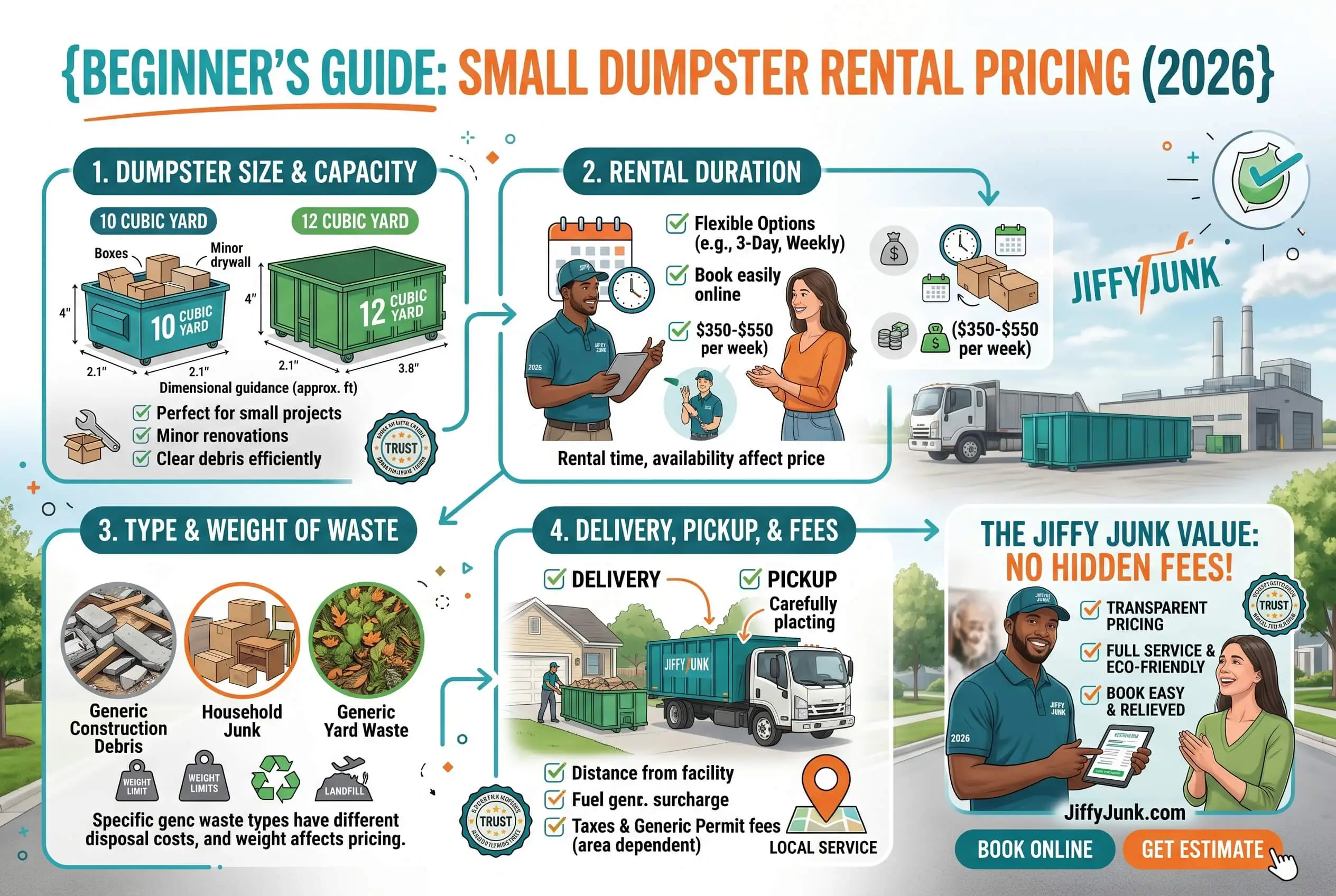
A small (10-yard) dumpster rents for $250 to $450 in most U.S. markets for a standard seven-day rental. A 15-yard run $325 to $525. A 20-yard, the largest unit most haulers still file under "small," typically lands between $375 and $600.
What moves the price within those ranges:
Region. Northeast metros pay an average of $80.67 per ton in landfill tipping fees, well above the South Central average of $44.87 (EREF, 2024). That gap shows up directly in your quote.
Weight allowance. Most small dumpsters include 1 to 3 tons. Going over triggers an overage fee of $40 to $100 per additional ton.
Rental length. Seven days is the residential default. Extension days run $5 to $15 each.
Permit. Add $25 to $100 if the dumpster sits on a public street rather than your driveway.
Debris type. Light loads (household clutter, furniture, yard trimmings) keep costs down. Concrete, brick, dirt, and shingles often require dedicated heavy-debris dumpsters at different rates.
The single best move before booking: get three quotes and walk through your specific project with each hauler. Pricing variation between haulers in the same zip code regularly hits 30 percent.
Top Takeaways
A 10-yard small dumpster rents for $250 to $450 in most U.S. markets, and 15- and 20-yard units climb from there
Six variables drive what you actually pay: size, rental length, weight allowance, debris type, location, and permits
Hidden fees (overages, trip fees, prohibited items, disposal surcharges) live in the rental agreement, not in the website quote
Northeast renters typically pay 30 to 50 percent more than the national average. Rural markets pay less.
Wrong-sized rentals cost more than oversized ones — overage fees outpace empty capacity every time
Three quotes from local haulers regularly turns up a 30 percent pricing spread within a single zip code
For loads under a pickup truck's worth, full-service junk removal often beats a dumpster on total cost
What a Small Dumpster Actually Costs
Across most U.S. markets in 2025, a 10-yard dumpster runs $250 to $450 for a standard seven-day rental. A 15-yard sits between $325 and $525. A 20-yard, the largest unit most haulers still file under "small," tends to land between $375 and $600. Coastal metros (New York, Boston, San Francisco, Seattle) routinely come in 30 to 50 percent above the national average. Rural markets sit below it.
A 10-yard dumpster holds roughly three pickup truck loads of debris. That works out to about 60 standard trash bags, plus room for a few pieces of bulky furniture items. The dumpster footprint runs about 12 feet long, 8 feet wide, and 3.5 feet tall, which fits on a standard two-car driveway with walking room on three sides.
Quick Price Reference
10-yard: holds about three pickup truck loads. National price range for a seven-day rental: $250 to $450
15-yard: holds about four to five pickup truck loads. National price range for a seven-day rental: $325 to $525
20-yard: holds about six pickup truck loads. National price range for a seven-day rental: $375 to $600
Six Variables That Move the Price
Six factors do most of the heavy lifting on what a renter actually pays.
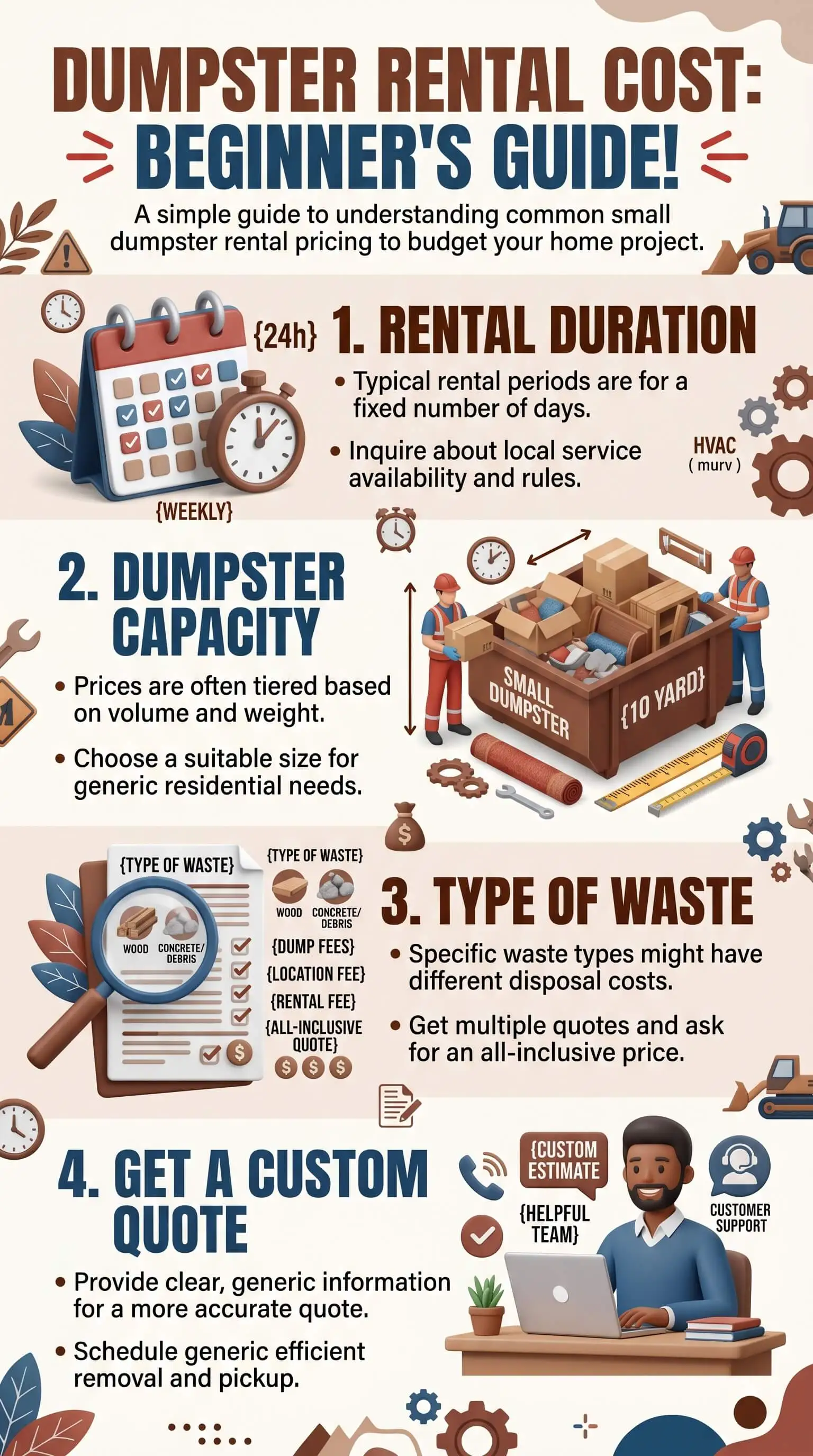
Size. Bigger units cost more upfront, but the price per cubic yard drops as you size up. Right-sizing matters more than chasing the cheapest sticker.
Rental length. The default is seven to ten days. Extension days run $5 to $15 each. Short-handed projects often need an extension. Padded ones rarely do.
Weight. Most small dumpsters include a one-to-three ton allowance. Anything over that triggers an overage fee, usually $40 to $100 per additional ton. Concrete, dirt, and roofing shingles fill weight allowances fast.
Debris type. Light loads (household clutter, furniture, cardboard, yard trimmings) keep costs down. Heavy loads like concrete, brick, and dirt often require dedicated heavy-debris dumpsters at different price tiers.
Location. Landfill tipping fees vary by region. Northeastern landfills averaged $80.67 per ton in 2024, well above the South Central average of $44.87, per EREF data. That gap shows up directly in what renters pay.
Permits. If the dumpster sits on a public street rather than your driveway, your municipality may require a permit. Permit costs run $25 to $100 in most cities.
The Hidden Fees Most Renters Don't See Coming
Six line items deserve attention before you sign anything:
Tonnage overage fees, charged per ton beyond the included weight
Trip fees if the truck arrives and can't service the unit
Late fees for keeping the dumpster past your rental window
Prohibited item fees for tossing batteries, tires, paint, electronics, or anything classified as household hazardous waste
Disposal or environmental surcharges itemized separately from the base rental
Fuel fees, often a small fixed line item
All of these show up in the rental agreement. None of them are illegal. They just don't appear in the headline price the website quotes.
Rental Periods Explained
Seven-day rentals are the residential default. Ten-day windows are common on renovation projects with mid-week loading days. Fourteen-day rentals usually get negotiated up front and priced higher. If a project runs long, calling for an extension before your end date is almost always cheaper than paying the late fee after.
Where Beginners Save the Most Money
Five tactics deliver the biggest savings on a first-time rental:
Get three quotes. Pricing variation between haulers in the same zip code regularly hits 30 percent.
Right-size on the first try. Under-sizing forces a swap or overage. Oversizing wastes capacity you paid for.
Time the rental around your loading days. If your demo runs Saturday and Sunday, don't take delivery on Monday.
Ask about flat-rate pricing. Beginners do better with flat-rate quotes than with variable per-ton pricing.
Compare against full-service junk removal for small loads. For under a pickup truck of debris, junk removal often beats a dumpster rental on total cost.
For a deeper pricing breakdown that compares small residential units against larger roll-off options across real-world cost scenarios, the Jiffy Junk team published a detailed walkthrough on small and roll-off dumpster rental prices that pairs well with this guide.
"After working with hundreds of homeowners on cleanouts and renovations, the pattern that surprises me most isn't sticker shock. It's how often a renter signs up for the wrong size. A 15-yard for what should have been a 10-yard. A 10-yard for what really needed a 20-yard roll-off. Sizing matters more than the dollar figure on the quote, because the quote isn't the final price. The final price is the quote plus whatever happens when reality meets the dumpster you actually ordered. The single best move a beginner can make is twenty minutes on the phone with the hauler before booking, walking through the project out loud. That conversation saves more money than any coupon code I've seen."
7 Essential Resources
Every link below points to a current authoritative source. Bookmark them before your first rental.
EPA's National Overview: Facts and Figures on Materials, Wastes and Recycling. The federal benchmark for what Americans throw away each year. Useful context for understanding what your dumpster is actually contributing to.
EPA's Construction and Demolition Debris Material-Specific Data. Breaks down the debris categories most often loaded into residential dumpsters: drywall, shingles, concrete, wood products, brick.
EPA Household Hazardous Waste (HHW) page. The definitive list of items that can't go in a residential dumpster. Read this before you book.
EPA Sustainable Management of Construction and Demolition Materials. Guidance on diverting C&D debris from landfills, useful for renovation projects where reuse may save you weight on the dumpster bill.
EPA Reducing and Reusing Basics. Practical pre-rental checklist for what to donate, sell, or repurpose before paying to haul it away.
Harvard's Leading Indicator of Remodeling Activity (LIRA). Quarterly projections on national home improvement spending from the Joint Center for Housing Studies. Tracks the demand-side pressure on hauler pricing.
Environmental Research & Education Foundation Analysis of MSW Landfill Tipping Fees. EREF's annual report on landfill disposal costs by state and region. The single best resource for understanding why a dumpster costs more in Boston than in Tulsa.
3 Statistics
1. Americans generated 292.4 million tons of municipal solid waste in 2018, or about 4.9 pounds per person per day. Source: EPA, National Overview: Facts and Figures on Materials, Wastes and Recycling
2. The U.S. national average landfill tipping fee reached $62.28 per ton in 2024, a 10 percent increase over 2023 and the largest single-year jump since 2022. Source: Environmental Research & Education Foundation, Analysis of MSW Landfill Tipping Fees, 2024
3. Total annual U.S. homeowner spending on improvements and repairs is projected to reach $522 billion by the end of 2026. Source: Harvard Joint Center for Housing Studies, Leading Indicator of Remodeling Activity, January 2026
Why these matter for a small dumpster rental: tipping fees set the floor on what your hauler must charge. Renovation activity sets the demand pressure on hauler availability. The total waste figure puts the size of your project in context. Together, they explain why the same 10-yard dumpster can cost $289 in one zip code and $612 in another.
Final Thoughts and Opinion
Most renters overpay because they treat the dumpster like a commodity and the hauler like a vendor. A dumpster rental is a logistics decision wrapped around a project, and the hauler knows the local landfill quirks, weight rules, and permit traps your zip code holds.
The question that beats every coupon code: "What size did you put on the last project that looked like mine?" If the hauler answers quickly and specifically, the rental is going to go fine. If they hedge or default to recommending the largest available size, get another quote.
Frequently Asked Questions
How much does it cost to rent a small dumpster for a weekend? Most haulers don't price weekends as a standalone tier. You'll pay the seven-day rate even for a two-day project, which lands at $250 to $450 for a 10-yard unit in most markets.
Can I throw furniture in a small dumpster? Yes. Most household furniture goes in a small dumpster without issue, though some haulers add a small fee for mattresses and box springs because of local landfill restrictions.
Do I need a permit? Only if the dumpster sits on a public street, sidewalk, or alley. Driveways and private property typically don't require one. Permits run $25 to $100 in most municipalities.
What can't I throw in? Household hazardous waste (paint, batteries, motor oil, pesticides, electronics, tires, asbestos, refrigerants) cannot go in a residential dumpster, including materials tied to pest control methods. The EPA's Household Hazardous Waste page lists the full set.
Is dumpster rental cheaper than junk removal? Depends on the load. For under a pickup truck's worth (usually one or two large items), full-service junk removal beats a dumpster on total cost. Multi-day projects with steady volume favor the dumpster.
What happens if I go over the weight limit? Overage fees apply. Most haulers charge $40 to $100 per additional ton above the included allowance. Heavy materials like concrete, brick, shingles, and dirt hit weight limits fast, so flag the load type when you book.
Bookmark This for the Next Cleanout
Renting a dumpster gets easier the second time around. Save this guide for your next project, share it with the neighbor mid-renovation who keeps asking what size to order, and treat the first phone call to the hauler as the most important twenty minutes of the rental. The next dumpster decision goes faster when the price isn't the surprise.