This guide covers how the 10 yard dumpster size offers practical capacity for the right projects, what fits comfortably, what can exceed its weight limit, which jobs suit the size, and which projects need something bigger. It also walks through the loading mistakes that turn a clean rental into an overage bill. By the end, you'll know whether 10 yards is the right call before you book, and you'll have the EPA and industry references to verify any of it for your situation.
TL;DR Quick Answers
10 yard dumpster size
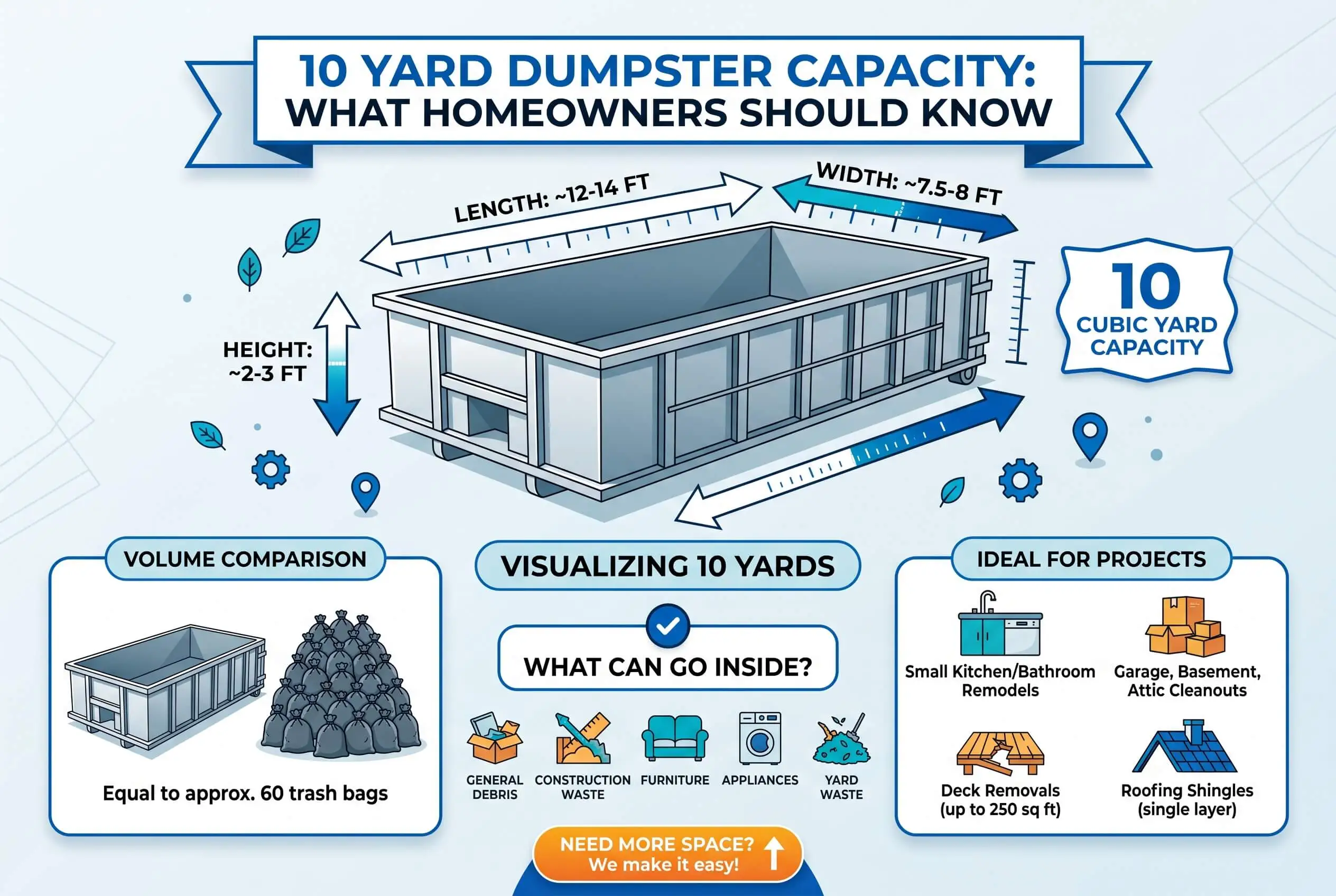
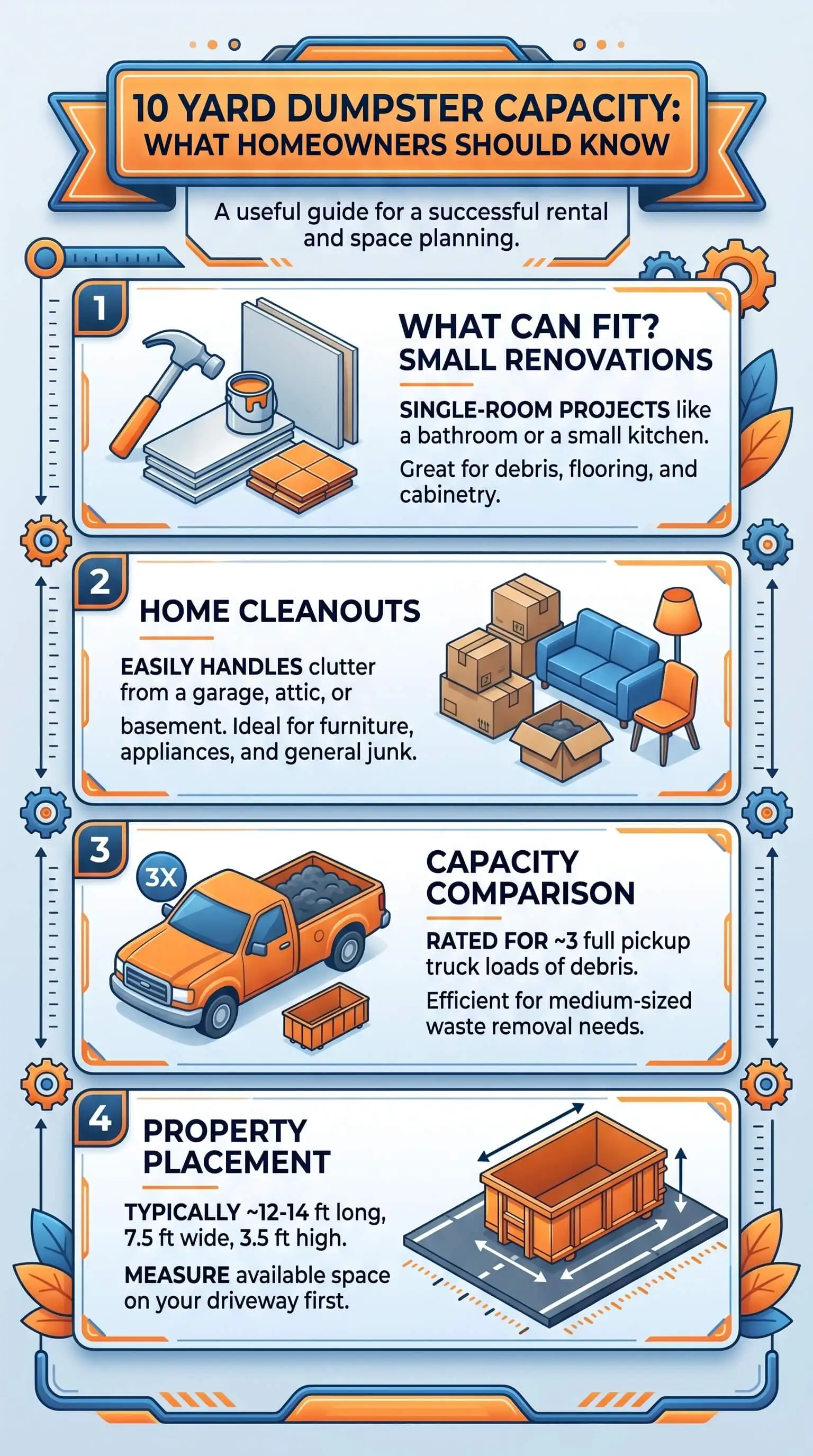
A 10 yard dumpster is the smallest roll-off most rental companies offer. It holds 10 cubic yards of debris (about 3 pickup truck loads or 50 to 70 trash bags) and typically measures 12 to 14 feet long, 7 to 8 feet wide, and 3.5 to 4 feet tall, with a weight limit of 1 to 2 tons.
Key specs at a glance:
Volume: 10 cubic yards
Footprint: roughly the size of one parking space
Weight allowance: 2,000 to 4,000 pounds
Best fit: single-room renovations, garage cleanouts, small roofing jobs
Common pitfall: heavy materials like tile, concrete, and shingles trigger overage fees long before the container looks full
The honest take from the homeowner cleanouts we've researched: weight, not volume, is what determines whether a 10 yarder fits your project.
Top Takeaways
Dimensions: 12 to 14 ft long, 7 to 8 ft wide, 3.5 to 4 ft tall. About the footprint of one parking space.
Capacity: 10 cubic yards, or roughly 3 pickup truck loads or 50 to 70 trash bags.
Weight limit: 1 to 2 tons (2,000 to 4,000 lbs). This is what triggers overage fees, not volume.
Best for: Single-room renovations, garage cleanouts, small roofing jobs, moderate landscaping.
Wrong for: Whole-house cleanouts, multi-room renovations, large roofs, estate cleanouts, major demos.
Heavy materials warning: Concrete, tile, and shingles max out the weight limit long before they fill the volume.
Pro move: Use a weight calculator before booking, and pay for higher tonnage upfront if you're borderline.
How Big Is a 10 Yard Dumpster, Really?
A 10 yard dumpster, specifically the roll-off variety used for residential cleanouts, holds 10 cubic yards of debris. That works out to roughly three pickup truck loads, or 50 to 70 standard 13-gallon trash bags. Most providers build their containers to measure 12 to 14 feet long, 7 to 8 feet wide, and 3.5 to 4 feet tall, with a weight limit between 1 and 2 tons.
Picture it sitting in your driveway: a parking space with a few feet of clearance on each side. The low 4-foot wall is the underrated feature here. You can toss items over the side without a ladder, which matters more than you'd think when you're moving 50+ trash bags out of a garage.
Quick Capacity Reference
Volume: 10 cubic yards (about 3 pickup truck loads)
Length: 12 to 14 feet (about one parking space)
Width: 7 to 8 feet (standard driveway width)
Height: 3.5 to 4 feet (waist-high; load over the side)
Weight limit: 1 to 2 tons, or 2,000 to 4,000 lbs (about 50 to 70 trash bags)
Exact dimensions vary by manufacturer and rental company, so confirm specifics with your provider before delivery day.
Best Projects for a 10 Yard Dumpster
This size handles a specific set of jobs well:
Single-room renovations: Bathroom or kitchen remodels generate debris that fits comfortably without paying for excess capacity.
Garage and attic cleanouts: Years of accumulated boxes, tools, and old furniture from one storage area typically max out right around 10 yards.
Small roof replacements: A roof up to about 1,500 square feet usually stays in range, though watch the weight on shingles.
Landscaping projects: Shrub removal, sod replacement, or moderate tree trimming.
Pre-move decluttering: Downsizing or clearing unwanted items before a move.
When You Should Size Up
Here's the part most rental websites won't tell you. 10 yards is too small for a lot of projects people try to use it for. The pattern we see often: homeowners fill a 10 yarder halfway through day one of a whole-house cleanout, then scramble for a second container at full price. The honest list of when to skip 10 yards and go straight to 15 or 20:
Whole-house cleanouts (try a 20 or 30 yard)
Multi-room renovations
Roof replacements over 1,500 square feet
Estate cleanouts and foreclosure cleanouts
Major demolition projects
If you're already asking yourself "will 10 yards be enough," your gut is usually right. The cost gap between sizing up and ordering a second container is rarely close.
The Weight Limit Trap Most Renters Fall Into
First-time renters fixate on whether their stuff will physically fit. The more expensive question is whether the weight will trigger overage fees. A 10 yarder filled with cardboard barely registers on the scale. The same container half-full of broken concrete blows past 2 tons before you notice.
Common materials and what they weigh:
100 sq ft of asphalt shingles: 200 to 240 pounds (heavier for architectural or slate)
Bathroom's worth of ceramic tile: about 500 pounds [VERIFY]
Concrete debris: roughly 150 pounds per cubic foot
Because weight matters more than volume, it's worth comparing pricing tiers (including overage fees) before booking. For a detailed 10 cubic yard dumpster rental cost guide that breaks down weight allowances, overage fees, and project-specific pricing, this resource from Jiffy Junk covers what most rental quotes leave out.
Smart Loading Tips That Actually Save You Money
Disassemble bulky items first. Breaking down furniture, cabinetry, and shelving before they go in lets you fit roughly twice as much in the container.
Place heavy items at the bottom. Bricks, concrete pieces, and dense debris go in first for stability.
Pack vertically. Stacking items rather than tossing them flat puts the full 3.5 to 4 feet of container height to work.
Fill empty pockets. Smaller debris and bagged items can fill the gaps between large pieces.
Stay below the rim. Most rental contracts prohibit loading above the top edge, and you'll pay a fee if the driver can't legally haul it.
Separate prohibited items in advance. Batteries, tires, paint, refrigerants, and electronics typically can't go in any roll-off.
"The mistake I keep seeing homeowners make is treating a 10 yard dumpster like it's the cheapest option, full stop. It is the cheapest sticker price, but loading it with the wrong materials erases that advantage fast. A bathroom tile demo can trigger a $200 overage fee on a $300 rental when the tile alone weighs more than the included tonnage. Paying $50 more upfront for a higher weight allowance would have come out ahead. The part of dumpster rental that separates a smooth project from a frustrating one is weight planning, not size planning."
7 Essential Resources
These are the resources worth bookmarking before you book. We've checked every link below; each goes to an authoritative source: EPA, industry calculators, and government recycling tools.
1. The EPA's Household Hazardous Waste Guide
Before you start tossing stuff in the dumpster, check what counts as hazardous waste in your home, especially products connected to safe pest control methods and strategies. Pesticides, solvents, paint thinners, and pool chemicals can't go in a roll-off and require special collection programs.
Source: U.S. Environmental Protection Agency
Link: https://www.epa.gov/hw/household-hazardous-waste-hhw
2. Budget Dumpster's Free Weight Calculator
Don't guess your debris weight. This calculator gives you tonnage estimates for shingles, concrete, drywall, and carpet, which are the four materials that most often trigger overage fees on 10 yard rentals.
Source: Budget Dumpster
Link: https://www.budgetdumpster.com/resources/dumpster-weight-calculator.php
3. The Universal Prohibited Items List
Some items can't go in any dumpster, anywhere, no matter what your rental company says. Tires, batteries, paint, refrigerants, electronics, and chemicals all need separate disposal. Check this list before delivery day.
Source: Dumpsters.com
Link: https://www.dumpsters.com/resources/prohibited-items
4. Dumpster Permit Requirements by City
If your driveway can't accommodate the container and you need to park it in the street, most cities require a permit. Permits typically run $20 to $150 and need 1 to 2 weeks of lead time. Don't get caught off guard on delivery day.
Source: Budget Dumpster
Link: https://www.budgetdumpster.com/resources/permits.php
5. EPA's Sustainable C&D Materials Guide
If you're tackling a renovation, the EPA's guide to sustainable construction and demolition materials management explains what can be recycled, what can be diverted from landfills, and which materials have the highest recovery rates. Worth a read before any major demo job.
Source: U.S. Environmental Protection Agency
Link: https://www.epa.gov/smm/sustainable-management-construction-and-demolition-materials
6. Earth911's Recycling Center Search
Type in any material (paint, electronics, mattresses, fluorescent bulbs) plus your zip code, and you'll get a list of nearby drop-off locations. It's the single most useful tool for handling items that can't go in your dumpster.
Source: Earth911
Link: https://search.earth911.com/
7. Wikipedia's Dumpster Reference Page
If you want background on roll-off containers, dumpster history, regional terminology, and the engineering behind how these things actually work, Wikipedia's overview covers the territory well.
Source: Wikipedia
Link: https://en.wikipedia.org/wiki/Dumpster
3 Statistics
Dumpster capacity matters beyond your driveway because what Americans throw away is a national-scale problem. Three EPA statistics put residential cleanouts in that wider context.
1. 600 Million Tons of C&D Debris Generated Annually
The EPA estimates that the United States generates 600 million tons of construction and demolition debris each year. That's more than twice the volume of all municipal solid waste combined. Demolition projects alone account for over 90% of that total. When you rent a dumpster for a renovation, you're feeding into this stream, which is why diverting recyclable materials matters.
Source: EPA - Sustainable Management of Construction and Demolition Materials
2. 50% of Municipal Solid Waste Still Goes to Landfills
Americans generate 292.4 million tons of municipal solid waste every year, or about 4.9 pounds per person, per day. Of that total, more than 146 million tons (50%) ends up in landfills. Recycling, composting, and energy recovery handle the rest. The takeaway for homeowners: anything you divert from your dumpster to a recycling stream actively shrinks that 50% number.
Source: EPA - National Overview: Facts and Figures on Materials, Wastes and Recycling
3. The EPA Tracks More Than 2,600 Active MSW Landfills
The EPA's Landfill Methane Outreach Program database currently tracks more than 2,600 municipal solid waste landfills across the U.S. As capacity tightens in some regions, tipping fees rise, and those costs eventually flow back to homeowners through higher disposal pricing. That's part of why dumpster rental costs vary so dramatically by region.
Source: EPA - LMOP Landfill and Project Database
Final Thoughts and Opinion
Here's the honest take from how these rentals actually shake out. A 10 yard dumpster is a strong option when the project fits its profile: one room, one defined area, a weekend of work. It's the wrong choice when you're guessing whether your project fits, or when you're tackling heavy debris like concrete, tile, or roofing without doing the weight math first.
The single most expensive mistake we see is renters who pick the cheapest size on the menu, fill it halfway, and then either pay overage fees or rent a second container. Both options cost more than just sizing up to 15 or 20 yards from the start. If your gut is telling you 10 yards might not be enough, listen to it.
Our take: 10 yards is a great size for the homeowner who's done the homework. That means measuring the project, estimating the weight, and confirming the project type fits the container. For everyone else, sizing up by one tier is almost always the cheaper bet.
Frequently Asked Questions
What are the typical dimensions of a 10 yard dumpster?
Roughly 12 to 14 feet long, 7 to 8 feet wide, and 3.5 to 4 feet tall, depending on the rental provider and manufacturer. The low 4-foot wall is one of the size's main advantages because it lets you load items over the side without a ladder.
How many trash bags fit in a 10 yard dumpster?
About 50 to 70 standard 13-gallon trash bags, equivalent to roughly 3 pickup truck loads. That said, bag count can mislead, because dense items like bricks, tile, and shingles max out the weight limit long before you hit the bag count.
What's the weight limit on a 10 yard dumpster?
Most providers cap weight at 1 to 2 tons (2,000 to 4,000 pounds) before overage fees kick in. Concrete, ceramic tile, and asphalt shingles will hit that ceiling much faster than household junk or yard waste.
Will a 10 yard dumpster fit in my driveway?
Most 10 yard containers fit comfortably in a standard residential driveway. You'll need a footprint about the size of a parking space, plus a few feet of clearance on each side for door access and pickup. Confirm overhead clearance for trees and wires before delivery day.
What can't go in a 10 yard dumpster?
Universally prohibited items include batteries, tires, paint, refrigerants, electronics, hot water heaters, propane tanks, and any hazardous chemicals. Some materials vary by location, so confirm with your rental provider and check the EPA's household hazardous waste guide for proper disposal options.
Is a 10 yard dumpster enough for a whole-house cleanout?
Almost always no. Most whole-house cleanouts need a 20 or 30 yard container. Use a 10 yarder only when your project is contained to one room, one garage, or one defined outdoor area.
Do I need a permit for a 10 yard dumpster?
If you're parking it on private property like your driveway, usually no. If it has to sit on the street, most municipalities require a permit costing $20 to $150 with 1 to 2 weeks of processing time. Check with your local city office before booking.
TL;DR Quick Answers
How big is a 10 yard dumpster? About 12 to 14 ft long, 7 to 8 ft wide, 3.5 to 4 ft tall. Holds 10 cubic yards or 3 pickup truck loads.
What's the weight limit? 1 to 2 tons. Watch this more than the volume.
What fits inside? Single-room renovation debris, garage cleanout junk, small roofing jobs, moderate yard waste.
What does NOT fit? Whole-house cleanouts, multi-room renovations, large roofing jobs, estate cleanouts.
Biggest mistake to avoid? Loading heavy materials (concrete, tile, shingles) past the weight limit and triggering overage fees.
Best loading tip? Heavy stuff at the bottom, disassemble bulky items, stack vertically, fill the gaps.
Ready to Make the Right Call on Your Dumpster?
Now that you know what fits, what doesn't, and where most homeowners go wrong, you're in a much better position than someone going off a single rental quote. Before you book, take five minutes with a weight calculator, confirm your project type matches the size profile, and check whether you'll need a permit. That small amount of homework saves homeowners hundreds of dollars in overage fees every week.
If you found this guide useful, share it with someone tackling a cleanout this weekend. And if you have a project that doesn't quite match the 10 yard profile, browse our other home cleanout guides for size comparisons and project-specific advice.