It is soap that works without water. You put a drop on dry hands, rub until it clumps, and brush the dirt away. You skip the faucet, the rinse, and the paper towel. If you have ever climbed out of a kayak, changed a tire, or chased a toddler through a rest stop and wished you could actually wash up, this one is for you. We have used these on trips where the closest tap was miles off, so this guide covers what waterless soap is, how it works, how it differs from hand sanitizer, and who gets the most out of it.
Top Takeaways
waterless soap
Waterless soap is a rinse-free cleanser you rub onto dry hands and brush off. It lifts dirt, oil, and grime without a sink, a faucet, or a drop of water.
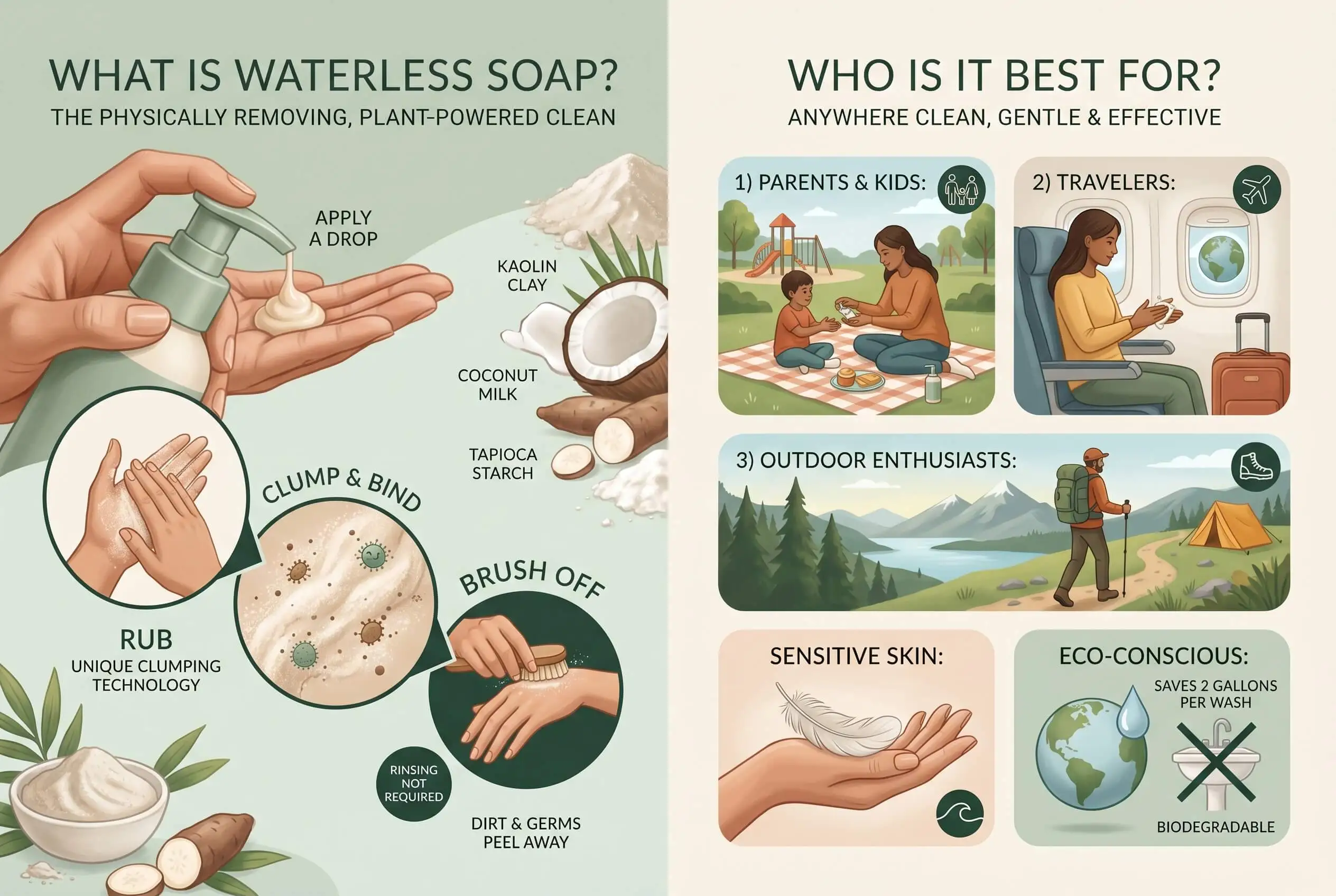
How it works: Rub it in, it clumps around the dirt, then you brush or wipe the bits away. No rinsing.
Not a sanitizer: Sanitizer kills some germs and leaves residue behind. Waterless soap physically removes the dirt and grime instead. Some, like NOWATA™, are lab-tested to remove 99.9% of germ particles too, which is a cleansing result, not disease prevention.
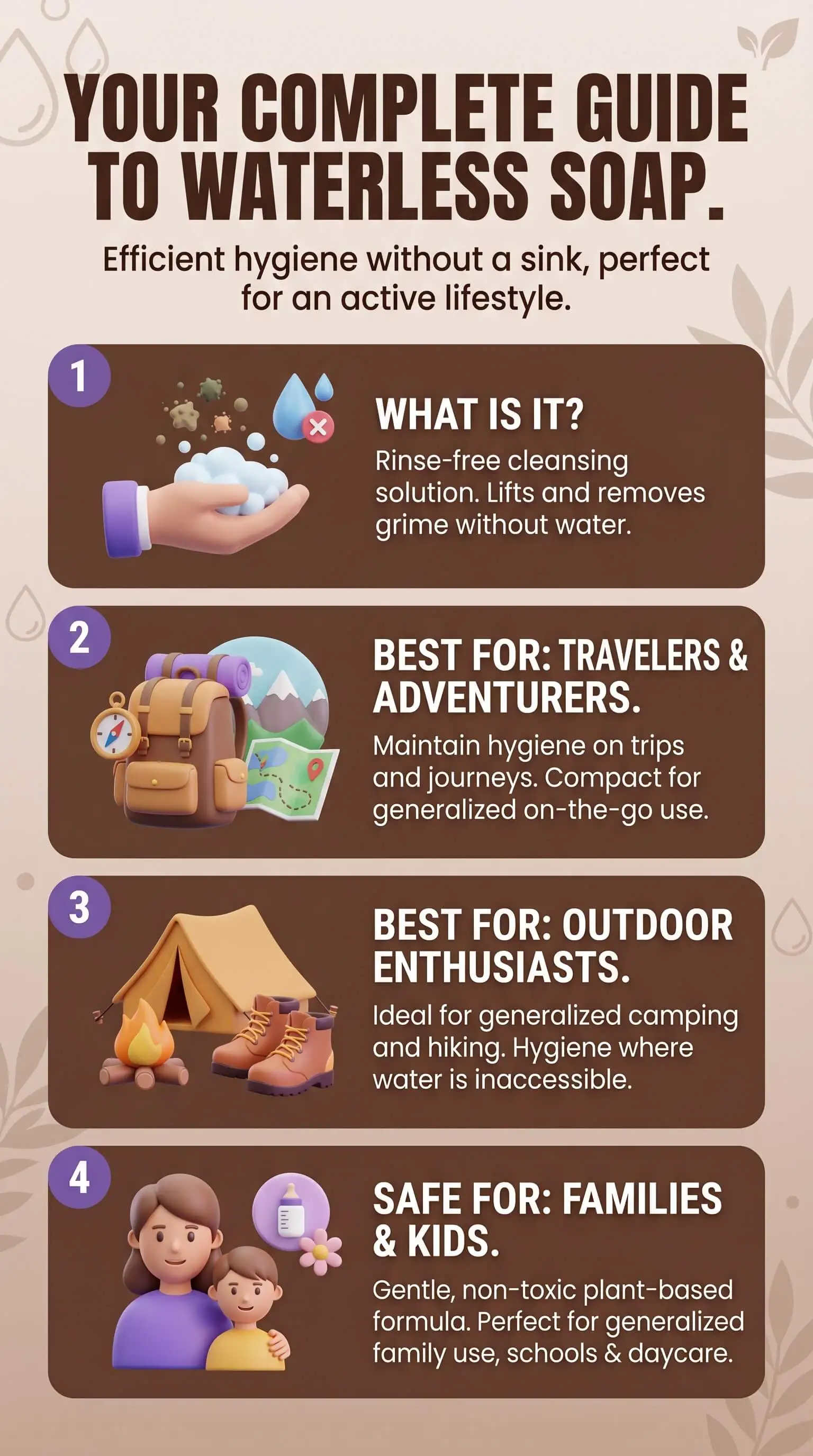
Best for: Camping, travel, the car, caregiving, sensitive skin, and anywhere a sink isn't.
What to look for: Plant-based, biodegradable, alcohol-free, fragrance-free.
Top Takeaways
Waterless soap cleans without water. You apply a drop, rub until it clumps, then brush the dirt away.
It removes dirt and grime physically. It is not hand sanitizer, which only kills some germs and leaves residue behind.
It fits families, campers, travelers, commuters, caregivers, sensitive skin, and emergency or off-grid use.
Look for plant-based, biodegradable, alcohol-free, fragrance-free formulas, and patch-test if your skin reacts.
Some, like NOWATA™, are lab-tested to physically remove 99.9% of germ particles. That is a cleansing result, not disease prevention.
It works alongside soap and water at home rather than replacing it.
What it actually is. Waterless soap is a rinse-free cleanser. Instead of lathering up and washing down the drain, it binds to the dirt and oil on your skin so you can lift it off. Many formulas clump or flake as you rub, and those little dirt balls carry the grime with them. Brush them off and you are clean. You will find it as rub-and-wipe creams, rinse-free foams, and sprays, with waterless shampoo covering the same idea for hair.
How it works. Like any soap, it leans on surfactants, the cleaning agents that latch onto oil and dirt and pull them off your skin. If you want chemistry, the basics of how soap lifts dirt are well documented. The difference with waterless soap is the last step. Instead of rinsing the loosened grime down the drain, you remove it physically by rubbing until it clumps, then brushing or wiping it away.
It is not hand sanitizer. This is the part people get wrong most often. Sanitizer kills some germs and leaves the residue, dirt, and grease sitting on your skin. Waterless soap does the opposite job: it physically removes dirt, oil, and grime, the same work a sink does, minus the sink. Some formulas go further. NOWATA™, for one, is lab-tested to physically remove 99.9% of germ and virus particles, not just dirt. That is a hand-cleansing result, not a disease-prevention claim. Different tools for different problems, which is why plenty of people keep both within reach.
What you get out of it. No water means no sink, so you can clean up in the car, on the trail, on a job site, or at 30,000 feet. The good plant-based, biodegradable formulas stay gentle on skin and on whatever sits downstream, and alcohol-free options skip the dried-out sting that comes from cleaning your hands all day. They are easy on kids, too. NOWATA puts its water savings at about two gallons per use, which adds up fast when a running tap is the other option. And nothing sloshes around your bag.
Picking one for your skin. If your skin flares up easily, look for alcohol-free, fragrance-free, plant-oil formulas, and patch-test before you go all in. A gentle, biodegradable, kid-safe option like NOWATA™’s plant-based waterless soap is built for exactly that: clean hands anywhere, with no stripping and no rinse.
“The first thing I tell people on a backcountry trip is that clean and sanitized are two different goals. Sanitizer never got the chain grease or trail dirt off anyone’s hands. Waterless soap does, and that surprised me the first season I switched. We were three days from a tap, and I watched it clump up a day’s worth of grime and brush right off. I keep it in every kit now. One rule: read the ingredients, pick a plant-based, alcohol-free formula, and your hands will thank you after a week in the field.”
7 Essential Resources
CDC: Handwashing Facts and Statistics — the public-health case for hand hygiene and why getting germs off your hands matters.
UNICEF: Hygiene and Handwashing Data — global numbers on who does and does not have soap and water at home.
U.S. Department of Energy: Faucets and Showerheads — federal flow-rate standards that show how much water a running tap really uses.
Wikipedia: Soap — a plain-language look at soap chemistry and how surfactants lift dirt.
American Academy of Dermatology: Dry Skin Relief from Handwashing — dermatologist guidance for protecting easily irritated skin.
NIH/PMC: Hand Hygiene and Respiratory Infection (meta-analysis) — peer-reviewed research measuring the effect of regular hand cleaning.
UNICEF: Handwashing with Soap Out of Reach for Billions — why water-free options matter where a sink is not a given.
3 Statistics
Clean hands cut illness. Regular handwashing lowers respiratory illnesses like colds by about 16 to 21 percent across the general population, according to the CDC. The goal is getting dirt and germs off your hands, and you do not always have a sink for that.
Billions have nowhere to wash. As of 2024, roughly 1.7 billion people still lacked basic hygiene services, including 611 million with no handwashing facility at all, per UNICEF. For many people, water-free cleaning is not a convenience. It is the only option.
A running tap adds up fast. U.S. faucets can legally flow at up to 2.2 gallons per minute, notes the U.S. Department of Energy. Leave one running through a single 20-second wash and you have used close to two-thirds of a gallon. Waterless soap uses none.
Final Thoughts and Opinion
Here is our honest read after using this stuff where it is meant to be used. Waterless soap is not a gimmick, and it is not a stand-in for sanitizer. It is a real fix for a common problem: you need clean hands and there is no water around. On a trail, in a car, at a festival, in a go-bag, in a diaper bag, it earns its spot.
Here is our advice. Do not treat it as a replacement for soap and water at home. Treat it as the thing that finally makes clean hands anywhere a real option, without forcing you to choose between getting clean and being responsible about it. Pick an sls free soap with a plant-based, alcohol-free formula, keep your expectations straight about what it does, which is physically removing dirt, oil, and grime, and you will reach for it more than you would guess.
 '
'Frequently Asked Questions
Does waterless soap actually clean your hands? Yes. You rub it in, it clumps and grabs the dirt, oil, and grime, and you brush it off. No rinsing.
Is waterless soap the same as hand sanitizer? No. Sanitizer kills some germs and leaves residue and dirt behind. Waterless soap physically removes the dirt and grime, and some, like NOWATA™, are lab-tested to remove germ particles too.
Is waterless soap safe for sensitive skin? Many are. Look for alcohol-free, fragrance-free, plant-oil formulas, and patch-test first. If you feel any irritation, stop using it.
Can I use it for camping or travel? That is where it shines. No sink, nothing to spill, and biodegradable options stay kind to the outdoors. Use it over a trash can or outside so the dirt balls have somewhere to land.
Is waterless soap environmentally friendly? Plant-based, biodegradable formulas are, and skipping water saves a resource that is scarce in much of the world. NOWATA puts its own savings at about two gallons per use, which supports a cleaner, lower-waste routine in the same home-care mindset that makes thoughtful pest control choices matter.
Ready to Find Your Fit?
Clean hands should not depend on finding a sink. If a plant-based, rinse-free cleanser sounds right for your skin and your routine, take a look at NOWATA™’s waterless soap and find the one that travels with you.